
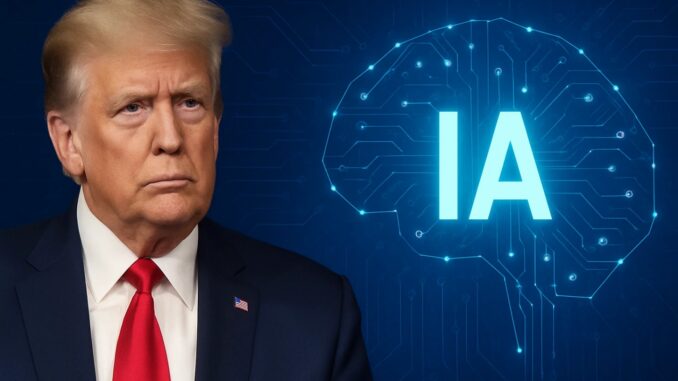
WASHINGTON (EFE).— The new general director of the NGO Human Rights Watch, Philippe Bolopion, highlighted yesterday in an interview with EFE the potential danger that the growing advances of artificial intelligence (AI) may pose in the hands of certain governments, at a time when there is also a global “democratic decline.”
Bolopion, who took office in November, recalled that a senior executive at a technology company recently told him that in the last decade, governments and companies around the world have collected enormous volumes of personal data.
“There are huge amounts. But that data was difficult to process, analyze and use. Now, with AI you can take all that data, analyze it and use it to, for example, control what people think, what they do, how they will vote,” he says.
The former French journalist believes that the latest advances in AI provide reasons “to worry that it could drastically accelerate democratic decline.”
“Governments such as those of China or Russia have been pioneers in the development of technology for population control, and they are sharing these techniques with other countries.” warns.
Given the global democratic setbacks, Bolopion took the opportunity, coinciding with yesterday’s publication of HRW’s annual report, to point out that 2025 has been a “particularly dangerous” year. He pointed out that the rise of authoritarian currents and attacks against the rules-based global system “has been happening for 20 years.”
During the presentation of the report, the executive director of the organization recalled that China, Russia or the United States are less free today than two decades ago.
“Democracy experts often say that democracy doesn’t die suddenly, with a bang. It erodes and fades little by little. It dies with a whimper. And it often happens at the hands of democratically elected leaders,” he says.
As an example, he cites presidents such as Recep Tayip Erdogan, in Türkiye, Viktor Orbán, in Hungary, and Donald Trump, in the United States.
Bollopion pointed out that the United States “is not the biggest violator of human rights right now” thanks to the strength of its institutions, but highlighted that the first year of the second Trump administration “has been extremely corrosive for human rights.”
When asked about the first message he would try to communicate to Trump if he had the opportunity to speak with him, Bollopion pointed out that he would emphasize “how dangerous a world is where force prevails over reason, where norms, rules and international institutions are undermined. It is a return to the law of the jungle in the international arena.”
“I think it is a lose-lose situation, even for a country as powerful as the US. The idea that the US, because it is powerful, can impose its dominance in the world order and get what it needs from other countries will not lead to a peaceful and prosperous world,” he noted.
In the prologue to the report presented yesterday, Bollopion urges countries that respect human rights to “form a strategic alliance that resists” the authoritarian agenda promoted by Beijing, Moscow and Washington.
“Only an alliance of this type has the necessary strength to resist and, yes, provide commercial advantages, for example, or help each other in defense matters, but also at the international level, in multilateral institutions, to defend the entire structure of laws, treaties and human rights that has contributed to making the world a better place,” he concluded.
authoritarianism
Statements by the director general of Human Rights Watch, Philippe Bolopion.
Human rights
The report published yesterday speaks of “a blatant disregard for human rights” and “atrocious violations” of these in the US, since the return to power of Donald Trump, who is accused of aligning himself with “white supremacy” or taking a “marked turn towards authoritarianism.”
Leave a Reply