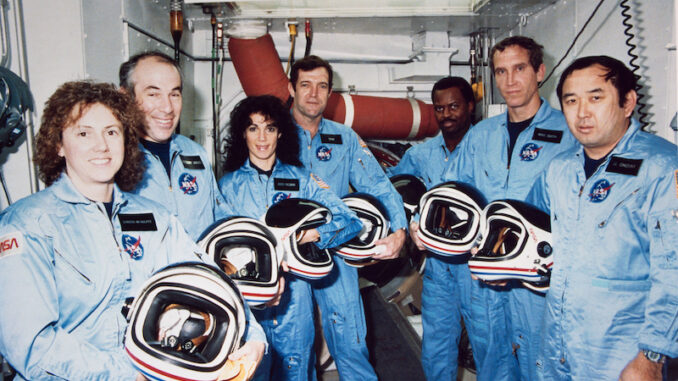
Photo of the Challenger crew taken on January 9, 1986 during training at the Kennedy Space Center. Left to right: Christa McAuliffe (teacher in space) with astronauts Gregory Jarvis, Judith Resnik, Dick Scobee (mission commander), Ronald McNair, Mike Smith (pilot) and Ellison Onizuka. Image via NASA.
January 28, 1986
On this day 40 years ago, we lost seven crew members of the space shuttle Challenger (mission STS-51-L), when the shuttle suffered a catastrophic structural failure just 73 seconds after liftoff. The tragedy was caused by a faulty O-ring seal in the right rocket booster. The spacecraft broke up over the Atlantic Ocean off the coast of central Florida.
It was later determined that the failure of the O-ring had caused a failure of the rigid connection of the rocket booster that it was supposed to seal. The breach allowed compressed hot gas from the solid rocket motor to escape. The hot gas impinged on adjacent rocket booster mounting hardware and the external fuel tank. And this impact in turn led to the separation of the right solid propellant rear attachment and the structural failure of the external tank.
Aerodynamic forces then broke the orbiter apart.
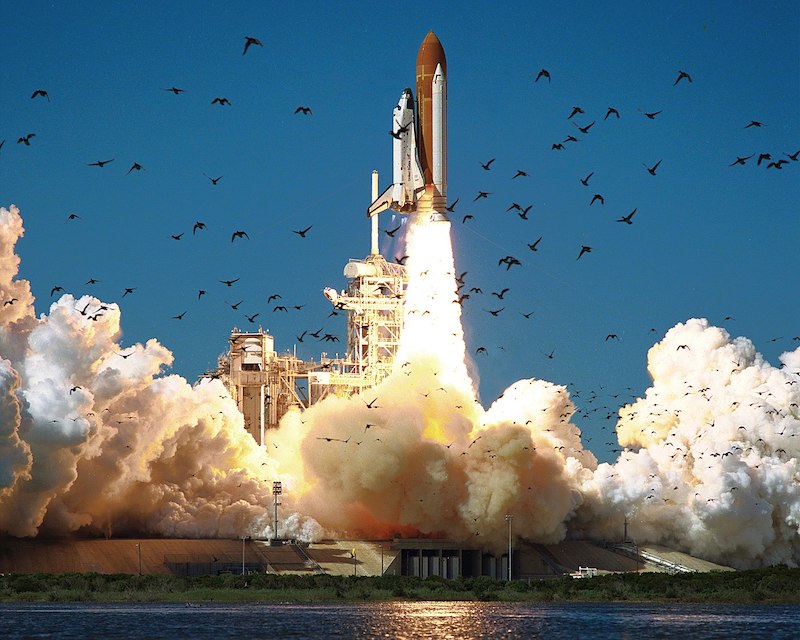
Space Shuttle Challenger lifted off from Launch Complex 39B, Kennedy Space Center, at 11:38 a.m. EST (4:38 p.m. UTC) on January 28, 1986. Image via NASA/ Wikimedia Commons.
Bottom Line: The space shuttle Challenger suffered a catastrophic structural failure just 73 seconds into its flight after an O-ring in its right solid rocket booster (SRB) failed during liftoff. RIP Michael J. Smith, Dick Scobee, Ronald McNair, Ellison Onizuka, Christa McAuliffe, Gregory Jarvis and Judith Resnik.
Deborah Byrd
View articles
About the author:
Our Editor-in-Chief Deborah Byrd tries to keep all the astronomy balls in the air between the EarthSky website, YouTube page and social media platforms. She is the editor-in-chief of our popular daily newsletter and a frequent host of EarthSky Live. Deborah created the EarthSky radio series in 1991 and founded EarthSky.org in 1994. Prior to that, she worked for the University of Texas’ McDonald Observatory from 1976, creating and producing their Star Date radio series. She has received numerous accolades from the broadcasting and scientific communities, including having an asteroid named 3505 Byrd in her honor. In 2020, she received the Education Award from the American Astronomical Society, the largest organization of professional astronomers in North America. A science communicator and educator since 1976, Byrd believes in science as a force for good in the world and an essential tool for the 21st century. “Being editor of EarthSky is like hosting a big global party for lovers of the great outdoors,” she says.

Leave a Reply