

Please note that we are not authorized to provide any investment advice. The content of this page is for informational purposes only.
Canadian Prime Minister Mark Carney has announced that Canada will dramatically reduce its tariffs on Chinese electric vehicles (EVs), signaling a thaw in relations with the country’s second-largest trading partner.
Under a new “strategic partnership” agreement signed in Beijing, Canada is replacing its blanket 100% surcharge with a more standard trade framework, reducing the tariff from 100% to 6.1%, in line with the most-favoured-nation (MFN) rate. However, there would be an import quota of 49,000, rising to 70,000 over five years.
Canada cuts tariffs on Chinese EVs
In exchange for lower tariffs on electric cars, China agreed to cut its tariffs on Canadian canola seed from roughly 84% to 15% by March 1, 2026. Restrictions on Canadian lobster and crab were also lifted.
Lowering the entry-level EV barrier is seen as critical to meeting national emissions targets, as high cost remains a major barrier to Canadian EV adoption.
Prime Minister Carney characterized the deal as a “reversal to predictability” in response to increasingly volatile trade relations with the United States.
Asked if China was a reliable partner compared to the US, Carney said: “In terms of the way our relationship has evolved with China in recent months, it’s more predictable and you’re seeing the results of that.
“Given the current complexity of Canada’s trade relationship with the US, it is no surprise that the Carney government is interested in improving bilateral trade and investment relations with Beijing, which represents a huge market for Canadian farmers,” he said. Even Rogers Pay based in Beijing Trivium China.
The EU is set to move to a minimum price for Chinese electric vehicles
Separately, the European Union (EU) and China recently reached a consensus to replace punitive tariffs on Chinese electric vehicles with a “price commitment” mechanism, commonly known as a floor price.
The deal aims to de-escalate the trade war that has been simmering since 2024, providing a “soft landing” for both the European car industry and Chinese exporters.
Under the framework, previous additional duties (which ranged from 7.8% to 35.3%) would be phased out in favor of individual price commitments. Chinese manufacturers must agree to sell their battery electric vehicles (BEVs) at or above a specified minimum import price. This price is calculated to “remove the harmful effects” of state subsidies that the EU originally investigated.
Unlike a flat rate, each manufacturer can submit its own price offer based on its specific models and investment plans in Europe. The EU has indicated that it will look more favorably on bids from companies that have committed to localize production and invest in the EU supply chain.
Chinese companies have gained market share in the EU
The EU strictly monitors “cross-compensation”, ensuring that manufacturers do not cut the prices of hybrid vehicles (which are not subject to a floor) to compensate for the higher costs of pure electric vehicles. Analysts expect Chinese brands to move away from low-end entry-level models in favor of premium, high-tech SUVs and sedans to justify mandatory minimum prices. The “price floor” acts as an incentive for Chinese firms to build factories in Europe (e.g. BYD in Hungary), ultimately freeing these vehicles from import restrictions.
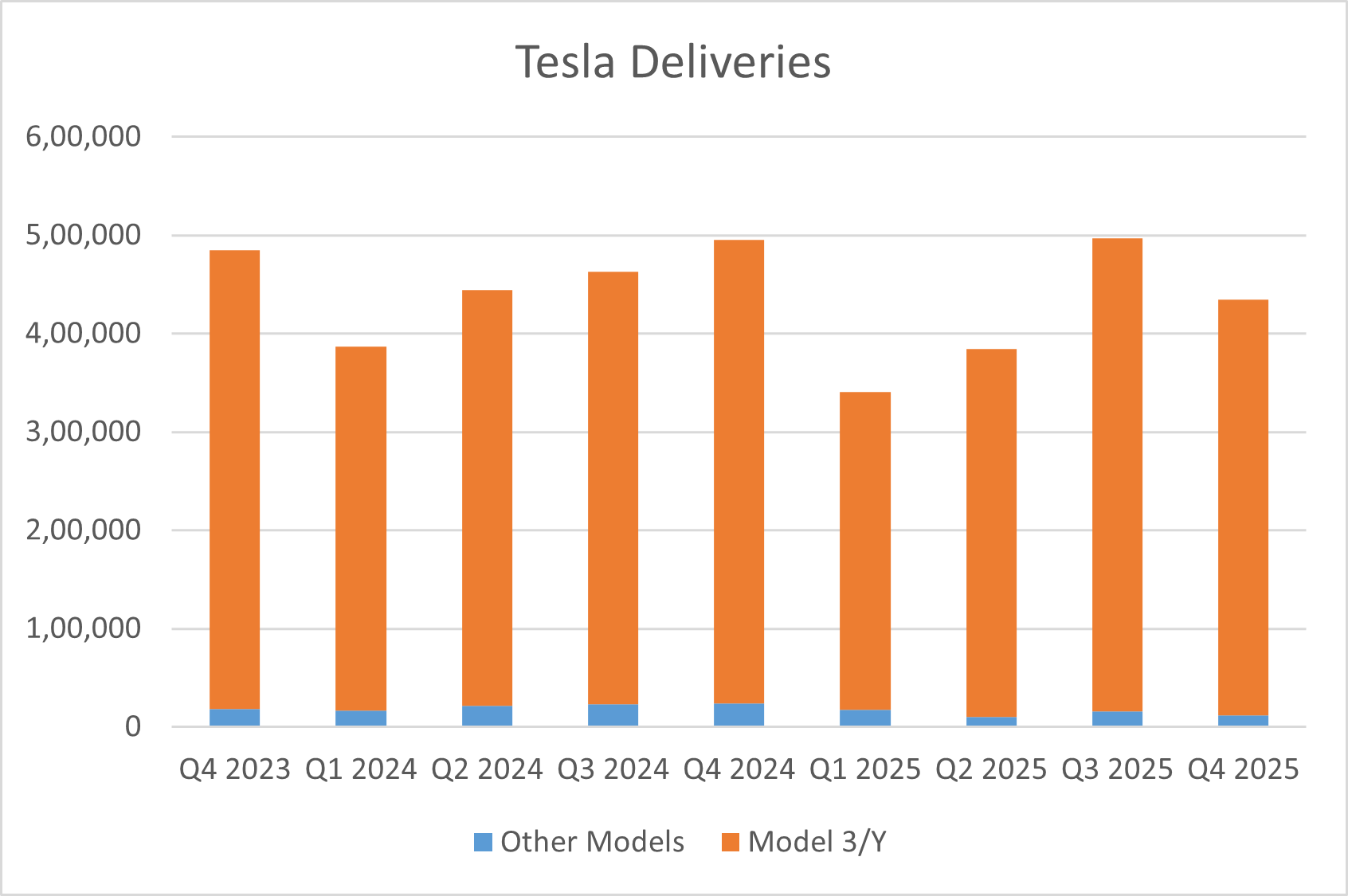
Notably, Chinese EV companies have gained market share in the EU, even as Tesla’s sales have declined in the region.
BYD became the largest seller of BEVs in 2025
Last year, BYD shipped 2.26 million battery electric vehicles (BEVs), well ahead of Tesla’s 1.64 million deliveries.
BYD surpassed Tesla’s total sales in 2022, even as the US EV giant retained its title as the biggest seller of BEVs. It reached another milestone when its sales surpassed Tesla’s in 2024. BYD’s annual revenue rose 29% year-on-year to $107 billion in 2024, while Tesla’s sales were around $97.7 billion. BYD’s sharp increase in sales was led by a record 4.27 million deliveries, which was well ahead of Tesla, which saw its deliveries drop year-on-year in 2024 – the first in the company’s history.
Notably, in 2011, Tesla CEO Elon Musk laughed off the possibility of BYD becoming a competitor to Tesla. However, the Chinese company proved the critics wrong and became a serious competitor to Tesla, not only in China but also in global markets.
Musk praised Chinese EV companies
Musk has been praising China’s electric car companies recently, saying during Tesla’s Q4 2023 earnings call: “Frankly, I think if trade barriers aren’t put in place, they’re going to destroy most other companies in the world.
The billionaire added: “Chinese automakers are the most competitive automakers in the world. So I think they will have significant success outside of China depending on what tariffs or trade barriers are put in place.”
China now controls roughly 80% of the world’s battery supply chain. This vertical integration allows Chinese brands to produce EVs significantly cheaper than their Western or Japanese counterparts. Experts note that China can now produce electric cars at a lower cost than many of the older gasoline car makers can.
Chinese EVs are quite competitive
China’s early and massive investment in new energy vehicles (NEVs) has paid off. While Japanese giants like Toyota have focused heavily on traditional hybrids, Chinese companies like BYD and Nio have built an entire ecosystem for pure electric cars. In 2025, nearly half of China’s car exports were electric or plug-in hybrids.
In 2025, the global automotive scene has reached a historic turning point and China has officially overtaken Japan to become the world’s largest exporter of automobiles. The shift marks the end of a decades-long era of Japanese dominance and signals the rise of a new “automotive superpower” fueled by electrification and aggressive global expansion.
Chinese EV companies have also capitalized on the withdrawal of Japanese, European and American automakers from the Russian market following the invasion of Ukraine and have become the dominant player in Russia, with brands such as Chery and Great Wall filling the gap left by brands such as Nissan and Toyota.
Leave a Reply