
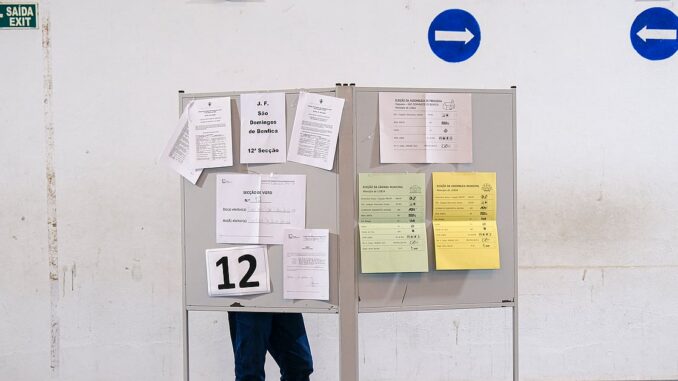
With 68 municipalities in a state of calamity due to the effects of bad weather, the scenario of postponing the second round of the presidential elections entered the political debate. One of the candidates, André Ventura, even defended this Thursday, February 5th, a national postponement, after current President Marcelo Rebelo de Sousa admitted the scenario in the affected municipalities – such as Alcácer do Sal, where the local mayor has already formalized the request for postponement to the National Elections Commission. António José Seguro, the other candidate, argues that the elections “should take place wherever possible” and criticizes what he called “demobilization speeches”. After all, what is legally possible?
Given the state of calamity, is it possible to postpone the second round of the Presidential elections, scheduled for next Sunday (8), nationwide?
The Electoral Law of the President of the Republic does not provide for national and general postponement presidential elections by central political or administrative decision. Article 81 of the law just admit localized postponementslimited to polling stations, when some calamity occurs “in the parish” on the day scheduled for the elections or in the three days before.
There is no legal basis, in the Electoral Law of the President of the Republic, for postponing the election throughout the national territory, unless the calamity situation was applied to the entire country and all mayors decided to postpone it in their respective municipalities.
What does the law say about postponement scenarios?
Article 81 of the Electoral Law of the President of the Republic establishes that there is three scenarios that could lead to the vote does not take place at a polling station: the table is unable to be constituted; riots or serious disturbances of public order occur; or, as is the case with the current scenario experienced in 68 municipalities, there is a calamity on Election Day or the three days before.
Who makes the decision to postpone?
According to the law, the decision rests exclusively with the mayoron the mainland; or to Representative of the Republicin the Autonomous Regions.
Until when should a postponement be decided?
To her does not set a deadline. In strictly legal terms, the decision can be taken up to the day of voting, if the calamity occurs at that time. In practice, the CNE and the municipalities advocate that the decision be taken as soon as possible, to guarantee clear information to voters.
In the 68 municipalities experiencing calamity, does the postponement apply to the entire municipality?
Not necessarily. The decision may cover the entire municipality, a parish, or just some polling stations or sections. The assessment is made case by casebased on actual conditions on the ground. The simple fact that a municipality is in a state of calamity does not automatically imply a postponement of the vote.
Were there municipalities where it was necessary to change voting locations?
Sim. In several municipalities, councils chose to change voting locationsinstead of postponing the election, due to damaged buildings, lack of access, or security conditions.
How do I check if my voting location has changed?
Voters can confirm in three ways:
-no Census Portal (www.recenseamento.pt)
– through free shipping of a SMS to number 3838 with the message RE (space) Civil Identification Number (space) Date of birth in YYYYMMDD format
– or by calling helpline to the voter by calling 808 206 206.
When will voting take place in the places that decide to postpone?
In the case of the second round of presidential elections, the law is clear: voting takes place on the seventh day after. That is, in the following Sunday (February 15th) to the national election (8).
What if it is also not possible to vote on this new date?
If, for reasons of calamity, turmoil or objective impossibility, It is also not possible to carry out a new votethe law provides for a definitive solution: the final calculation of national results is done without counting these votes, avoiding for the election to be blocked indefinitely.
What happens to the votes cast this Sunday? Are they counted on the same day or do they wait for voting in places where the election is postponed?
The votes are counted on the same day in all assemblies that operate normally and are part of the national provisional count, released on election night. It is the same procedure used in situations of electoral boycott at certain polling stations.
Leave a Reply