
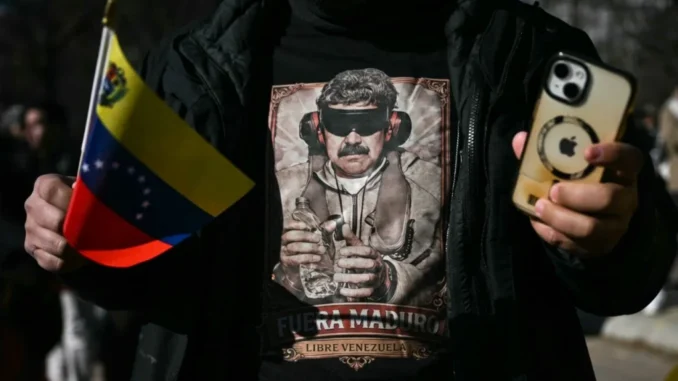
The capture of the Venezuelan autocrat, Nicolás Maduro, at the beginning of the year, executed by US forces (commanded by Trump) in a lightning operation, triggered an immediate rearrangement in Latin American politics. For experts, the region, which had come from years of internal tensions, ideological disputes and an unstable balance between external powers, suddenly entered a phase marked by the centrality of Washington.
To José Luis Valdés Ugaldepolitical scientist and researcher CISAN-ONEthe operation of January 3 It is not an isolated event, but “the beginning of a new stage in which USA seeks to impose peace and prosperity by force, under its own terms.” In his opinion, this turn “fractured the relationship with the continent and established a framework in which countries will operate under constant pressure from Trumpism.”
What is the Monroe Doctrine and how is it transformed under Trump?
The Monroe Doctrineproclaimed in 1823established that no European power should intervene in the affairs of the American continent, laying the foundations for American hegemony in the hemisphere. Although presented as a principle of regional defense, over time it became the political support for multiple interventions by Washington in Latin America.
You may also be interested in: After disputes, Donald Trump receives Gustavo Petro at the White House
Monroe Doctrine Nationalism
"The Monroe Doctrine means what it has meant since President Monroe and John Quincy Adams enunciated it… that we would oppose a foreign power extending its power to the Western Hemisphere.”
-John F. Kennedy https://t.co/ugPT3v3Ps9 pic.twitter.com/TlsdAtve2F
—
The American Culturist

The so-called “corollary Trump“is a contemporary reinterpretation of that logic. It is not a formal doctrine approved by the Congressbut of a strategic framework that reaffirms the preeminence of the United States in the Western Hemisphere as a national security priority, now with an emphasis on curbing the influence of China y Russiasecure strategic assets and reinforce border security.
Valdés Ugalde explains that this strategy represents a contemporary reinterpretation of the Monroe Doctrine, now aimed at curbing the influence of China and Russia, securing strategic assets and reinforcing the border security of the United States. “Any actor who deviates from the quadrant drawn by Trump will be subject to sanctions and pressure,” he warns.
The National Defense Strategy 2026 from the Pentagon supports this approach by placing Latin America as a geopolitical priority and announcing that Washington “will restore its military dominance in the Western Hemisphere,” with special emphasis on migration, drug trafficking, and territorial control.
Petro’s turn and his survival calculation
The Colombian reaction illustrates the extent of that pressure. Gustavo Petro He went from a confrontational discourse to a posture of strategic submission. Valdés Ugalde maintains that this transformation responds to direct warnings from Trump: if he did not stop the export of cocaine and moderate his criticism, “he would remove him from power.”
Petro seeks to avoid a scenario similar to the Venezuelan one and correct previous errors: “he has been unskillful and erratic in international politics,” says the expert. To demonstrate cooperation, the president has deployed symbolic gestures—such as gifts and conciliatory messages—and concrete actions, including the handover of a powerful drug trafficker to the United States.
Mexico: ambiguity in the face of growing pressure
In the Mexican case, the pressure is also visible. The president has opted for an ambiguous response, offering humanitarian aid to Cuba while tacitly assuming Washington’s demand to stop the shipment of crude oil—about 20 thousand barrels per day— to the island.
“Mexico has the United States’ gun to its temple,” summarizes Valdés Ugalde. The Cso Blanca It seeks to condition immigration cooperation, toughen the fight against drug trafficking and even keep open the possibility of US military operations in Mexican territory. The room for maneuver narrows and the scenario becomes more complex.
Regarding the sending of humanitarian aid to Cuba, President Sheinbaum (@Claudiashein) indicated that the objective is for it to be completed this weekhttps://t.co/n45uzXDatT
: Government of Mexico pic.twitter.com/zAapKCIsMe
— @diario24horas (@diario24horas) February 3, 2026
You may also be interested: Spain seeks to prohibit social networks for those under 16 years of age
A region with few buffers
Faced with this panorama, Latin American countries are attempting specific responses. Joint support for the candidacy of Michelle Bachelet for the UN General Secretariat —backed by Argentina, Brazil, Mexico y Chile— represents a gesture of regional coordination. But, the political scientist warns, it will hardly lead to an effective alliance capable of containing US pressure.
The region, he maintains, needs an “offensive defense strategy” that limits Washington’s unilateral action. For now, this capacity is reduced, and Latin America is undergoing an accelerated reorganization whose political, military and symbolic epicenter is once again located in the White House.
Leave a Reply