
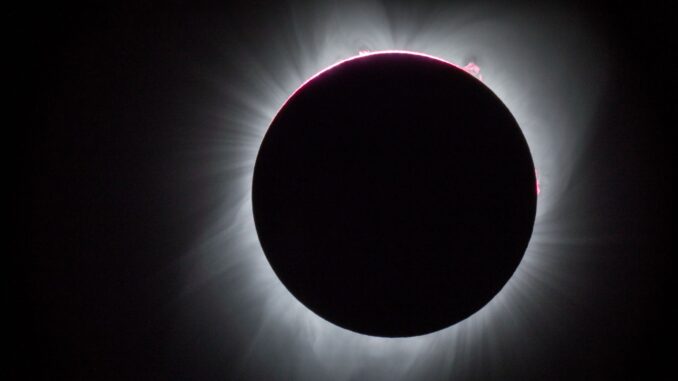
A total solar eclipse has not occurred since “The Great American Eclipse” on April 8, 2024 — but now two are coming in the next two years.
The first of them in total solar eclipseOn August 12, 2026, it will grace parts of Greenland, Iceland and Spain. The second, on August 2, 2027, will take place in parts of North Africa, southern Spain and the Middle East and is being called the “Eclipse of the Century”.
Solar eclipse in August 2026
The 2026 total solar eclipse will begin as a dawn eclipse in remote northern Siberia, with the path of totality—the path of the Moon’s dark central shadow where the total eclipse is visible—spanning across eastern Greenland, the west coast of Iceland, and northern Spain, before ending with a solar eclipse over the Mediterranean Sea.
For European observers, this is the first total eclipse visible from mainland Europe since 1999. In Spain, cities such as León, Burgos and Valladolid will be the best places to witness the totality.
The eclipse will be visible about 10 degrees above the horizon, which is about the width of your fist at arm’s length.
Totality will occur there near sunset, and clear skies are likely for both the eclipse and the peak of the annual Perseid meteor shower later that night. It may even be possible to see a meteor in the twilight-like sky of totality, which will last less than two minutes.
Travelers looking for the longest totality – just over two minutes – can head to Iceland’s Snæfellsnes peninsula or the fjords of East Greenland. At these August latitudes, the nights are too short for reliable meteor viewing. However, northern lights it may appear during a brief night or perhaps during a passing totality.
August 2027: “Eclipse of the Century”

Although every total solar eclipse is special, the 2027 event is a once-in-a-lifetime spectacle.
The total solar eclipse on August 2, 2027 will last an extraordinary 6 minutes, 22 seconds and will be seen from the path of totality, affecting parts of Spain, Morocco, Algeria, Tunisia, Libya, Egypt, Saudi Arabia, Yemen and Somalia.
The eclipse is already being billed as the ‘Eclipse of the Century’, with observers near Luxor, Egypt enjoying the longest land-based totality of the 21st century. In addition to being the longest total solar eclipse of this era, the event is special for another reason: The climate in the path of totality means clear skies are likely to be seen throughout the region.
While these two total solar eclipses are already exciting sky watchers, a lesser-known totality lies just behind them. A total solar eclipse will pass through Australia and New Zealand on July 22, 2028, with Sydney witnessing its first total solar eclipse since 1857. It’s boom time for eclipse hunters around the world.
Leave a Reply