
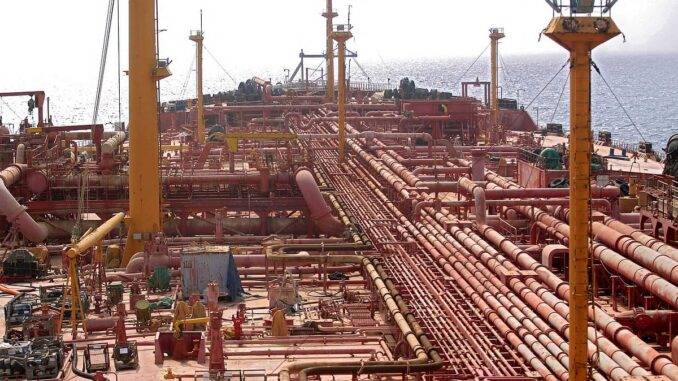
The rate for transporting oil and liquefied natural gas (LNG) from the Middle East on the largest tankers in existence (so-called supertankers) doubled from around 180,000 euros per day (last Friday) to more than 360,000 euros per day (around 424,000 dollars per day at current exchange rates), a historic high, indicates a document from the financial group of the London Stock Exchange Group (LSEG).
Maritime insurers are canceling coverage contracts for these ships due to the extreme danger in the region, which has caused freight costs to skyrocket to values that, according to several analysts, are unaffordable and which in practice cancel out this market.
The start of the war with Iran, on Saturday, and the numerous attacks by the USA and Israel, plus the Tehran regime’s retaliation against several neighboring countries in the Persian Gulf (Saudi Arabia, Oman, United Arab Emirates, Qatar) and several US bases in these Arab states, caused the price of the raw materials themselves (oil and gas) to soar.
But the situation is even worse. The transit of ships (some were even the target of projectiles) through the Strait of Hormuz, a region controlled by Iran, has been interrupted since Saturday, but, as mentioned, with the escalation of the war, insurers specializing in maritime fronts are refusing to provide risk coverage, taking into account the ongoing regional war.
More than 20% of the world’s production of oil and liquefied natural gas in the Middle East is transported to Asia (India and China, for example) and to Europe and the Mediterranean region (via Suez) through the Strait of Hormuz in ships with a capacity of two million barrels of oil (or gas equivalent) – the largest, called supertankers.
According to the US Department of Energy, the fronts that leave the Middle East through the Strait of Hormuz transport (transported) 30% of all the world’s oil flown by sea, that is, without counting the crude oil flown through pipelines. This 30% is equivalent to an outflow of 20.3 million barrels per day. Most of this oil is destined for Asia.
The same source from the US government’s Department of Energy shows that the Strait of Hormuz is also the exit point for 20% of LNG gas produced globally (the largest producer is Qatar).
All this maritime flow has now been interrupted (since Saturday, February 28th, despite the Strait not being officially closed) because there are no insurance companies willing to cover the risk.
The impact on prices is clear. The oil contract brent (the benchmark for Europe) for May delivery has soared more than 15% since Friday, trading now (Tuesday) at 83 dollars per barrel.
The cost of the TTF (Title Transfer Facility) futures contract, the reference in Europe for LNG gas, rose 35% to 69.6 dollars (the price is the equivalent of energy generated by gas per megawatt-hour). Since Friday, these prices have risen by more than 76%.
Leave a Reply