

On November 4, 1979, everything was going smoothly for the president Jimmy Carter. Just one year before re-election, his approval was above 55% and the image of the United States in the world had been reinforced with the Camp David agreements, which put an end to decades of armed confrontations between Israel and Egypt.
The Republican Party, still in the throes of the Watergate affair that took down Richard Nixon and left his vice president politically wounded, Gerald Fordshe had to throw herself into the arms of a former Hollywood actor, Ronald Reagan.
However, everything changed that day when an uncontrolled mob took over the United States embassy in Tehran and held 52 Americans captive for fourteen months.
The lack of foresight to evacuate the diplomatic mission after the triumph of the ayatollahs, the absolute absence of a plan to free them, the military failures suffered by Carter and the consequent increase in the price of oil and inflation throughout 1980 left Reagan in the White House and Carter away from the political front line and confined to his Foundation.
The man who had lifted the country from the leaden years of Nixonism and who could have gone down in history as a man of peace and an efficient negotiator, had to live for the next forty-five years with the stigma of failure in Iran.
His entire legacy collapsed due to his inability to organize, which exposed all of North America’s weaknesses, something that its citizens do not forgive.
Trump’s dangerous game
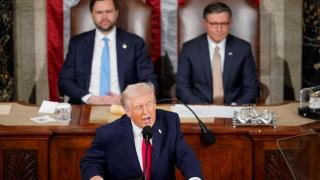
If Iran was Carter’s political grave, could something similar happen to Donald Trump, now that he is involved in a war with no objective or defined duration against the ayatollah regime? The differences, from the outset, are obvious: Trump has not encountered this problem, but has sought it.
Since the beginning of his first term, he has had Iran between his eyebrows: in 2018, he withdrew the United States from the nuclear agreement it had signed. Barack Obama; In 2020, he ordered the assassination of the general Qasem Solemainihead of the Quds Force, and in 2025 he collaborated with Israel in the so-called operation Midnight Hammer.
You could say, in fact, that the fight against Iran has been the only constant in an otherwise erratic foreign policy. That is where the similarities with Carter come in: although, in principle, Trump does not have the pressure of an election around the corner – he cannot repeat his term – the truth is that intervention in the Middle East presents an enormous political risk.
To begin with, despite the fact that the first days of the operation are being sold as an absolute success, death of Ali Jamenei included, the truth is that Americans are reluctant to engage in military adventures abroad.
More than 55% of citizens, according to a CNN poll published this Monday, oppose the bombings… and it is not just Democratic voters who are against anything Trump proposes, but also Republican voters, many of them MAGA supporters, who elected the New Yorker precisely to focus on domestic issues.
At the moment, there are only four confirmed casualties in the various bombings that Iran has launched on US bases in Qatar, Dubai, Abu-Dhabi, Saudi Arabia and the rest of neighboring countries.
It is a dangerous figure, but acceptable. If the operation gets tangled and the days go by, with the foreseeable increase in American casualties, general disapproval will skyrocket.
What is the objective?
Now, can the United States become more entangled in Iran than expected? The problem is that we don’t know what is planned.
This Monday, at a press conference, Trump assured that they were going “faster than expected,” but at the same time he stated that they could spend four or five weeks bombing Iran.
Beyond the doubtfulness of the latter, unless the Western allies join the bombings, the problem is that it is not known what the United States is looking for. We sense that Israel wants to eliminate the ayatollahs for security reasons, but what about the White House?
The altruistic defense of human rights has been ruled out, since in that case this operation arrives very late, and without any plan to invade the Persian country by land and seize its oil — it would be falling into the trap of Afghanistan in 2002 and Iraq in 2003 that the “alternative right” always blames. George W. Bush—, the only plausible explanation, if we accept that the nuclear program was truly “undone” in June of last year, as Trump himself repeats, is to overthrow the regime.
To do this, it is not enough to kill the dome. If these fundamentalist organizations stand out for something, it is for their capacity for constant reinvention. We saw it with Hamas in Gaza and with Hezbollah in Lebanon.
This is not like the Chavista regime, it is not enough to remove the head so that the rest of the body does not know what to do or to which bidder to sell itself. We are talking about fanatical clerics whose goal has always been the subjugation of their people and the destruction of the United States.
The left hand does not know what the right hand is doing
No matter how much it is repeated that the Tehran regime is in its worst moment since the aforementioned 1979, that does not mean that it will be easy to overthrow it.
The cruelty of the ayatollahs is maximum, as proven by the tens of thousands of civilians killed last January by shots fired by their guards. If there is no ground intervention, there will hardly be any surrender.
It gives the feeling that Steve Witkoff and Trump thought that placing the ships near the coast and launching the planes over Iranian territory would be enough to deter the Shiite leaders, but this has not been the case.
Nor has Khamenei’s death, as expected, overly decomposed their will to resist. The bombings will go on and on, but thinking about an imminent regime change seems somewhat optimistic at the moment.
A transition from within would be easier, but there we again see signs of enormous disorganization. According to Trump himself, they had five candidates to succeed Khamenei within his entourage. Five moderate clerics with whom they could sit down to negotiate a future for the country.
The only problem is that, in forty-eight hours, they have already killed the five according to the president himself.
It is really incomprehensible, although we cannot rule out that he invented it.
Disappoint MAGA
You might think that Trump has no legacy to worry about, but that’s not knowing the New York billionaire. Beyond his obsession with the Nobel Peace Prize, which moves further and further away with this type of actions, Trump does have a reputation to maintain among “his base,” as he himself says.
They voted for him in 2016, they voted for him in 2024 and, according to him, they even voted for him in 2020. Trump doesn’t care what the progressive media or the half of the country that can’t see him says about him… but he couldn’t bear to see how his people turn their backs on him.
And that, of course, could happen if things go wrong in Iran and the price to pay for a mere regime change is a relatively high number of American casualties.
The pain will be felt throughout the country, as is logical, but the feeling of deception will be felt by all those middle and lower classes who have supported Trump thinking that he was going to lower the price of food and suddenly find that their relatives stationed in bases abroad are risking their lives.
Leave a Reply