
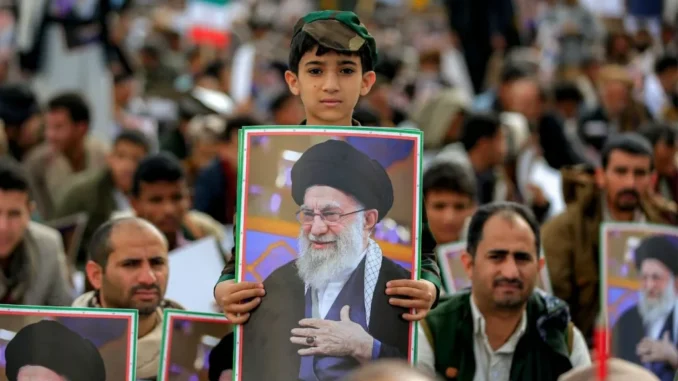
The military operation launched by Donald Trump y Benjamin Netanyahu contra Iran opened a new phase of confrontation in Middle Eastsince after a series of bombings coordinated with Israelthe Iranian supreme leader died, Ali Jamenei, which unleashed retaliatory attacks against Israeli territory and US bases in the Gulf.
Washington reported the death of three soldiers in Kuwait and confirmed more than a thousand targets hit on Iranian soil, including command centers and the headquarters of the Guardian Corps of the Islamic Revolution. Israel, for its part, intensified the bombing of “the heart of Tehran” and mobilized reservists.
In response, Tehran activated an interim committee while the succession remains in the hands of the Assembly of Experts. The body, dominated by conservative clerics, will define the next supreme leader in a context of maximum regional tension.
You may also be interested in: Shooting in Austin, Texas, leaves 3 dead and 14 injured
Succession in Iran without moderate turn
The internationalist and academic Augustine Berea considers a political turn unlikely in interview for 24 HOURS. “There was already a succession plan,” he explains, and maintains that Khamenei “dedicated himself to removing the most moderate clerics” since he Washington abandoned the nuclear deal 2015.
In his opinion, the replacement will emerge from the most conservative circle. “All those left in positions of power are hardliners,” he says. It even contemplates that the successor come from within the security apparatus itself, consolidating a confrontational stance.
Berea warns that the expectation of a popular uprising favorable to Washington is limited. “The majority would not be happy to be bombed,” he points out. Although there are critical sectors of the regime, “they are not in favor of the United States or Israel.” For the specialist, the idea of a regime change is remote: “The most you could hope for is to cause a civil war.”
Political calculations
At the strategic level, Berea suggests that the offensive responds to political incentives different from both Donald Trump and Benjamin Netanyahu. “For Netanyahu this is a net gain,” he points out. The state of emergency would allow him to postpone elections in 2026 amid internal investigations. “I think this was a strategic victory that buys him a lot of time,” he adds.
Regarding Trump, the balance is different. “I don’t think it was of any use to him at all,” he maintains. The conflict could lead to higher human costs and inflationary pressure in the United States if the price of crude oil soars. The president himself anticipated that operations could extend four weeks and acknowledged that “there will probably be more” casualties.
Energy and military risk
The conflict altered traffic in the Strait of Hormuzthrough which a fifth of the world’s oil flows. Shipping companies suspended routes and the OPEC+ announced production adjustments. For Berea, the immediate impact will be financial: “We will see an increase in the price of oil and precious metals.” In the medium term, he warns, it could translate into inflationary pressures.
In the military field, Iran maintains a limited response capacity. “You are not going to beat the United States with the amount of assets it has in the area,” he says. Closing Hormuz would be the extreme option, but “it would precipitate an invasion.” The alternative, he predicts, will be to harass bases and raise the economic cost of the US deployment.
It also sees a less centralized reorganization of the Iranian apparatus, with regional structures capable of operating autonomously. This scheme, he explains, makes a ground offensive difficult and increases uncertainty.
Mediators and global rearrangement
Europe and regional powers such as Saudi Arabia y Oman They explore ways of containment. For Berea, “the one you have to convince to leave is the United States.” He believes that Oman could maintain a credible mediation role, while other actors face costs for their involvement.
The massive deployment of US assets in the area opens another question: the redistribution of resources towards other strategic fronts. “Where are you pulling the blanket from?” asks the analyst, pointing out that concentrating interceptors and ships in the Middle East implies subtracting them from Asia.
You may also be interested in: Iranian drone causes fire in the luxurious Burj Al Arab hotel in Dubai
Mexico before the storm in Iran
To Mexicothe immediate economic effect could be favorable due to higher oil revenues. However, Berea raises a diplomatic dimension: the country should defend international law against actions without multilateral endorsement. “Not because Mexico has love for Iran, but because it is its historical doctrine,” he points out.
As Tehran redefines its leadership and Washington promises to continue the offensive “until all objectives are met,” regional order faces a critical test. The convergence between the interests of Trump and Netanyahu has ignited a scenario whose duration and outcome remain open.
Leave a Reply