

The announcement of the declassification of a file of documents related to the coup d’état of 23 February 1981 caused much media fanfare and generated enormous interest in an affair that seemed to have been overlooked.
Above all, however, it fueled the illusion of certain sectors who dreamed that these sources could definitively clarify the once great mystery of this involutionist operation: paper Juan Carlos I.
However, and even more, confirmed by the summary and the act of oral examination (documents not published) that the former monarch did not participate in 23-F, the feeling that the 167 documents that saw the light is disappointing.
This set of writings is divided into six large blocks.
1. The first corresponds to the information kept at the Ministry of the Interior. This group includes conversations recorded in summary, as Tejero I traded him for a friend Juan Garcia CarresFalangist and former president of the Sindicato de Actividades Diversas during the Franco era, on the night of February 24.
According to the name, it was also known in other ways Overview of operations on the goit was developed by the Centro Superior de Información de la Defense (CESID, now CNI). It contained all the civil, civil-military and military actions carried out in the 1980 march to remove Suarez.
Lieutenant General Gutiérrez Mellado confronts the coup plotters in the presence of Prime Minister Adolfo Suárez.
From this document Prime Minister, Deputy Prime Minister Manuel Gutierrez MelladoMinister of Defense Agustín Rodríguez Sahaguninterior Juan Jose Roson and the same monarch received a copy in November 1980.
Interestingly, however, we can already learn about the first handwritten version.
It is also worth checking the documents that appear in this block. The first is an inquest for which the coroner put some Tejero Andres CassinelloAccording to the Information Service of the Civil Guard on November 16, 1978, as a result of the disarticulation of Operation Galaxia, the first attempt at the Transición coup.
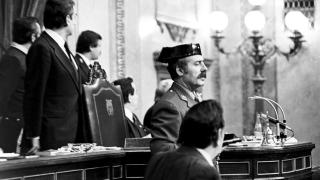
2. This is followed by writing that under the title Vasco regional office, expressing the message of Lt. Tejero regarding the possible situation of tension due to the presence of ETA (1975), reflects the concerns of the head of the 513 Comandancia de la Guardia Civil (Guipúzcoa) about the increase in ETA activities.
If both authors are directly connected to 23-F, they may be interested in the process of radicalization of the first coroner, which culminated in the attack on the Congress of Representatives and where the increase in terrorist attacks was crucial.
The second block corresponds to the general police department. There is nothing retroactive in this block and it does not contain any specific information about the public order situation during the hours when the coup attempt lasted.
Of this anecdotal nature, one can cite the recognition of funds for the families of detainees and the mention of concerns Santiago Carrillothe General Secretary of the Spanish Communist Party (PCE) who tried to accuse the King of the coup de Estado.
“En el Informe Jáudenes that the participation of CESID agents in the direction of the convoys of the Civil Guards that attacked the Congress was expressly stated”
3. The third block is also notable for the great news it brings, rather than reflecting what is known: the tension that exists in the Spanish bureaucracy due to the fall of 23-F and the campaigns that have since begun against the figure of Juan Carlos I.
4. The fourth block is otherwise the most interesting, which refers to CESID. Informant of Secretary SM el Rey, General Sabino Fernandez Campoon the coronel Emilio Alonso Manglanodirector of this intelligence service and carried out on December 14, 1981, is of great importance for knowing the position of the head of state before the military tension that prevailed in the armed forces.
No, the three most important documents are as follows.
First place, el Jáudenes informs (I know you with precedent), developed teniente coronel Juan Jaudenesthat is, the participation of CESID agents in the direction of the civil guard columns that attacked the Congress of Diputados on Tejero’s orders.
Also another inscription on this page and without signature with title Information on the participation of AOME members (CESID) on 2/23/1981which refers to the same dynamic: the participation of information service members at the time.
Thirdly, the commander’s card Jose Luis Cortina Prietoaccused of participating in the coup d’état, Coronel Manglan, of October 3, 1981. Its contents revealed the behavior of this jefe during the criminal trial that ended with a commutation of his sentence.
There is also a document in this block, under the name of the document Progress report on February 23rd and 24thwhere a chronological description of the actions of the monarch during the coup d’état is included.
According to General Sabino Fernández Campo’s summary statement, they must have the same authority.
Likewise, it is necessary to cite other files located at the end of the blockade, which refer to various aspects related to CESID and Case 2/81, ordered to the juzgar of the coup d’état, as well as Capt. Gil Sanchez Valienteimplicated in those who left Spain on 24 February 1981.
These documents may be of some interest to historians.
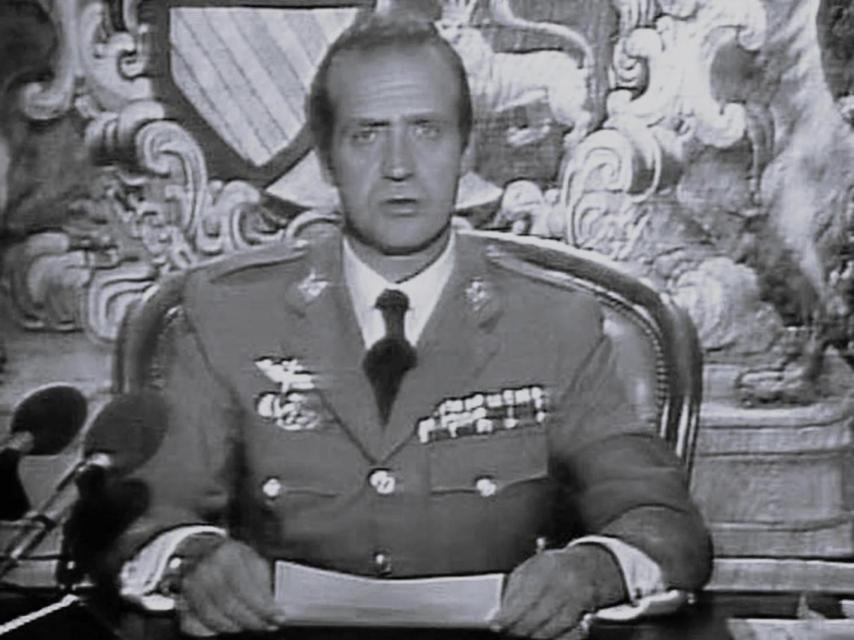
Juan Carlos in a speech at 23-F.
On the contrary, all writers who present an obsession with Oral view are absolutely indispensable because there are no transcripts of oral juicio journals, until resume mismas.
So the most interesting aspect of these texts is that they intertwine between them Information notes about the attitude of extreme groups and the impact of the process on their breasts.
Finally, in this block is a document that contains, under the heading above SM El Rey with military personnel involved in 23-F (5 February 1982)it had a great impact because it obtained a great conversation between Juan Carlos I and Lt.-Gen Jaime Milans from Bosch.
However, this is not verified and disputed information because the category is B2 and not A1.
In addition, the soldier’s behavior during the oral exam showed that this situation would never happen…
5. Fifth block below par Department of Defense General and Historical Archivesalthough it sheds much light on the coup d’état, which is integrated by a set of documents that, in addition to the captain’s service, hoja Sanchez Valienteit is a simple court proceeding.
Most of them are listed in the case summary 2/81.
6. The sixth and last block consists of documents from the Ministerio de Asuntos Externales, Unión Europea and Cooperación, where the most interesting files are those that refer to the activities of the United States during the coup d’état.
If much of the content was known, it is interesting to consider the sentiment of the Secretary of State’s statement Alexander Haig with the information contained in the block referring to the CESID and more specifically in the document Information on the participation of AOME (CESID) members on 2/23/1981because you can throw light over the edges.
In conclusion, we can say that if there are documents that represent some relevance, they are of value only to those people who have a deep knowledge of the Coup de Estado, because their content can expand knowledge on some of the 23-F issues.
However, for someone new to the subject, these documents do not provide a structured vision of what happened on February 23 and 24, much less the coup d’état.
Because of this, they experienced a huge disappointment.
*** Roberto Muñoz Bolaños is a professor at the Universidad del Atlántico Medio y del Centro de Educación Superior de Enseñanza e Investigación Educativa (CEIE), enrolled at the Universidad Camilo José Cela (UCJC). He is the author of the book ’23-F and the other coups de la Transición’.
Leave a Reply