
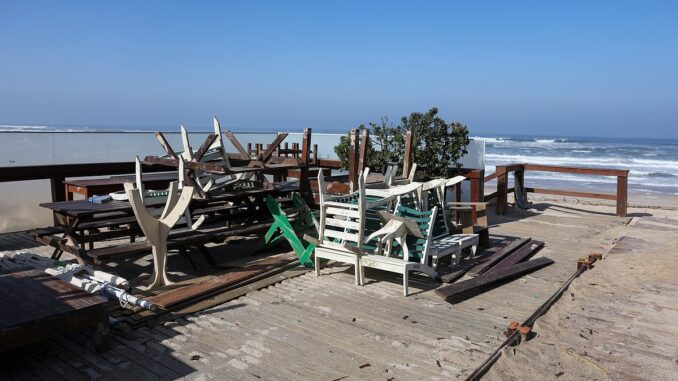
On the “Âncora” terrace, it was Carlos Costa, 72 years old, father of the space’s concessionaire, who rolled up his sleeves to try to repair the damage.
“Just last year he [filho] I had put the whole new roof on, now it was left without it” and without the terrace, without the front of the restaurant and without the kitchen, he said.
“A very heavy wooden beam flew more than 500 meters and stuck in a building”, he said, while trying to remove rubble from the road from the bar that he has been trying to recover, with the help of a group of scouts from Albergaria-a-Velha.
On the same side of the road, only the public bathrooms escaped without damage.
On the other side, the damage to the two still closed hotels is visible, one of which has a completely destroyed bar. In buildings, where walls and balconies were filled with sand, there are still people trying to replace tiles.
The marks of the “night of horror, with very bitter moments”, extend to Stélia Faustino’s car, where the windows gave way to plastic glued with tape, to the waste containers without lids, to the traffic signs and lamps bent by the force of the wind, or to the place where, until January 27th, there was a typical striped stall where Virgínia Crespo sold seafood for over 40 years.
“The wind took everything away, only the farm remained there”, he told Lusa, regretting that he had “no one’s support”.
“The lupine and dried horse mackerel stalls have the support of the council, but the seafood stalls do not have the support of the council or anyone else, despite their tourist importance”, he stated, fearing “not being able to support the investment” to recover the business.
On the beach, affected by Storm Leslie in 2018, no one has any doubt that “this time it was much worse” and that the effects of Kristin’s depression will leave many marks on the land, in business and in the minds of those who lived through it.
Leave a Reply