
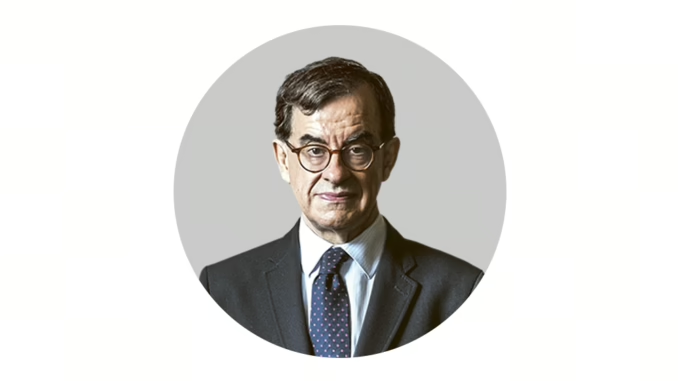
João Salgueiro left a greater legacy for the country, which cannot be forgotten or wasted. In fact, more than exercising direct power, he was someone who left a lasting mark on Portuguese society. The publication by Imprensa Nacional of the precious volume João Salgueiro – Planning, Politics and Economycoordinated by Emílio Rui Vilar and Rita Bessone Basto, with a preface by the President of the Republic, represents an unexpected and necessary gathering of texts, carefully chosen with great care, that give a faithful portrait of a unique journey of someone whose life lessons are still very present, and must be followed in the name of the best defense of the common good.
It is often repeated that improvisation is a supposed quality of the Portuguese. Pure mistake. It is a characteristic that can compensate for some errors, but should not be considered a method. Look at Portuguese History. We could only be relevant when we were able to plan, anticipate and carefully prepare what should be done. Read Zurara, understand the figure of Infante D. Henrique, remember the path of Perfect Prince and D. Manuel, and don’t forget Sebastião José…
Improvisation can only work when the plans are already clear and defined. Otherwise, nothing adds. When we read the texts presented here, we understand that “development is too serious to be left to the whim of circumstances”. This is why the interventions have a refined pedagogical sense, leaving the example of those who said and wrote them very much alive.
The six parts that make up the book follow the themes: Planning, SEDES, Politics, Banks, European Integration and Globalization, Financial Crisis, the Challenges of the Brazilian Economy.
The December 1969 text assumes founding importance. It was about Building a New Society. It was the end of autarchy that had to come to fruition. “The replacement of protectionist policies with active promotion schemes (of exports) thus constitutes a condition of survival for our production units. (…) In fact, whether or not we are aware of the phenomenon in advance, it is truly about building a new society in the coming decades.” It was necessary to carry out “objective, coherent and effective planning”, so that the Portuguese aspirations for progress gave way to a “truly common work of economic and social development”.
As he told us so many times at SEDES, there was persistent work that required a consideration of available resources, mobilized human capabilities and blockages. In the ten years that I presided over the Association, I have always counted on your availability, your commitment and your constant challenge to the idea of reform. That’s why I repeated so many times: “Changes postponed are ruptures made worse.”
In a remarkable text, in the first cycle of CIDSENIOR, animated by Alberto Regueira, entitled From Restelo to Globalization – From Portuguese survival and relevance (2017), João Salgueiro states that Portugal, true to its History, must have a project that guarantees higher levels of innovation and competitiveness, requiring a solidarity project, so that the transformation does not produce inequalities and poorly distributed costs. But he added that, despite the consensus on the great goals, we have not been able to translate it into strategies for change… This is the dilemma.
Leave a Reply