
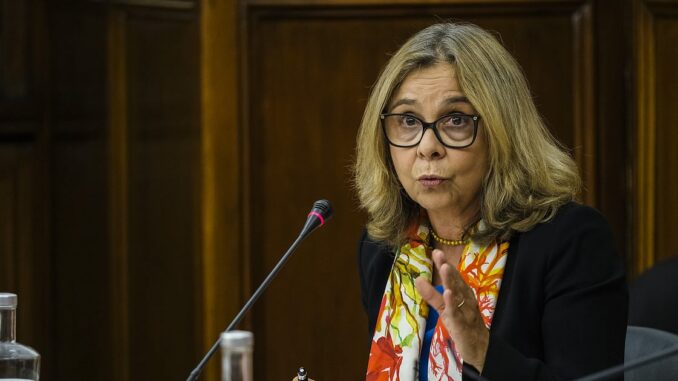
After the recent controversy caused by data released in a working document from the Central Administration of the Health System (ACSS), minister Ana Paula Martins chose to begin her statement at the regulatory hearing, in the Assembly of the Republic, on the morning of this Tuesday, 24th, by revealing the data from the SNS account and announcing that “the provisional results for 2025 show a positive and sustainable evolution”, noting that the SNS had a negative balance of 1.35 billion euros, “which represents an improvement in 533.9 million euros compared to the same period last year”. And by that, he meant that the SNS did not have the worst balance of all time, which was contradicted by PS deputy Mariana Vieira da Silva in the first round of questions from deputies.
In fact, in this round, which is still ongoing, the representatives of Chega ao PCP reminded the minister that “the numbers can have the intended reading”, and that they do not provide “answers”, also criticizing the fact that at this time the Local Health Units (ULS) “have not yet approved the terms of reference and their specifications for the year 2026”.
But, during the minister’s statement, Ana Paula Martins considered that the “evolution of the SNS results from a growth in revenue of 10.8%, higher than the growth in expenditure, which stood at 6.4%. Considering the capital allocations made, in the amount of 1,311,400,000 euros, the overall balance now stands at 276.3 million euros”.
In terms of accounts, the minister also announced that in relation to “the total debt to external suppliers of the SNS, the value reached 1.5 billion euros, an increase of 148.1 million euros compared to the same period last year, which corresponds to 10.9%.”
2.2% more consultations and 1.3% more surgeries
That said, and when it comes to the activity of hospitals and health centers, Ana Paula Martins came to tell Parliament that last year there was “a growth of 2.2% compared to 2024, reaching around 14.1 million consultations carried out”, which reflects “greater response capacity, greater access and also greater capacity for diagnosis and monitoring of users”.
In view of the surgical activity, Ana Paula Martins said that there was “a 1.3% increase in scheduled surgeries compared to 2024. Around 784,580 surgeries were performed, the highest value ever for the SUS, a milestone that is important to highlight”.
But he also assumed that there was “an increase in the number of patients on the list for surgery”. However, he explained that this happened because “new registrations increased by approximately 13,668”, despite 10,600 more surgeries having been performed.” In other words, the increase in waiting lists has to do with the increase in registered patients and not with a lack of SUS operation.
Regarding SUS activity, the minister said that it reflects the two flu peaks, one in January 2025 and the other in December 2025, which made her say that “we are operating more, but we are also diagnosing more and referring more patients, which demonstrates the dynamism of care and greater access to the SUS”.
Faced with this portrait, the minister agreed that, after all, not everything is well in the SNS and that “we have to work to improve”, announcing that “we will soon move forward with the first regional emergencies, in the area of obstetrics in the Setúbal Peninsula, centralized at Hospital Garcia de Horta, at the ULS of Vila Franca de and babies.”
However, he did not give further explanations about how these emergencies will work and what they will imply in professional terms on the ground, saying only that professionals were called to participate in this discussion.
Fewer emergency episodes
The minister also gave data relating to emergency episodes, stating that since January 1, 2026, the indicators are better compared to the same period in the years 2024-2025 and substantially better when compared to 2023-2024, as the number of emergency episodes recorded are “clearly lower than those seen in previous periods at all triage levels”, which, she highlighted, “evidences greater response capacity and better management of demand.” He also mentioned that “average waiting times, in the period between January 1st and 31st, 2026, registered significant improvements”.
Ana Paula Martins also said that there was “a reduction of 22.3% compared to the same period 23-24 and a reduction of 2% compared to 24-25” and that the “flow of clinical discharges began to exceed the number of hospitalizations, allowing the services to be progressively eased and relieved”.
To the deputies, the minister said that the transformation of the SUS requires “a strategy that takes time and that cannot be built overnight”. He also spoke about the vaccination campaign against Flu and Covid-19, the reinforcement of screening on the SNS24 Line, which is used in more than 27 ULS, which avoided unnecessary trips.
In terms of primary care, the minister said that “the response capacity has been reinforced with many hundreds of consultations per day and a special focus on acute illness, helping to alleviate the pressure on hospitals” and that nine competitions have been launched for the allocation of Family Health Units (Model C, private management) in various regions of the country, such as in Lisbon and the Tagus Valley and Algarve. He also said that “the hospitalization capacity depending on the level of contingency was increased and the management of so-called social beds was reinforced, allowing greater fluidity in the system and freeing up vacancies in emergency services”.
In the end, the minister said that “transforming the health system and in particular the SNS is always an unfinished work. There is, in fact, still a lot to be done to ensure that access is universal and in a timely manner for everyone. Serving over 1.5 million users registered in the National User Registry requires more from all of us”.
Updating
Leave a Reply