
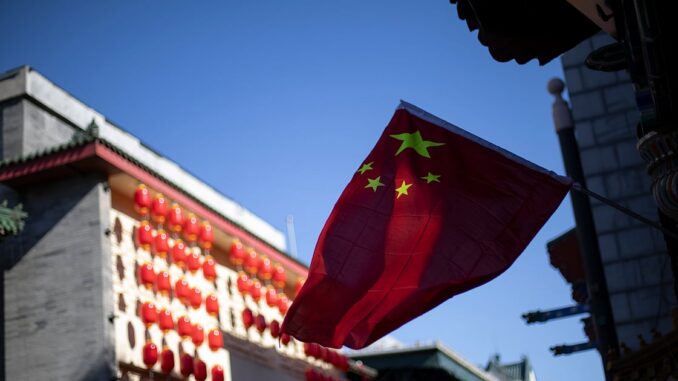
The Chinese Ministry of Commerce announced this Monday, the 23rd, that it is “evaluating” the content and impact of the United States Supreme Court’s decision on the tariffs imposed by the Donald Trump Government, reiterating its opposition to the “unilateral” measures.
In a statement, the ministry indicated that it “took note” of the court decision in the tariff dispute and that it is carrying out a “full assessment” of its implications.
China “systematically opposes unilateral tariff measures” and reiterates that “the trade war has no winners and protectionism has no way out”, said the ministry, after the United States Supreme Court ruled that the Trump Administration exceeded its powers by invoking the International Emergency Economic Powers Act (IEEPA) as a legal basis for imposing tariff rates.
The ministry added that the so-called “reciprocal tariffs” and tariffs related to fentanyl constitute ‘unilateral’ measures that, according to Beijing, “not only violate international economic and trade rules”, but also the “domestic law” of the United States, and “do not serve the interests of either party”.
Beijing also insists that relations between the two powers must be managed based on cooperation. “Facts have repeatedly demonstrated that China and the United States benefit when they cooperate and are harmed when they confront each other,” said the ministry, which urged Washington to “cancel” unilateral tariffs imposed on its trading partners.
Beijing said it has observed that the United States is “preparing” to resort to alternative measures such as “trade investigations” with the aim of continuing to impose tariffs on its partners, and warned that China will “maintain close vigilance” and “firmly protect” its interests.
The statement follows the United States Supreme Court’s ruling on Friday, reached by six votes to three, that limited the use of IEEPA as a basis for imposing widespread tariffs in peacetime.
Following the court ruling, Trump initially announced a new 10% global tariff under Section 122 of the 1974 Trade Act, but this Saturday he raised that tariff to 15%.
The rule invoked allows tariffs to be increased by up to a maximum of 15% for periods of 150 days, which raises questions about its application in the medium term and about the legal mechanisms that the White House can use if it wishes to extend the measure.
The situation occurs in the context of a year-long trade truce announced last October between Washington and Beijing, which included partial reductions.
Leave a Reply