
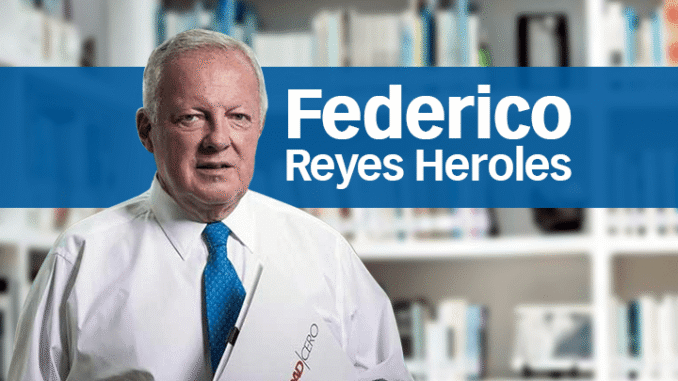
Federico Reyes Heroles
It was the end of the seventies. In Mexico, the social sciences were dominated by Marxist thought. In fact, you could complete a degree with reading Capital as your sole axis. Other types of approaches were disqualified as “bourgeois.” There were rare birds, some teachers who taught courses focused on other currents.
Mariclaire Acosta, one of them: Durkheim, Merton, Easton, Veblen. The French influence was fortunately still present in great mentors from the UNAM Faculty of Political Sciences. Enrique González Pedrero, Víctor Flores Olea, Gerardo Estrada and others. They brought us closer to Raymond Aron, Alexis de Tocqueville or Sartre. But Marxism predominated. It was difficult to broaden philosophical horizons.
The Cuban Revolution, Castro, Che, were alive on the walls full of phrases and their profiles. They were considered permanent and unquestionable heroes. The pretension of “single thought” was threatening. That expression was not used.
Suddenly people began to talk about the “Frankfurt School”. It was a group of thinkers, with very diverse inclinations, whom no one could accuse of being conservative because of their profound knowledge of Hegel, Marx, Freud and others.
Far from Stalinist degradation, their batteries were directed towards the consumer society, towards the alienation of the industrial era, towards authoritarianism, towards the homologous culture. Max Horkheimer, Theodor Adorno, Herbert Marcuse, Walter Benjamin, Erich Fromm himself, its main founders, discovered dimensions simply unattainable by Marxism. The interdisciplinary character—philosophy, sociology, psychoanalysis, economics, aesthetics—injected a freshness that fractured the Marxist asphyxiation.
José María Pérez Gay wandered through the corridors of the FCPyS, a brilliant philosopher, I would say, although his origins were in communication, who mastered German, knew these authors and kept up to date with their publications and theses. There were no translations, they were very scarce and often very bad, which is why the beloved “Chema” obtained the original versions, many of them at Suhrkamp Verlag.
The so-called “School” also had another source of strong coincidence. Philosophers and also scientists of Jewish origin sought refuge outside Germany. Marcuse spent a large part of his life and professional career in the United States.
Einstein goes to Princeton. Karl Popper would write in New Zealand his great text “The open society and its enemies” against single thinking. What libraries would he have consulted for this work that became a watershed for Western philosophy? It was a diaspora that enriched the world.
Through “Chema”, “Herr Pérezz”, I came to the work of Jürgen Habermas. His theses left their mark on me.
To achieve the consensus of a true democratic agreement, the fundamental thing was to deepen the forms of communication. Universal principles could only emerge from true dialogue. Knowledge was a social process. The recognition of intersubjectivity was another essential factor.
Habermas’s work is very complex for several reasons. The first is that he was a continuer of the tradition of the great treatises, like Hegel. Second is the requirement for high abstraction. Third, his great ability to develop new concepts. Hegel already said it, “the effort of the concept.” Byung-Chul Han, the popular Korean essayist, is an heir to Frankfurt.
Habermas came to Mexico, he had a cleft lip and his English pronunciation was very closed. “Chema” juggled to translate his presentation, back at the old medical school. He was strong, a great swimmer. I applied for a scholarship from the German government and presented a project for doctoral studies. He accepted me as a student.
But life, that bungling, got in the way and I was never able to leave.
It is said quickly, but Habermas expanded democratic philosophy and thought. One of the greats left. Auf Wiedersehen.
Researcher and analyst
Habermas’s work is very complex for several reasons. The first is that he was a continuer of the tradition of the great treatises, like Hegel. Second is the requirement for high abstraction.”
Related
Source
Leave a Reply