
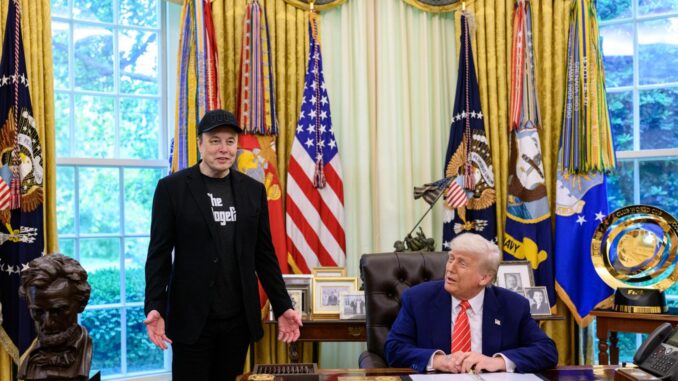
A year ago, the promise was to slim down the State. Donald Trump’s administration launched one of the biggest administrative experiments in decades. Elon Musk thus became the symbol of crusade against federal bureaucracy.
The mission was simple: reduce the size of government. Eliminate waste. Demonstrate that Washington could function with many fewer officials. The cuts were massive. Since January 2025, the White House has fired, suspended or accepted the departure of more than 387,000 federal employees.
The plan was articulated around the call Department of Government Efficiency (DOGE for its acronym in English). For months, the White House presented the initiative as an administrative revolution.
The Government eliminated offices, closed programs dedicated to civil rights and diversity and froze much federal contracting. But the economic balance ended up being much less clear than promised.
Federal spending in 2025 was higher than the previous yearand the administration has not presented the evidence of the massive fraud it claimed it would find. Now, the government is backing down.
Several agencies have returned to Hire staff to fill critical positions and recover vacancies that have been lost after cuts. The administration itself admits it. “We probably have some profiles that we need to rehire,” acknowledged Scott Kupor, the director of the Office of Personnel Management.
The turn reflects a silent rectification one of the first priorities of the president’s second term. Although the White House assures that it wants to rebuild the bureaucracy under new rules, Kupor acknowledges that “sometimes it restructures too much”.
Washington hires again
Following the layoffs, the government has hired approximately 123,000 workers. The figures, published by the Office of Personnel Management, make it clear that the State machinery has not been able to sustain itself with the announced cuts.
Federal agencies are searching, without the expected success, for personnel to prevent basic services deteriorate or are lost.
For example, the Administration of the Social security plans to incorporate in the short term at least 700 public service workers and expand your staff with 1,000 more employees.
The organization lost some 7,000 jobs last year and has had to transfer personnel from other areas to respond to the increase in calls from citizens, the majority still unanswered.
The Department of Affairs Veterans It is trying to strengthen its health personnel, but the labor market has become an obstacle. Applications to fill nursing positions have fallen by 50% so far this year and patient waiting lists are eternal.
Even the IRSthe tax agencyhas had difficulty filling vacancies. The organization has incorporated only 50 of the approximately 2,200 employees which he hoped to hire to process the 2026 tax returns, which are already underway.
The need to rehire also responds to operational risks within the government itself. One of the most affected agencies has been the Cybersecurity and Infrastructure Security Agency (CISA), responsible for protect critical infrastructure against cyber attacks.
The organism has lost about 40% of your staff in the last year and the workers assure, preferring to remain in the shadows, that the situation is critical and that the government now functions with much less margin for error.
A smaller, younger and more political state
The Trump administration maintains that it wants to continue governing with a much smaller state than the one it found when it arrived at the White House. But the objective goes further. You want to decide who enters, who leaves and under what criteria they work a civilian workforce of about two million employees.
The White House has lifted some of the restrictions imposed after last year’s cuts. It has also created new job categories. These classifications make it easier to hire profiles aligned with the president’s priorities and fire more easily those who are not.
In parallel, the Executive has centralized hiring decisions that previously depended on each agency. It has also expanded the weight of political positions in selection processes and has reversed several diversity initiatives promoted by previous administrations.
For their advocates, these changes will make the government more responsive to leaders elected at the polls. For his critics, the risk is different. That the public service loses part of the neutrality that for decades it has tried to protect against political power.
The reconstruction is being piloted from above. Senior White House officials are directly involved in hiring talks. Among them is Stephen Millerone of Trump’s closest strategists. Miller has insisted on prioritizing young profiles aligned with the presidential agenda.
Some job offers reflect this change in climate. A qualified immigration officer position “Defender of the Fatherland” asks candidates to be prepared to “protect their homeland and defend their culture.” It also demands explaining how they would advance Trump’s executive orders and policy priorities.
The administration also wants to rejuvenate an aging bureaucracy. Today only the 7% of officials are under 30 years old. To correct this imbalance, Kupor has launched Tech Forcea two-year program developed with companies such as OpenAI and Meta.
The plan will deploy software engineers and data analysts across federal agencies. The idea is to present the government as a platform for easy-to-mold graduates and early-career professionals. Areas such as health, program management and technology are priorities.
But even as it rehires, the White House is not ruling out further adjustments. Kupor said that this year there are still “more opportunities to restructure” agencies. Without detailing in which more cuts could occur. It also has not released hiring plans submitted by agencies under Trump’s executive order.
That is, ultimately, the balance that defines this new stage. The administration corrects part of the damage caused by Musk’s experiment, but without giving up the political project that promoted it. Washington is hiring again. Only now he wants to do it with a more docile, less experienced bureaucracy and much more controlled from the White House.
Leave a Reply