
The keys
nuevo
Generated with AI
nuevo
Generated with AI
The Oscars have been operating as thermometer of American politics. The opening monologue is usually the moment when Hollywood takes a position—sometimes subtle and sometimes more direct—on the political climate of the country.
Since Donald Trump entered the White House, that moment has become quite predictable. In each ceremony the same pattern is usually repeated: a presenter or an actor throws a dart against Trumpism, the theater applauds and the next day conservative commentators respond by accusing Hollywood of having become a progressive pulpit.
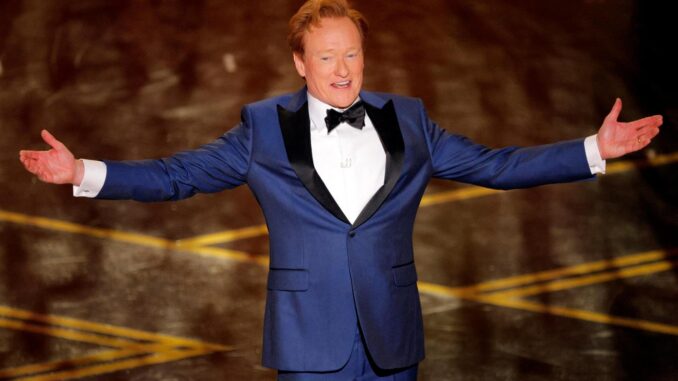
This year, however, Conan O’Brien has done something different by opening the 98th Academy Awards. He hasn’t mentioned Trump even once. during his inaugural speech. But that doesn’t mean it was any less political. In reality, almost the opposite has happened.
O’Brien has constructed a monologue full of political innuendos, cultural references and social jokes who have been targeting almost all the sensitive topics of the moment—the MAGA ecosystem, the power of Silicon Valley, the American health system, the Epstein scandal or global uncertainty—without dwelling too much on any of them.
It was not an apolitical monologue. It has been a political monologue by accumulation.
The ‘MAGA’ culture war
The notice came soon. “Tonight could get political“O’Brien said as he began his speech.
The first signal appeared a few seconds later. If someone was uncomfortable with his tone, he explained, they could always look at some alternative Oscars.”presented by Kid Rock at Dave & Buster’s on the corner.”
The reference had more charge than it seemed.
Kid Rock has become one of the cultural symbols of the MAGA movement and a regular figure in the political environment of Trumpism. During the last Super Bowl, the most watched in history and with Bad Bunny as the star, the musician starred in a alternative show aimed at the conservative public after the half-time show was criticized by the government.
The scene almost draws a parallel cultural universe: entertainment designed for an ideologically aligned audience. That’s what O’Brien was pointing out.
Trump did not appear in the initial speech. But yes in the cultural ecosystem that surrounds it. Instead of placing the president at the center of the stage—the easy resource—the presenter opted this time for something more effective: portraying the political landscape of Trumpism without making it the protagonist.
Silicon Valley, healthcare and Epstein
The second front of the speech pointed towards another type of power: economic and technological.
One of the most celebrated moments came when O’Brien was heading to Ted SarandosCEO of Netflix.
“He’s here tonight,” he said. “And it’s his first time in a theater!”
Then he imitated the executive’s voice: “Why are you all together enjoying yourself? You should be home alone, so I can monetize it“.
The irony worked because it touched on a real tension within the industry. The Oscars were born as the great ceremony of cinema in theaters. Today many of the productions come from platforms that have completely transformed Hollywood’s business model.
O’Brien goes one step further. Amazon Studios, he recalled, had not gotten any major nominations this year.
“It is also Walmart, Alibaba and Chewy have been left out“.
The exaggeration is evident. But it captures an increasingly widespread sensation in Hollywood: cinema is beginning to seem like another segment within the universe of large technology corporations.
And right after, domestic politics also appeared in the script.
Commenting on the movie Hamnetthe host recalls that Shakespeare’s wife gives birth alone in the woods.
“What in the United States we call affordable healthcare”.
The phrase points to one of the country’s structural debates. Unlike Europe, the United States does not have comparable universal public healthcareand access to health care continues to be one of the great battlefields of national politics. Especially after the one-page plan that Trump has presented in recent weeks.
And, if that were not enough, the most uncomfortable moment came shortly after.
Noting that there were no British performers nominated this year in the two main acting categories, O’Brien added: “A British spokesperson said: ‘Yes, but at least we arrest our paedophiles.'”
A second of silence and then applause.
The allusion referred to the case of Jeffrey Epstein, the financier accused of sex trafficking of minors whose connections with powerful figures in politics, business and royalty shook several international elites. And to Trump’s continued denials of having had any kind of relationship with him, although the documents say otherwise.
Hollywood and the anxiety of the moment
The third axis of the speech actually pointed to Hollywood itself.
“It is an honor to be the last human host of the Oscars. Next year it will be a Waymo in a tuxedo“.
Waymo is Google’s self-driving car company. The occurrence works as a technological joke, but also as a fairly clear metaphor for the moment the industry is going through.
Hollywood is experiencing a period of accelerated transition: business mergers, growing dominance of platforms, changes in distribution and debates about the impact of artificial intelligence on creative work.
The presenter turns it into humor. But the underlying nervousness is real.
There is also a difference with last year. In his previous appearance as host, O’Brien avoided direct political confrontation and maintained a relatively light tone. The only serious note came when remembering the fires that were affecting Los Angeles at the time and suggesting that such a ceremony could seem frivolous in that context.
This time the focus has been more precise. Less chaos. Less absurd humor. More intention in each blow.
And then, the final twist.
“Everyone watching this knows that we live chaotic and scary times“, said.
He later recalled that the nominated films represented 31 countries from six continents and that each one was the result of the work of thousands of people of different languages and cultures.
“We celebrate not only cinema,” he added, “but global collaboration, resilience and that quality so rare today: the optimism“.
The result has not been a less political speech.
It has been a less frontal one.
O’Brien has not needed to mention Trump to talk about the country that Trump represents: its cultural tensions, its social fractures, the armed conflicts and the uncertainty that the United States is going through today.
And perhaps that is why the message has been even more effective.
Leave a Reply