
The escalation of tensions in the Middle East could last longer than expected after Iran closed the strategic Strait of Hormuz following attacks attributed to the United States and Israel. The maritime blockade has unleashed turbulence in the oil market and complicates any attempt by Washington to de-escalate the conflict.
According to the Axios portal, even if US President Donald Trump decided to withdraw the military forces deployed against Iran, the economic and energy pressure derived from the closure of the maritime passage could force the intervention to be maintained or reactivated.
A KEY STEP FOR WORLD OIL
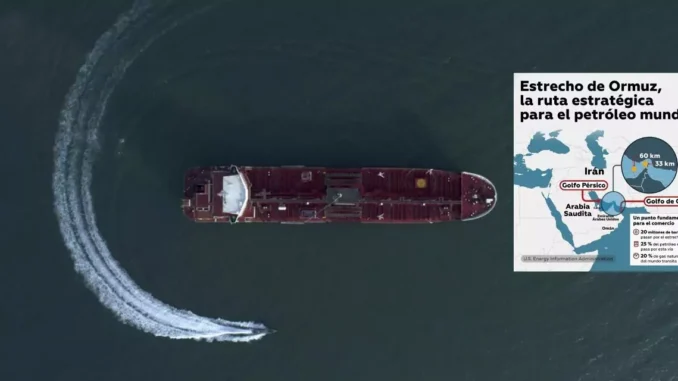
The Strait of Hormuz connects the Persian Gulf with the Gulf of Oman and is considered one of the most important strategic points in global energy trade. Approximately one fifth of the oil transported in the world circulates through this sea route.
After the US-Israeli offensive, Iranian authorities announced the closure of the pass and warned that “not a single drop of oil” will leave the region by sea as long as the confrontation continues.
The measure paralyzed the transit of oil vessels and generated immediate concern in international markets.
VOLATILITY IN ENERGY MARKETS
The impact of the blockade was quickly reflected in the price of crude oil. On March 9, the market registered strong volatility: the price of a barrel exceeded $100 and approached $120 during the first hours of the day.
This Monday, Brent oil futures registered increases again, trading above $104 per barrel, a level that has not been seen since July 2022.
Specialists warn that a prolonged closure of the strait could generate global inflationary pressures, affect supply chains and raise energy costs in numerous countries.
RISK OF LONGER INTERVENTION
According to Axios, the blockade itself could prevent a rapid withdrawal of the United States from the military scene. Even if Washington reduced its presence, Iran could keep the strait closed, putting pressure on the White House to intervene again to restore maritime transit.
A senior US administration official cited by the media warned that this dynamic could trap the United States in a spiral of escalation that is difficult to reverse.
In parallel, sources from the US government and allied countries indicated that instability in the region could extend at least until September, even if hostilities evolve into a lower intensity conflict.
INTERNATIONAL TENSION AND PRESSURE ON ALLIES
Amid the crisis, Trump also hinted at the possibility of requesting NATO support to unblock the Strait of Hormuz, which could further internationalize the conflict.
The situation opens a new chapter of geopolitical uncertainty in a region that has historically been key to global energy supply and where any alteration in oil routes usually has immediate repercussions on the global economy.
Leave a Reply