
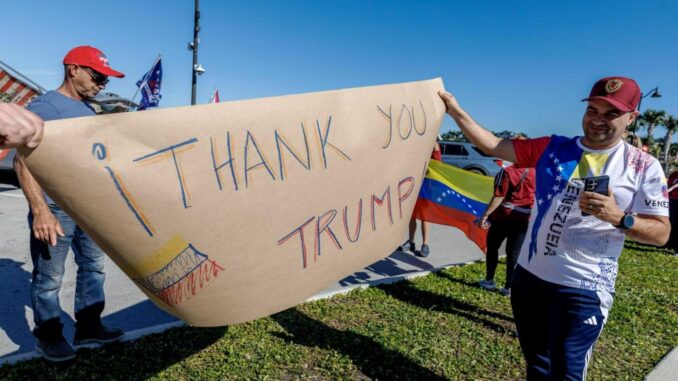
On the night of January 3, a Chinook helicopter took away the dictator Nicolas Maduro to a prison New York. Behind were the bodies of 87 soldiers killed during the rapid intervention of the Delta Force, a government ‘in charge’ of Vice President Delcy Rodríguez and a people plunged into uncertainty, exhaustion and hope.
Two and a half months later, the street is wondering how much longer they will have to wait for their country to function again. One has to rebuild it from the basics: electricity that is not cut off all the time, running water that flows through the taps, medicines that alleviate the suffering of the sick and free elections.
Julio Borgespresident of the National Assembly of VenezuelaIn 2017, he declared in a recent interview with this medium: “When Trump took Maduro, he removed a plug from the future of this country.” Now we can think about tomorrow, but there is still much to do.
Arantxa descends from Basques who emigrated to Venezuela with the Francoism. Born in Caracas 59 years ago and she is very proud of her origin: “Eight Basque surnames are few. I have twice as many,” she says.
Her sisters returned to Álava years ago, but she had to stay to take care of her mother: “Nothing has changed here. If anything, we are worse,” he says. He laments that in these months life has gone up a lot and surviving has become a very complicated exercise.
“Supermarket prices they are in dollars“he says. The problem is that the currency has been greatly devalued since Maduro’s capture: at the beginning of the year, one dollar was exchanged for 300 bolivars. Now it costs close to 450. In practice, everything is 50% more expensive than two months ago.
“Before, at least, it was easy to find dollars on the black market,” he says. “To the eliminate drug traffickinghave stopped circulating. There is no way to get them if a family member doesn’t send them to you from abroad,” he adds.
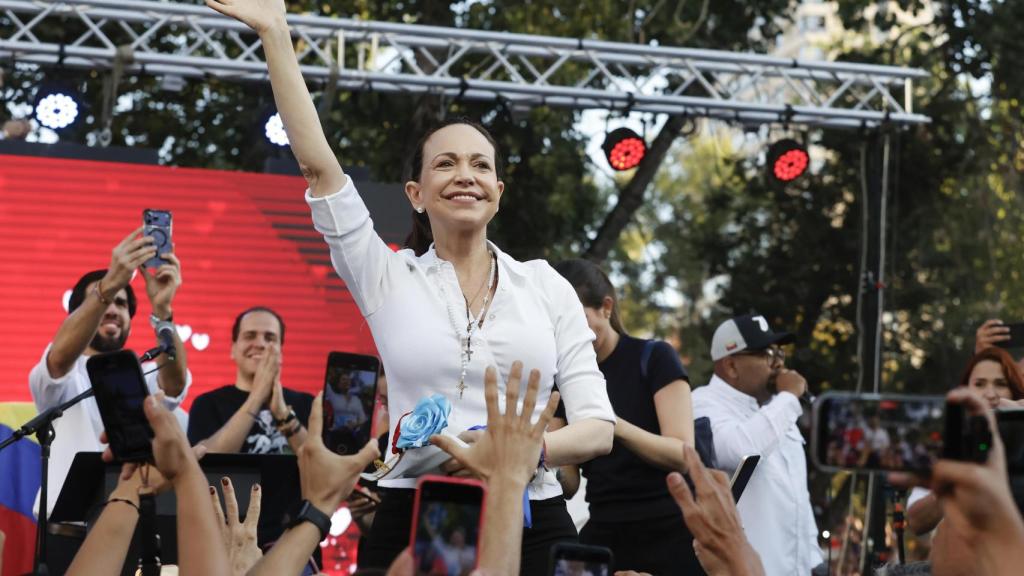
Opposition leader María Corina Machado acclaimed in Chile.
EFE.
The worst is the lack of medicine. There are few and those that are found are expensive: “Sometimes I have to choose between taking the pill or buying food for my mother and me,” he says.
Arantxa does not have a stable job. It is dedicated to audiovisual production for companies. “In the last two months, everything is stopped“she confesses. “When I need money, I offer to transport things or run errands, sew, whatever. What I want is to work“, he declares.
He wonders where the dollars he says are going to end. Government that are entering. Venezuelans distrust that the money will reach where it is needed. “They say they have sent a lot of medicines, but I don’t know anyone who has seen them,” he denounces.
When she thinks about her future she breaks down: “I’ve spent half my life fighting to get ahead. I’m exhausted! I can’t take it anymore!“, he sobs. He feels like he has wasted many years and is distressed by not knowing how he will live his own old age.
But the Venezuelan people are distinguished by their resilience. This is going to be a long and difficult process, but it is inevitable to feel anxious when you see that the end is approaching: “When I can buy my medicine, I take the pill, I look at the sky and I think that we are on the right track“he confesses.
Nancy is 55 years old and is human resources manager at a domestic gas distributor. As a citizen, she suffers the hardships of a rampant cost of living. As an executive in her specialty, she must deal with a diabolical work model.
“The minimum wage in Venezuela is 130 bolivars per month” he explains. At the current exchange rate, that means just under 30 euro cents. “Of course, you can’t live on that amount,” he says.
The government authorizes companies to pay additional bonuses to their employees to reach up to 300 euros of monthly income. A kilo of beef costs about 15 euros, 5% of the average salary.
Mario is a 35-year-old lawyer. Live in Guacara160 km west of Caracas and is dedicated to politics: “The feeling is expectation“, he acknowledges. “It shows that the repression to which we have been subjected in recent years has relaxed a bit,” he adds.
Describes the first public meeting of the political leaders of his region. Open facewithout hiding: “It was a very emotional moment. For the first time in a long time we could get together without hiding. But you can see that people distrust. It is still early and our fear has not gone away,” he declares.
“The Americans have authorized the sale of oil. Production is still small, but they have already left 100 million barrels. “Those are dollars that enter the country through legal channels,” he details. Furthermore, Washington It has also allowed gold to be sold, opening another channel of income for the country.
The young lawyer laments that local leaders are oblivious to the transition process: “The chavismo had all the powerbut Caracas is one thing and the interior is another. The local chiefs are the ones who dominate the provinces,” he explains.
Venezuelans think
At the end of January, the American political strategist Mark Feierstein conducted a survey to find out the opinion of the Venezuelan people on recent events. Feierstein was actively involved in reestablishing relations with Cuba during the mandate of Joe Biden and he is well versed in the situation in Venezuela.
The results are very eloquent: 77% of those surveyed show an unfavorable impression of Nicolas Maduro and 55% approve of his capture. The opinion also extends to the president in charge Delcy Rodriguez: 73% disapprove of his figure and 68% think that it does not represent a change of regime.
The main concern of citizens is the cost of living, followed by health and employment. Only 7% believe that democracy should be between the two priorities of the Government.
81% think that the US should take care of the economic recovery and 6% state that they should focus only on restoring the democracy. Two-thirds of those surveyed believe they should elections be called before a year and the same proportion declares that they will vote for Maria Corina Machado.
The data indicates that the Venezuelan people experience what happened as a first step in the right direction. He sees the future with hope, although he recognizes with pragmatism that the effort must be concentrated on economic recovery. Then democracy can come.
Only 7% believe that democracy should be among the Government’s two priorities.
The most striking thing is that 67% think that the amnesty should not be extended to military personnel or politicians involved in crimes of corruption or crimes against human rights. Many Venezuelans would like to return to their homeland and participate in its reconstruction. In parallel, a reconciliation process will have to be addressed, although the majority makes it clear that it cannot be about suspicions of impunity.
Leave a Reply