
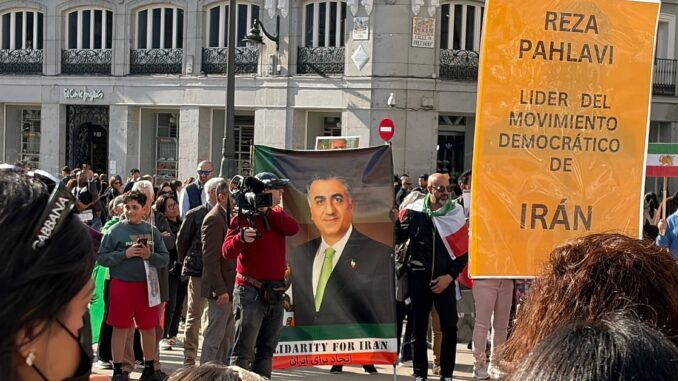
Reza Pahlavi, who has not returned to Iran since the 1979 revolution that overthrew the monarchy, leads one of many foreign-based opposition movements and rose to international prominence during Iran’s protest movements, which reached their peak in January.
Pahlavi said the process of selecting members of the transitional body was being led by Saeed Ghasseminejad, the t’s chief adviser on Iranian affairs.hink tank American Foundation for the Defense of Democracies and staunch opponent of the Islamic Republic.
“The transitional system, under my leadership, will be ready to take over the government of the country as soon as the Islamic Republic falls and, as quickly as possible, establish order, security, freedom and the conditions for the prosperity and flourishing of Iran,” Pahlavi added in his message, published in Persian and English.
However, the son of the last shah has not yet secured the support of the President of the United States, Donald Trump, who has never officially met with him and has repeatedly expressed skepticism about his ability to lead the country.
“They’re talking about the shah’s son… but he’s not there [no Irão] many, many years ago,” Donald Trump said recently.
The White House leader also alluded to the scenario of an internal solution inspired by Venezuela, where US forces captured President Nicolás Maduro in January, who was replaced by his vice-president, Delcy Rodríguez.
“I like the idea of an internal solution because it works well; I think we’ve already proven that in Venezuela,” he said.
The United States and Israel launched an air offensive in Iran on February 28, which killed the supreme leader, Ali Khamenei, on the first day of bombings.
His son Mojtaba Khamenei was injured in the same attack, according to several sources linked to the regime in Tehran, and has not been seen in public for several days, despite being chosen last weekend as the new supreme leader.
Both the Washington and Tel Aviv leaderships have repeated that one of the objectives of their offensive is to create conditions for the Iranian people to rise up and overthrow the regime.
Last January, anti-government demonstrations across the country were brutally repressed, resulting in tens of thousands of deaths and arrests.
Under Israeli-American attack, senior Iranian leaders defied the threats and marched through the center of Tehran on Friday, seeking to demonstrate strength and unity.
Among those present were Iranian President Masoud Pezeshkian, the head of the judiciary, Gholam-Hossein Mohseni Ejei, the secretary of the Supreme National Security Council, Ali Larijani, and the Minister of Foreign Affairs, Abbas Araqchi.
On the same day, the United States announced a reward of ten million dollars (8.7 million euros) for information on the location of senior figures in the regime, mainly linked to the Revolutionary Guard, but also its new supreme leader.
Leave a Reply