
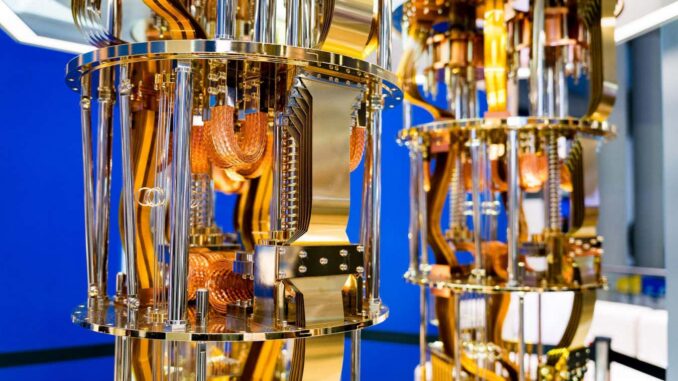
Quantum computers will not be truly useful until they are able to correct their errors
David Bonaldo / Alamy
Quantum computers are already here, but they make too many mistakes. That’s probably the biggest hurdle to making the technology actually useful, but recent discoveries suggest a solution may be on the horizon.
Bugs creep into traditional computers too, but there are well-established techniques for fixing them. They rely on redundancy where extra bits are used to detect when 0s are incorrectly swapped for 1s or vice versa. In the quantum world, however, it is much more challenging.
The laws of quantum mechanics prohibit the duplication of information inside a quantum computer, so redundancy must be achieved by spreading information between groups of qubits—the building blocks of quantum computers—and exploiting phenomena that only exist in a quantum setting, such as when pairs of particles come together through quantum entanglement. These groups of qubits are called logic qubits, and finding the optimal way to assemble and use them is critical to determining how best to eliminate errors.
A recent surge in progress has researchers optimistic. “It’s a very exciting time in error correction. For the first time, theory and practice are really coming together,” he says Robert Schoelkopf at Yale University.
One of the stumbling blocks for quantum error correction has been that the number of qubits needed to create a logical qubit tends to be large, making an entire quantum computer expensive and difficult to build. But Xiayu Linpeng at the International Quantum Academy in China and his team recently demonstrated that this may not be the case.
The researchers found that just two superconducting qubits can be combined with a small resonator to create one larger qubit that makes fewer mistakes and can automatically flag a mistake when it occurs. They then went a step further to show how three such qubits can be grouped together using quantum entanglement to build computing power without hidden errors.
So did Schoelkopf’s team recently demonstrated how several operations necessary for quantum computer programs could be implemented with the same type of qubit and with exceptionally low error rates, with some errors occurring as rarely as one in a million qubit manipulations.
Although approaches like this will catch many errors, useful quantum computers will need to contain thousands of logical qubits, meaning some will still sneak in. Arian Vezvaee at the start-up Quantum Elements, and his colleagues were testing a way to add additional error protection to logic qubits, like wearing a raincoat under an umbrella.
The key idea is not to let any qubits sit idle for too long, as this will cause them to lose their special quantum properties and become damaged. The team showed that by adding idle qubits, an extra “kick” of electromagnetic radiation can create the most reliable entanglement between logic qubits yet.
The exact recipe of how to combine physical qubits into logical ones really depends on some very precise calculations, e.g. David Muñoz Ramo at the quantum computing firm Quantinuum and his colleagues have found an algorithm that determines the lowest possible energy a hydrogen molecule can have. There, the required accuracy is so high that basic error correction methods are not enough.
Such innovation in error-correcting programs will be critical to the success or failure of quantum computers, he says James Wootton at the start-up Moth Quantum. “We’re still at the stage where researchers are figuring out how all the pieces of error correction fit together.” Quantum computers can’t yet operate efficiently without errors, but their engineering foundations are beginning to emerge, he says.
topics:
Leave a Reply