
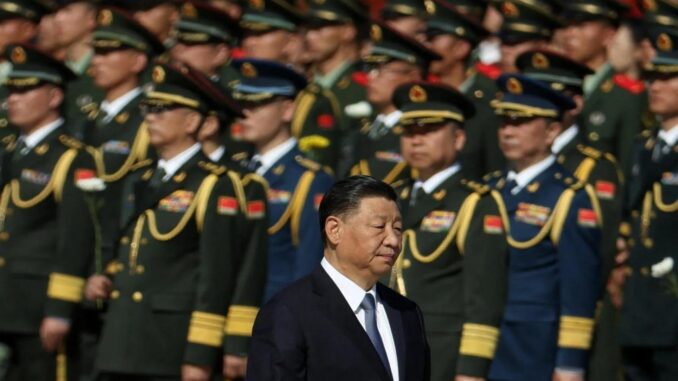
After more than a week of attacks by the United States and Israel against Iran, a question hovers over the conflict:Why is China not protecting Tehran? Some interpretations of the conflict even suggest that Washington’s ultimate objective is weaken Beijing.
Veteran sinologists and Chinese analysts, however, downgrade that thesis. Experts see the most determining factor global impact of a disruption in the Middle East —especially the closure of the Strait of Hormuz— than an immediate desire to hit China through Iran.
The imminent presentation of 15th Five-Year Plan (2026-2030) It also helps to understand Beijing’s position. For years, China has prioritized energy autonomy, economic and military modernization and internal security without getting involved in foreign wars of attrition.
Lucy Hornbya non-resident associate at the Center for Strategic and International Studies (CSIS), rules out that Beijing was the driving force behind this war. Thus it prevents against the temptation of convert effects into causes.
“The attacks against Iran are driven above all by concerns of the United States and Israel and have little to do with China, as the news reports,” he points out in dialogue with EL ESPAÑOL.
Charles Partonanalyst think tank British Royal United Services Institute (RUSI), agrees: “I do not believe that China was the factor that prompted the United States and Israel to start the war, although some of its effects cause serious headaches for China“.
This analysis is supported by a revealing detail. While the Chinese Foreign Ministry condemned the attack Donald Trump As “a flagrant violation of international law,” military analysts of the regime internally posed a starker question: Does Beijing need the Islamic Republic to survive? His response was: “Not necessarily“.
What China loses
Chinese purchases of Iranian oil were already conditioned by sanctions. Much of China’s crude imports are fixed through forward contracts, not spot purchases that are exposed to volatility.
Therefore, Hornby explains, the immediate economic impact for Beijing depends above all on whether the attacks lead to a broader regional war. The really sensitive variable, he insists, is the Strait of Hormuz.
An eventual closure would not only isolate Iran, but would affect much broader energy flows. Even so, Hornby reminds us that China has shock absorbers. “It has a lot of coal and other fuelsand has done much to diversify oil supply routes, including the construction of pipelines.”
Energy is at the center of China’s strategic calculus, and the 15th Five-Year Plan provides context. By 2030, Beijing has set reduce carbon intensity by 17%down from 18% of the previous plan. Between 2021 and 2025 the reduction was 12%.
The trend points to a less dependence on oilalthough without eliminating it. China will maintain its domestic production around 200 million tons annuallyit will expand strategic reserves, boost gas and continue advancing infrastructure such as the Power of Siberia 2 pipeline. It has, in short, greater absorption capacity in the event of an energy shock.
It is also worth putting its dependence on Iranian crude oil in perspective. The analyst Xiao Xiaopao maintains that this represents only 13.4% of Chinese crude oil imports. Furthermore, it is mainly acquired by a small group of refineries in Shandong, not the large state ones. “China maintains real interests in Iran, but they are not vital,” he summarizes.
Why the Strait of Hormuz is so important.
Yu Zeyuan It is more obvious. “It doesn’t matter who’s in charge in Iranit is unlikely that economic agreements with China will be broken.” That is why Beijing has not panicked. But that does not mean that the war does not harm China.
As pointed out Jesse Marksan expert on relations between the United States and China, this reaction is disturbing for those who take for granted an ideological alliance between Beijing and Tehran.
For Chinese analysts, the nuclear talks before the attack were little more than a smokescreen. And they believe that the Iranian regime will not collapse, although there is a risk of civil implosion and factional struggles for power.
Parton summarizes several clear costs. “A rise in energy prices will not help the Chinese economy, not only because of its direct effect but because a slowdown in the global economy would be detrimental to China, whose prosperity depends largely on exports“.
Added to this is Beijing’s exposure in the Gulf. War threatens much more important investments in Saudi Arabia and other countries of the Gulf Cooperation Council (GCC) than those carried out in Iran.
The amount actually invested by China in Iranian territory is modest, just about 5,000 millionaccording to the agency Reutersvery far from the 400,000 million proclaimed as a result of the 2021 bilateral agreement.
China could also lose market in Iran, although not in a devastating way. Iranian imports are closely linked to Beijing because the renminbithe Chinese currency, is the only one usable in that commercial circuit.
But even here another embarrassing limit appears for the official Chinese narrative. Beijing does not behave as a power capable of decisively altering international eventsdespite presenting itself as such.
And there is an additional, albeit unlikely, political risk. If a clearly pro-American government ends up installed in Iran, Chinese influence in the region would suffer a considerable blow, Parton concludes.
The crisis also projects another reality that Chinese analysts themselves have recognized: The United States is far from being an exhausted power. The diary South China Morning Post This week he collected reflections under a significant question: “Is the United States in decline?”
Here, the analyst Zheng Yongnian warned that Washington has demonstrated that “it retains formidable economic strength and possesses military power unparalleled worldwide.”
The question, in his opinion, is not whether the United States can act, but whether it wants to do so. He demonstrated it in 2003 with sadam husseinin 2011 with Osama Bin Ladenin January with Venezuela and now with the Ayatollah Ali Jamenei. “We should not underestimate the capabilities of the United States at all.”
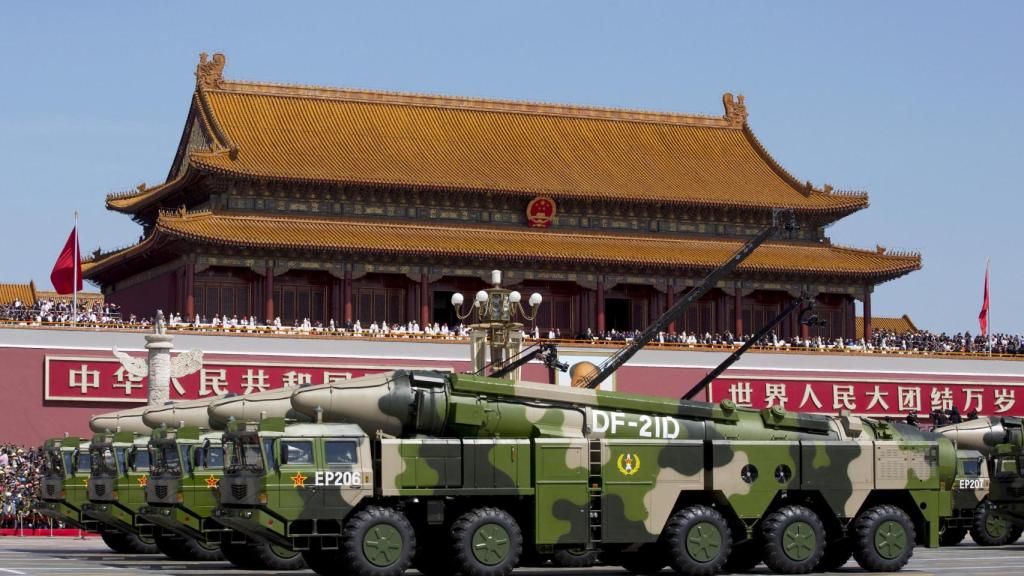
Chinese vehicles carrying DF-21D ballistic missiles at a parade in Tiananmen.
The lesson for Beijing is unpleasant. One thing is the political chaos generated by Trump — whose motivations for this war remain unclear — and quite another to confuse that disorder with an American structural weakness.
The narrative of Washington’s decline, so useful for Xi Jinpingneeds review: In military power, the United States remains ahead of China.
What do you expect to win?
Despite these costs, the war also offers political and strategic advantages to Beijing. “It’s a gift for Chinese propaganda“summarizes Parton. And the conflict reinforces the narrative of the Party that has ruled China since 1949.
The United States once again appears as a destructive power, while China tries to sell itself as a responsible actor, guarantor of stability and supposed builder of peace. Meanwhile, Washington’s involvement in Iran concentrates resources, attention and military capacity in the Middle East.
That reduces, at least temporarily, your room for maneuver in the Indo-Pacificthe main scene of rivalry with China for naval power, routes and credibility with its allies.
If the White House also gets bogged down in a long war, the wear and tear will also be political. Less ammunition, less focus and less internal willingness to face another high intensity crisis, for example around Taiwan.
The war too erodes western unity. This is where the clash between Trump and Pedro Sánchez, and the tensions with the British Keir Starmer fit in. Added to this are protests in countries like Pakistan and Greece. They are not equivalent to national surveys, but they do reflect public disapproval.
All of this helps explain why China will not intervene. In the short term, the real problem for Beijing is not just Iran, but a regional expansion of the conflict and, above all, the closure of the Strait of Hormuz, the great variable that alters routes, insurance, freight and energy costs.
In these crises, the price moves not only due to supply and demand, but also due to the risk premium. And the blow would also reach Gulf partners – Saudi Arabia, the United Arab Emirates and Oman – where China has much greater interests than in Iran.
Beijing has pressure instruments, but activating them would be expensive. Hornby mentions two: release held funds in controlled circuits and an eventual military supply. China could unlock money for its Iranian contacts and give oxygen to the state apparatus, but it would increase its traceability and the risk of secondary sanctions on banks and intermediaries.
Something similar would happen with direct military aid. It would mean moving from diplomatic protest to operational involvement, with sanctions, retaliation and deterioration of its position in the Gulf. Beijing can do things, but it won’t come for free.
The third reason is strategic. If the current window of brief, lethal attacks were to descend into a long, bloody war, intervention would drag Beijing into the kind of scenario it is trying to avoid: an alien, costly and unpredictable war of attrition. Its priority remains to reinforce security, stability and deterrence, not to embark on foreign adventures that compromise its agenda.
The fourth reason is political and reputational. this war exposes the real limits of Chinese power. Both the WSJ like Parton point to the same symbolic cost: the second world power does not act as a protector willing to rescue his partners when they get into a serious crisis. Iran is leaving it exposed.
Leave a Reply