
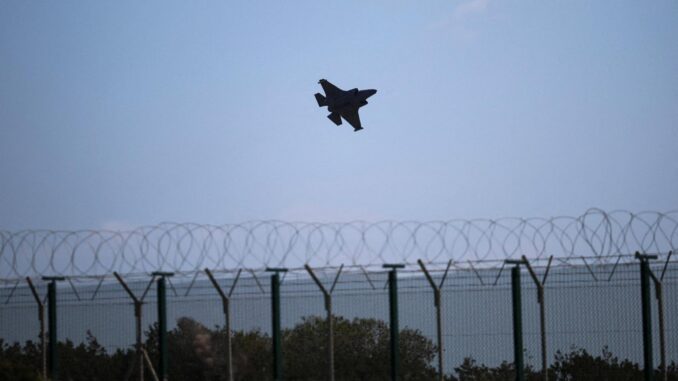
The conservative Greek government of Kyriakos Mitsotakis announced this Monday the immediate sending of two frigates and two F-16 fighters to reinforce the defense of Cyprus – the country that currently holds the rotating presidency of the EU and the closest to the region – after Tehran’s attacks against British bases on the island.
The incidents have forced postpone the informal meeting of European affairs ministers which was to be held this Monday and Tuesday in Nicosia. An informal summit of heads of state and government is scheduled for the end of April, the holding of which could be at risk if the conflict continues.
One of the attacks has managed to reach its objective: a drone hit the runway of the British base Akrotiri late Sunday, although it caused only minor damage.
“Although the Republic of Cyprus was not the goal, let me be clear: we collectively, firmly and unequivocally support our Member States against any threat,” said the president of the Commission, Ursula von der Leyen after speaking with the Cypriot president, Nikos Christodoulides.
“The attack on the Akrotiri air base last night is deeply worrying, an example of the dangerous and indiscriminate attacks by Iran and its proxies across the region,” The British Defense Minister said, John Healey.
During Monday morning, the Government of Nicosia has reported the downing of two other unmanned aerial vehicles that were heading to the same British base. According to the Cypriot press, the drones would have been launched by Hezbollah from Lebanon.
On Sunday, Healey himself revealed that Iran had launched two missiles in the direction of Cyprusintercepted by Israel when they crossed its airspace.
As a result of these incidents and the contagion effect of the Iranian war throughout the region, Greece – which has one of the most powerful armies in the Mediterranean – has announced that it will come to the rescue of Cyprus by sending two frigates and two F-16 fighters.
“After the unprovoked attacks against the territory of the Republic of Cyprusthe frigate will be sent immediately to Cyprus Kimonalong with a second Greek frigate equipped with the system (anti-drone) Centaur“, he announced this Monday Greek Defense Minister Nikos Dendias.
“Likewise, it will be sent to the Republic of Cyprus a couple of fighters F-16 Fighting Falcon to contribute to its defense against the threats it faces,” he added.
The reinforcement was decided after a telephone conversation between Mitsotakis and Christodoulides. “We thank the Government of Greece your quick response“said a Cypriot government spokesperson.
Nicosia complains that London has not made it sufficiently clear that it will not use its sovereign bases in Cyprus to launch attacks against Iran.
“Our country has not participated nor will it participate in military actions”assures the spokesperson of the Cypriot Government.
Starmer announced this Sunday that The United Kingdom has agreed to a US request to allow the use of British military bases to launch “defensive” attacks against Iranian missile positions, without specifying which ones.
The British Prime Minister assures that the United Kingdom has learned the lessons of the “mistakes of Iraq” and that did not participate in the initial attacks against Iran nor “will he now join in offensive actions.”
London, Paris and Berlin published a joint statement late Sunday in response to Iran’s attacks on its allies in the Gulf in which they announced that they will adopt “the necessary measures to defend our interests and those of our allies in the region.
That includes allowing “necessary and proportionate defensive actions to neutralize at its source Iran’s ability to launch missiles and drones.”
“We have agreed work together with the United States and with the allies of the region on this issue,” the brief statement concludes.
For his part, the Secretary General of NATO, Mark Ruttespoke this Monday with the president of Türkiye, Recep Tayyip Erdogan about Iran and the security situation in the region.
“We both agree on the importance of NATO’s 360-degree approach to security and that we are always prepared to deter and defend ourselves from any threatfrom any direction,” Rutte wrote on his X social network account.
Leave a Reply