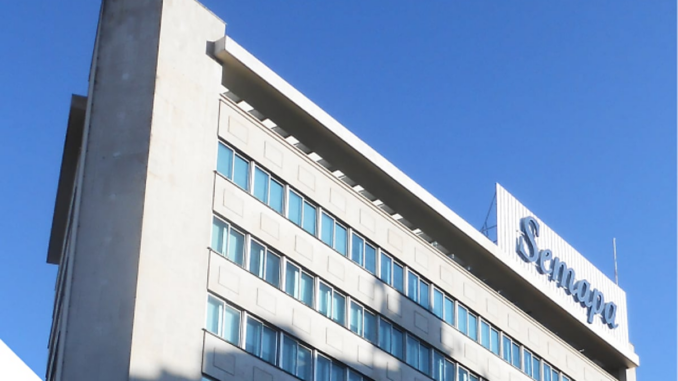
Semapa Group’s consolidated revenue in 2025 was 2,114.9 million euros, 1.6% lower than that recorded in the same period in 2024, the company announced to the markets this Friday. The company justifies this indicator with a “very challenging situation”, marked by the drop in pulp prices on the international market, with Navigator sales falling 5.7%. But if Secil’s contribution was taken into account (in the process of sale and analyzed separately), revenue would be 2,865.2 million euros, with a slight increase of 0.6% compared to the same period last year.
In the year that ended, Navigator (pulp and paper) was responsible for the lion’s share of the group’s value, with business worth 1,969.8 million euros, while 145.2 million euros were generated by ‘other businesses’. As for exports and sales abroad, these totaled 1,826.5 million euros, which represents 86.3% of revenue, in line with the Group’s strategic objectives, according to the information provided to the CMVM.
For 2026, Semapa Next announces a new investment cycle focused on Energy Transition, Technology for Industry, Supply Chain and Logistics and Vertical Software.
Purchases and sales
The year 2025 was marked by two impactful decisions. On December 19, 2025, Semapa signed the purchase and sale contract with Cementos Molin, for the sale of all of Secil’s capital, for 1.4 billion euros, which should be completed by the end of March. The group sees this deal as “a step in line with its strategy of active investment portfolio management and long-term sustainable value creation”.
“The operation represents a strategic move to reinforce the Group’s financial and investment capacity and focus its portfolio on priority areas of growth within the outlined strategy”.
Another big decision was to reinforce its presence in Spain, with new investments. “As part of the diversification and growth strategy, the Semapa Group continued with its strong ambition and invested a total amount of 459 million euros in 2025, of which 230 million euros in investments in new businesses (financial holdings)”.
Considering Secil’s contribution on December 31, 2025, the total investment value would be R$545 million. “During 2025, the Semapa Group made important acquisitions in Spain. In July, Semapa acquired Imedexa, a European leader in the design and manufacture of metallic structures for electricity transmission and distribution infrastructure for a consideration paid of 148 million euros“, says the company. This acquisition represents, for the group, “an important milestone in Semapa’s portfolio, being Semapa’s first direct foreign investment. In January, ETSA acquired Barna for a payment of 33.5 million euros, expanding its activities to a new geography, in a new business segment, fish rendering”, informs the report and accounts. Additionally, during 2025, Semapa Next made follow-on investments worth 49 million euros in 7 companies and in the funds in which it is a participant, among which the reinforcement of the investment in Gropyus worth a total of 39 million euros stands out. euros, in a context of strong dynamism from the company of Austro-German origin, which combines technology and industrialized production of modular construction solutions.
Faced with a net profit of 156.6 million euros, 76 million less than in 2024, the group will maintain the level of dividend distribution. The board of directors will propose to the General Shareholders’ Meeting a dividend distribution of 0.626 euros per share, which corresponds to a total value of approximately 50 million euros, equal to that distributed in relation to 2024.
In 2025, consolidated EBITDA totaled 381.2 million euros (-29.0% vs. the same period in 2024). In the period under review, 375.7 million euros were generated in Navigator and 12.6 million euros in the Other Business segment. The consolidated EBITDA margin reached 18.0%, (-7.0 pp vs. the same period in 2024). It was impacted by Navigator’s lower performance than in the same period of 2024 (-31.3%), partially offset by the Other Business segment (+203.4%). Navigator maintains its focus on reducing variable costs, which reflects the downward trend in unit cash costs across all its businesses and the strategy of controlling fixed costs, stabilizing them towards 2024.
Leave a Reply