
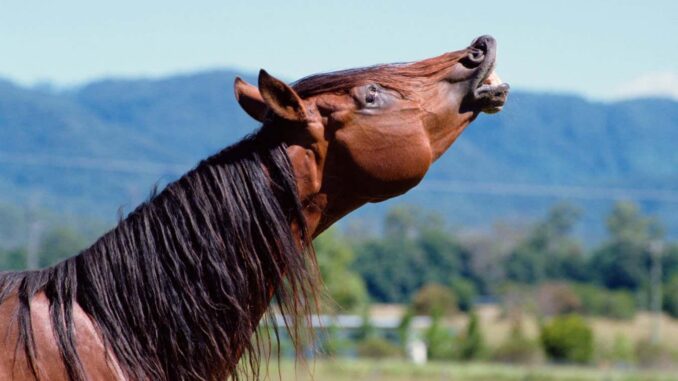
Now we know how horses whine
Horizon International Images/Alamy
When a horse neighs, it makes two sounds at the same time, as no other animal can: a low sound made in a manner similar to a cow’s lowing, and a high-pitched whistling sound made in the throat.
Horse neighing has long been known to contain both a low-frequency sound, around 200 hertz, and a high-frequency sound above 1000 hertz – a phenomenon known as biphonation. The low-frequency component is easily explained by vibrations in the horse’s laryngeal vocal cords, similar to human speech or singing. But the high-frequency sound is unusual for such a large animal, and how it is produced is a mystery.
“Although humans have coexisted and evolved with horses for 4,000 years, we still have an imperfect understanding of their communication,” he says. Tecumseh Fitch at the University of Vienna, Austria.
To solve the puzzle, Fitch and his colleagues first performed a series of tests, scans and experiments on horse larynxes obtained from a horsemeat supplier.
“We blew air over them and initially only had a low component,” says Fitch. “But with a bit of playing we were able to get the high-frequency component as well.”
This showed that both components are produced by the larynx itself, unlike human whistling, which is done by the lips.
For further evidence of the whistling mechanism, the researchers blew air and helium, two gases of different densities, through the larynx. By comparing these gases, the researchers could test whether the high-frequency sound came from whistling or tissue vibration.
“The low-frequency component is produced by the vibrations of the vocal cords, just like a human singing or a cow mooing, and it didn’t change when we switched between gases,” says Fitch. “But the high-frequency component shifts significantly to be higher in helium, as predicted for whistles.”
Endoscopic tests on live horses have shown that the muscles around the larynx contract when neighing begins. This causes the glottis, the part of the larynx where the vocal cords are, to narrow, tilting the vocal cords and increasing airway resistance. This forces air through the slot-like opening at high speed.
Mice and rats can also produce laryngeal whistles, but in their case the frequency is too high for humans to hear.
“Horses are the only known mammal that uses the larynx to produce two frequencies simultaneously, one being a whistle, and in fact they are the only large mammal other than humans that produces whistles as part of the standard vocal repertoire,” says Fitch.
“This is the first strong experimental evidence of an aerodynamic laryngeal whistle in any animal outside the rodent family,” he says Ben Jancovich at the University of New South Wales in Sydney, Australia.
Fitch and his colleagues speculate that the whistle may make whining more noticeable and may help the sound carry further, but these hypotheses have not yet been tested.
topics:
Leave a Reply