
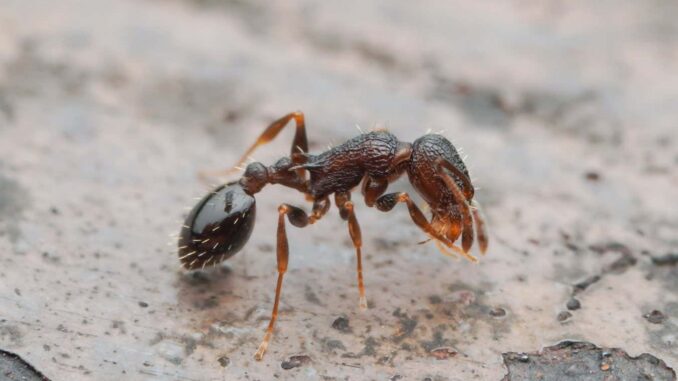
Temnothorax makora ants parasitize the related species Temnothorax kinomurai
psychic/iNaturalist
A parasitic ant species from Japan is the first ever to get rid of both male and female workers – instead, each individual is a queen trying to take over the nests of other species.
Typically, ant colonies consist of a queen, workers, and short-lived males that die after mating.
For more than 40 years, scientists have suspected that a rare parasitic ant Temnothorax kinomurai it only produces queens, but until now there has been no definitive proof.
The young queens of this parasitic species take over the nests of a related species, Temnothorax macrohe killed the host queen and some workers with a stab. They then reproduce asexually, producing cloned offspring in a process called parthenogenesis, which is rare in ants but common in some other insects. The T. macro workers are tricked into helping raise the young T. kinomurai queens.
Jürgen Heinze at the University of Regensburg, Germany, and colleagues collected six colonies of s T. kinomurai queens and reared them in artificial nest boxes in the laboratory. From these colonies, they were able to breed and rear 43 queen offspring in the laboratory. An inspection of their genitalia confirmed that there were no males.
These 43 queens were then given the opportunity to take over colonies T. macro. Seven queens survived and succeeded in their coup attempts. They gave birth to another 57 offspring, which were again confirmed to be queen females.
“They exhibit a completely new form of social organization and add another exciting dimension to the already rich and diverse world of ants,” says Heinze.
Invading colonies of other species is a risky strategy, as shown by the high queen failure rate observed in this study. But if all your offspring are queens, you have more chances to establish new reproductive colonies.
“If parthenogenesis develops as a result of random mutation, as in T. kinomuraiqueens can produce 100 daughters that don’t need to mate – so there are 100 queens trying to found a new colony,” says Heinze. “Clearly, parthenogenetic queens have a higher success rate than sexual queens.
“This species can be considered the last step in the evolution of social parasitism, which highlights the enormous flexibility in the life histories of social insects,” he says.
topics:
Leave a Reply