
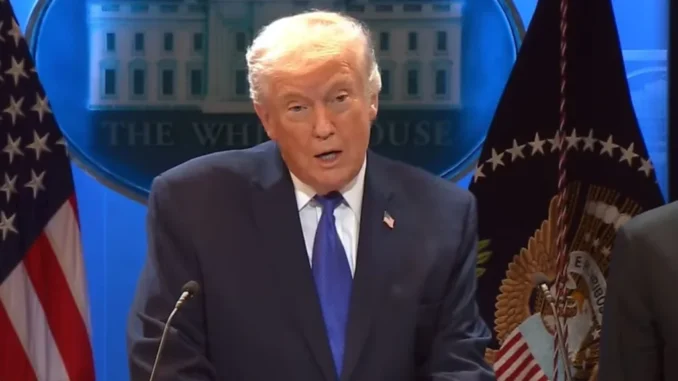
Defiantly, President Donald Trump announced this Friday a new 10% general tariff following a ruling by the United States Supreme Court that ruled that he had exceeded his authority by imposing customs duties as if it were a national emergency.
The government will now resort to other laws, mainly the commercial code approved in 1974, to continue taxing all imports, Trump said a few hours after the Court’s setback, with a conservative majority.
Trump declared himself “deeply disappointed” by the ruling, and directly accused some judges of the Court of being subject to “foreign interests.”
The Republican, who has based much of his foreign policy on a series of tariffs that vary as he pleases, acknowledged, however, that it is not clear whether he will have to repay the money collected so far, in the order of $140 billion in 2025, according to specialists.
That aspect “was not addressed by the Court,” Trump lamented to reporters, and now litigation before the courts could last “years.”
Justice Brett Kavanaugh, who dissented from the majority opinion (6 to 3) of the Court, warned that this legal process could be a “disarray.”
Champion of the motto “America first,” Trump did not acknowledge any error or haste in using the weapon of tariffs, which the Supreme Court recalled is in the hands of Congress.
The mistake was made by the six judges who voted against it, for “politically correct” reasons, he asserted.
Supreme Court did not authorize imposing tariffs
The United States currently applies an average tariff rate of 16.8%.
The Supreme Court decided that the International Emergency Economic Powers Act (IEEPA) of 1977 “does not authorize the president to impose tariffs.”
This decision refers to customs duties presented as “reciprocal” by Donald Trump, but not to those applied to specific sectors such as automobiles, steel or aluminum.
Trump already began using tariffs as a negotiating weapon during his first term (2017-2021), but upon returning to power in January 2025 he immediately announced that he was going to use the IEEPA to impose new taxes on virtually all of the United States’ trading partners.
In addition to tariffs for trade reasons, Trump enacted special customs tariffs on important partners such as Mexico, Canada and China because of drug trafficking and immigration.
Trump also used the IEEPA to pressure countries at war, and boasted of having managed to resolve eight long-standing international conflicts in 2025, for example between Thailand and Cambodia, thanks to the threat of tariffs.
But the high court recalled this Friday that “if Congress had intended to grant the distinct and extraordinary power to impose tariffs” through the IEEPA, “it would have done so expressly, as it has done systematically in other tariff statutes.”
The New York Stock Exchange, which had opened this Friday in the red, rose after the Court’s announcement: the Dow Jones gained 0.3% and the Nasdaq 1.0%.
In addition to the ruling, the United States woke up this Friday with a poor economic result: growth in 2025 was 2.2%, compared to 2.8% the previous year.
Trump overstepped his authority
A lower commercial court had ruled in May that Trump overstepped his authority with widespread levies and blocked most of them from taking effect, but that outcome had been put on hold pending the government’s appeal.
The European Union declared that it was studying the ruling “carefully” and the Canadian Chamber of Commerce called it a “realignment.”
“Canada must prepare for new, more forceful mechanisms, … potentially with broader and more disruptive effects,” Chamber of Commerce president Candace Laing said in a statement.
The Democratic opposition returned to the charge against Trump’s economic policy, less than ten months before the midterm elections.
“Donald Trump’s failed economic policies and the global trade war waged with irresponsible, intermittent tariffs against our allies and trading partners have generated enormous uncertainty,” declared the head of the Democratic caucus in the House of Representatives, Hakeem Jeffries.
Leave a Reply