
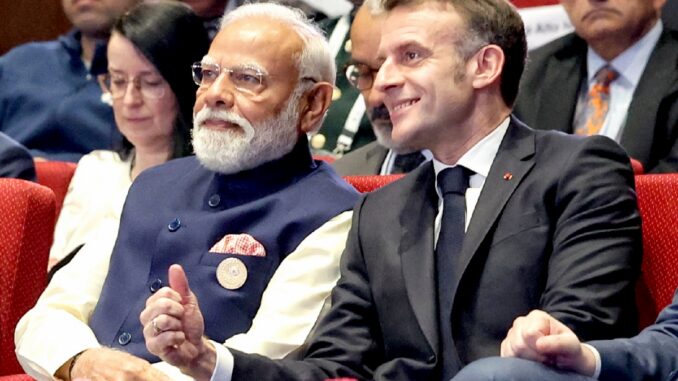

NEW DELHI (EFE).— The CAI Impact Umbrella met in New Delhi to leaders from around the world, who almost unanimously agreed that the development of artificial intelligence cannot remain under the exclusive control of large technology companies or millionaire elites.
During the plenary session, before the closing of the meeting, heads of state and government from more than twenty countries advocated for governance that prioritizes the public interest over what they described as a “digital monopoly”which — they warned — threatens the sovereignty of nations and can overshadow the use of a tool with still blurred borders.
The Prime Minister of India and host of the summit, Narendra Modi, led this front by proposing the promotion of open source as an alternative to the predominant model and rejecting the opacity with which some corporations They treat AI as a “confidential strategic asset.”
In tune with Modi, the president of FranceEmmanuel Macrondefended a policy that protects the most vulnerable. “No country is obliged to serve solely as a market where foreign companies sell models and download citizens’ data. No country,” he said.
The president of Spanish Government, Pedro Sánchez, joined the criticism of oligarchic control and maintained that AI must be guided by human values and not only by commercial interests, in addition to serving to “to expand freedom and democracy, not to undermine them.”
Along the same lines, the president of Brazil, Luiz Inácio Lula da Silva, denounced that the Global South faces a new form of colonialism. “When few control the algorithms and digital infrastructures, we are not talking about innovation, but rather domination. The data generated by our citizens is being appropriated without an equivalent counterpart in our territories,” he expressed.
In search of equality
The countries of the region, protagonists of the first summit held in the Global South, insisted on a equal and fair AI integration within a market that, according to nations like Cubatakes advantage of the critical minerals of its territories without guaranteeing sufficient technological return.
Other delegations, including the United Kingdom, China and Canada, advocated promoting a “community of shared destiny” through global governance that prevents the widening of social gaps under technological advance.
Private equity
He UN Secretary General António Guterreswas one of the most emphatic in warning that the future of humanity cannot be left in the hands of the “whims of a few billionaires.”
Guterres proposed the creation of a global fund of 3 billion dollars to ensure that technological development reaches all nations equally, a figure he described as a “small price” compared to the economic benefits generated by the sector.
This political rejection of the concentration of power coexists, however, with a massive flow of private resources from the large technology companies of Silicon Valley and national conglomerates, which have consolidated India as the digital axis of the Global South within the framework of this summit.
Giants like Reliance committed 110 billion to develop sovereign computing infrastructure, within a total mobilization estimated at 310 billion that includes firms like Tata, OpenAI, Microsoft and Google.
“We are going through a moment that, let’s just say, is interesting in international relations, as countries need to protect their digital sovereignty while we resolve trade issues,” acknowledged Microsoft president Brad Smith.
Smith urged to find formulas that allow interests to be protected without preventing “technology and services from crossing borders.”
Leave a Reply