
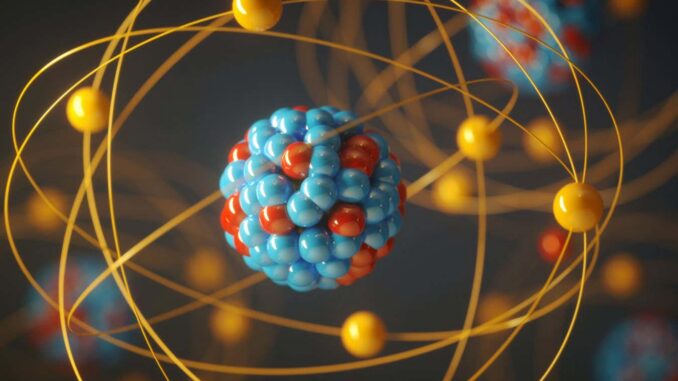
Some atoms appear to be particularly stable because of their number of protons and neutrons
Shutterstock/ktsdesign
A special set of numbers has formed the backbone of nuclear physics research for decades, and now we finally know how it arises from a quantum mix of nuclear particles and forces.
Almost 80 years ago, physicist Maria Goeppert Mayer showed that when the nucleus of an atom contains a certain number of protons and neutrons, such as 50 or 82, it becomes exceptionally stable. In the years since, researchers have accumulated evidence of more such “magic numbers” found in the most stable, and therefore most abundant, elements in our universe.
Goeppert Mayer and her contemporaries explained these numbers by suggesting that protons and neutrons occupy discrete energy levels, or shells. This model, which is still used to interpret many nuclear physics experiments, considers each particle in a nucleus to be independent, but our best quantum theories argue that the particles in nuclei actually interact strongly.
Jiangming Yao at Sun Yat-sen University in China and his colleagues have now resolved this contradiction, and in the process elucidated how these interactions give rise to the magic numbers.
Yao says the shell model relies on input from experiments and does not encode the details of interactions between individual particles. Instead, he and his team started their calculations from first principles, meaning they mathematically described how particles interact, how they stick together, and how much energy is needed to move them apart in more detail.
The two descriptions are analogous to images taken at low and high resolution, Yao says. “Previously, people directly modeled the system at low resolution or tried to understand the structure of the core at high resolution. We used modern methods to create a bridge between these descriptions.”
He and his colleagues started with a high-resolution description, gradually blurring it at each step of the calculation, watching how the structure the particles form changes.
As they moved across their mathematical bridge, the scientists saw how the symmetry of the particle’s quantum states changed—drawing a graph based on the equations for those states would produce shapes with different symmetries at different resolutions. This change resulted in a nuclear structure that was most stable when the particles clustered into magic numbers.
Jean-Paul Ebran The French Commission for Alternative Energies and Atomic Energy says the work offers a theoretical probe — a kind of mathematical microscope — that mirrors the workings of the experiments. “Nature looks different depending on the resolution at which you observe it. This.” [study] it really maps what we do experimentally.”
The change in symmetry the researchers identified is related to effects described by Albert Einstein’s theory of special relativity, creating an even more complete picture of how magic numbers connect different aspects of nuclear theory, Ebran says.
So far, the researchers have tested their theoretical work on a type of tin that is doubly magical because each of its nuclei contains 50 protons and 82 neutrons, as well as several other nuclei. In the future, they want to extend their analysis to heavier atomic nuclei, which are typically unstable, and study the processes by which heavy nuclei form in exploding stars or merging neutron stars, Yao says.
topics:
Leave a Reply