
Cuba is now experiencing one of the most critical moments in its modern history. The capture of Nicolás Maduro by the force of the last 3 years of the United States and the new control of the United States over Venezuela and its energy recursion have profoundly changed the political balance of the Caribbean and the Andean region. For an island that has depended on the Venezuelan mainland for more than two decades, the development is an inflection point. The system inherited from the 1959 revolution appears for the first time almost on the verge of collapse.
For years, Venezuela has been one of Cuba’s main economic and strategic pillars thanks to Hugo Chávez’s commitment to power. Nevertheless, recently the Cuban intelligentsia seemed to maintain key positions in support of the Chavista regime. Maduro’s cause will not only be eliminated, but will accelerate the internal decay of the island, which today finds itself in an economic and humanitarian crisis that has become virtually unsolvable.
Staggering inflation, chronic shortages of food and medicine, and a depleting population define Cuba’s present. A major energy crisis is emerging here: long-term breakdowns, fuel shortages and constant breakdowns in power plants have created levels of social pressure since the revolutionary triumph. In this context, and although some have called Trump a Corollario — a re-emphasized version of the Monroe Doctrine during the second administration of Donald Trump — the Castro regime appears to be facing a scenario that hardly seemed unthinkable.
However, the possible end of the Cuban regime will hardly be the romantic fantasy that some exiles have imagined over the decades. The socialist project collapsed on the promise of equality, not only because of the US-backed economic blockade, but also because of the structural flaws and mismanagement of the Cuban nomenclature. Like other socialist experiments, the utopia resulted in misery, disaster, and a massive flight of human capital in search of opportunities outside the Caribbean.
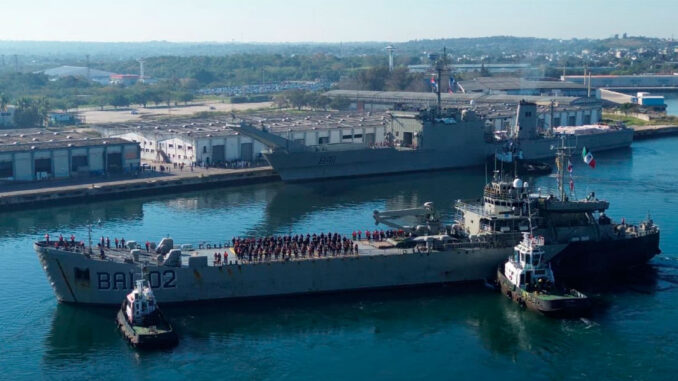
In the middle of this desolate panorama, Mexico turns into an ally of the island. The special relationship between the two countries began at the beginning of last year, when Mexico decided not to cut diplomatic ties with Havana. Indeed, major Mexican governments have maintained political gestures of persecution with Castroism. Today, in the midst of an energy and economic crisis, President Claudia Sheinbaum decided to send humanitarian and energy aid to Cuba, presenting the decision to Washington as an act of regional solidarity and defense of Mexican sovereignty.
Mexican authorities and parts of Latin American society celebrated the treatment as a heroic act of defiance against the United States. In real politics, however, things are rarely as they seem. You might wonder if this gesture actually happened, quietly encouraged by the White House, at a time when the Cuban regime has toned down its anti-imperialist rhetoric and appears willing to engage in a pragmatic dialogue with Washington.
Hemispheric power asymmetries continue to mark the sphere of influence of countries such as Mexico and Cuba. Faced with the new strategic priorities of the United States, it is not unreasonable to think that we have the quiet coordination to manage the Cuban side and avoid a chaotic collapse that tends to have high migration and political costs. As happened in Venezuela, Cuban elites may be negotiating an orderly transition to a new form of dependency.
In politics, the epic used to defeat pragmatism. Hemispheric power asymmetries severely limit the real autonomy of countries like Mexico and Cuba, forcing their elites to move within extremes defined by Washington. In this context, Mexico’s aid to the island can hardly be interpreted as an act of mutinous insurrection. Everything indicates, more importantly, that it responds to a shared calculation of how to manage the Cuban crisis without regional imbalances, especially in the area of migration.
Those who want to satisfy the United States, Mexico could thus act as a peripheral manager of the hemispheric order, paying the human and political costs of a regime in decadence with the arrival of the White House. The Cuban revolution is derailed neither by a popular uprising, nor by direct external intervention, nor by something much more blunt: the agony of its own model and the irreconcilable logic of power. Under the renewed Corolario Trump, the van itself does not reappear; simply apply without masks: America is driven by being for Americans.
Leave a Reply