
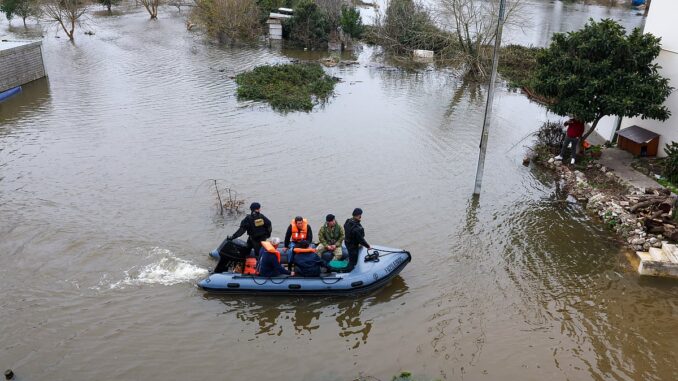
The waters are decreasing considerably in the Mondego valley, but it will still take a few weeks for the situation to normalize, the mayor of Montemor-o-Velho, José Veríssimo, told Lusa news agency this Sunday, February 15th.
“Things are improving every day and from Saturday to today the flow has dropped significantly, with a volume of 850 cubic meters per second at Ponte Açude, in Coimbra, half of what it was”, he pointed out.
On Saturday morning, according to the mayor, 1,600 cubic meters of water were still passing through the Açude Bridge per second, which decreased throughout the day and in the early hours of this Sunday it reached 850 cubic meters.
The mayor confirmed that the worst is over and added that, If it doesn’t rain in the near future, the situation could take three weeks to a month to normalize.
“It has a lot to do now with the conditions and flow of the river. Under current conditions, the flow could stabilize in 15 days,” said José Veríssimo.
The town of Ereira, isolated for several days, will remain without land connection for the next few daysalthough river levels in this area are also falling, although it takes longer due to the inflow of water from the Foja River.
The mayor of Montemor-o-Velho also said that, due to the lowering of water levels, National Road 111 has already reopened in the Tentúgal and Meãs do Campo area.
Sixteen people died in Portugal following the passage of depressions Kristin, Leonardo and Marta, which also caused many hundreds of injuries and displacement.
The total or partial destruction of homes, businesses and equipment, the fall of trees and structures, the closure of roads, schools and transport services, and the cut of energy, water and communications, floods and floods are the main material consequences of the storm.
The Centro, Lisbon and Vale do Tejo and Alentejo regions are the most affected.
The Government declared a state of calamity to date for 68 municipalities and announced support measures of up to R$2.5 billion.
Leave a Reply