
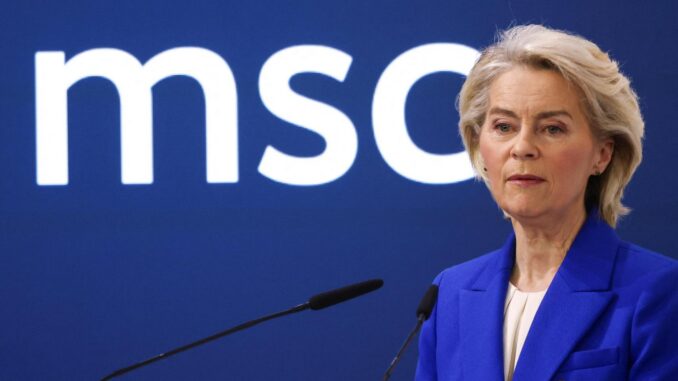
The threats of Donald Trump to intervene militarily to seize Greenland or to impose tariffs on allies who stand in the way of their plans have left indelible scars on the EU. “Lines have been crossed that can no longer be uncrossed,” he said this Saturday Ursula von der Leyen at the Munich Security Conference.
Of course, European leaders appreciate the conciliatory and diplomatic tone of the Secretary of State, Marco Rubiowhich has been the voice of the United States in Munich this year. “We are not seeking to separate, but to revitalize an old friendship“Rubio said this Saturday in a speech that marks a clear contrast with the belligerence of Vice President JD Vance last year.
At that time, Trump’s number 2 stunned allies by attacking Europe claiming that it had become a continent of censorship, suffocated by excessive regulation and irregular immigration. In the middle of the election campaign in Germany, Vance also openly supported the far-right AfD party.
“In these times when headlines announce the end of the transatlantic era, let it be clear to everyone that this is neither our goal nor our desire: because for us Americans, our home may be in the Western Hemisphere, but we will always be children of Europe“Rubio said to applause from the audience.
But beyond the “sigh of relief” (as described by the Conference organizer, Wolfgang Ischinger) due to the apparent de-escalation with Washington, European leaders are wary that Rubio’s measured rhetoric will translate into real changes. Brussels’ roadmap remains firm: achieve military independence from the EU as soon as possible.
“Secretary of State Rubio’s speech has not been well received in Paris, nor in many other EU capitals. His softer tone, although welcome, barely disguised the same intimidating approach towards Europe than Trump and Vance”, assures Mujtaba Rahman, European director of Eurasia Group.
“Rubio’s message was more sophisticated and subtle than Vance’s direct and frontal (and quite absurd) attack on what woke last year, but the bottom line remains the same: a imperialist vision of civilization where force dictates what is fair,” wrote Nathalie Tocci, director of the Institute of International Affairs, which was advised by Josep Borrell.
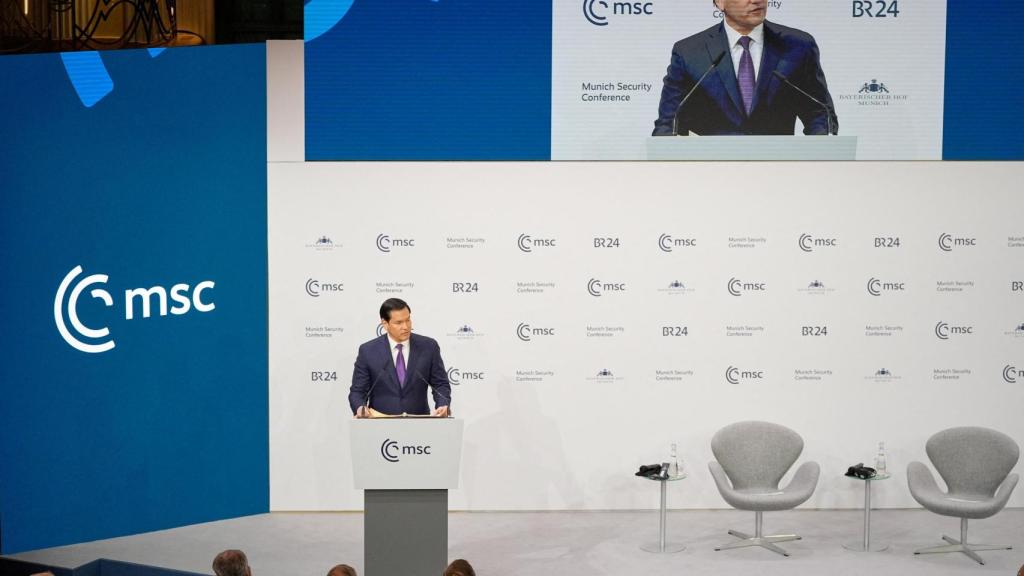
The head of American diplomacy, Marco Rubio, during his speech at the Munich Security Conference
Von der Leyen claims to feel “very comforted” by Rubio’s words. “We know him, he is a good friend, a strong ally, and it was very reassuring for me to hear him. We know that in the (Trump) administration there are those who adopt a harsher tone on these issues,” he noted.
“But the Secretary of State was very clear: he said that they want a strong Europe within the Alliance. And that is precisely what we are working intensely for in the EU. We have to be an independent Europe“not a Europe that depends on someone, but a Europe that moves forward together with its friends and allies,” says the President of the Commission.
In Munich, Von der Leyen has taken another step in her plan to accelerate the path towards Europe’s strategic autonomy: Europe must “give life” to its own mutual defense clausearticle 42.7 of the Treaty, has claimed.
“If a Member State is the object of armed aggression on its territory, the other Member States shall owe it help and assistance with all the means at their disposal,” this article says. This clause It has only been activated once, after the terrorist attacks in Paris in November 2015, but it did not result in any concrete action.
“Mutual defense is not optional for the EU. It is an obligation contemplated in our own Treaty. And with good reason: it is about our collective commitment to support each other in the event of aggression. Or, put simply, one for all and all for one,” argues the President of the Commission.
However, the EU had never before considered how to operationalize Article 42.7. Von der Leyen proposes doing so now not only in response to Russia’s war of aggression in Ukraine, but also because Trump has repeatedly questioned her commitment to NATO’s mutual defense clause, Article 5.
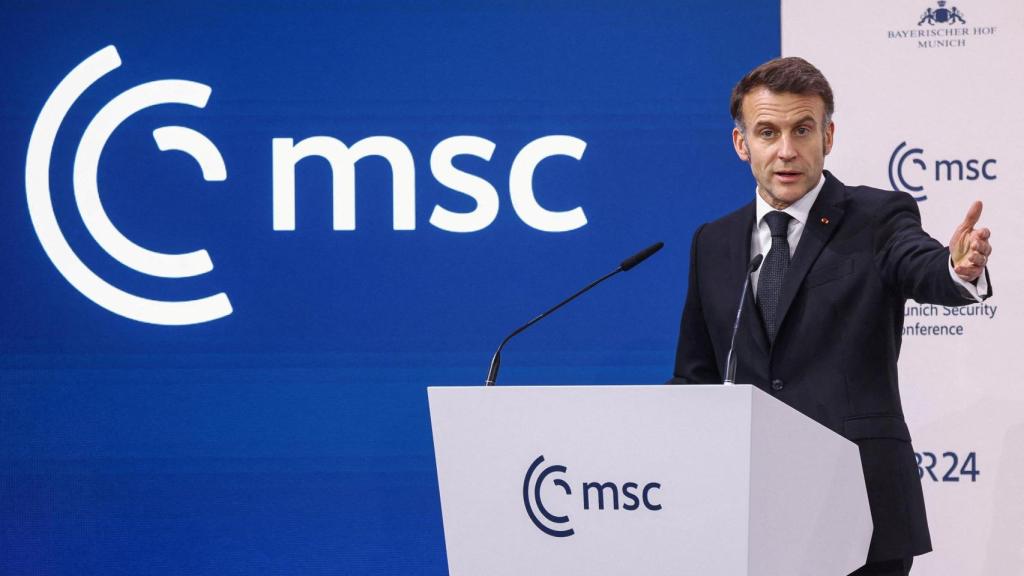
French President Emmanuel Macron during his speech this Saturday in Munich
The President of the Commission has also pointed out that, if unanimity at 27 is not possible, the EU must move forward at various speeds with ‘coalitions of volunteers’ in Defense, as well as forging new security alliances with countries such as the United Kingdom, Norway, Iceland or Canada.
Putin’s threat and the lack of reliability of the US president is what has also led Chancellor Friedrich Merz to begin negotiations with Emmanuel Macron to extend the France’s nuclear safety umbrella. A dialogue that has been talked about in Munich, which began a year ago but has not yet translated into concrete results.
“I think it’s normal that it takes time, because it’s a very sensitive and complicated issue. But I want to remember that, from the beginning, French deterrence, nuclear deterrence, has had what I would call a European inspiration,” the French president said this Saturday at the Security Conference.
“Europe must become a global player with a own security strategy. Article 42 of the EU Treaty obliges us to provide assistance in the event of armed aggression. We must specify how to organize it at the European level: not as a substitute for NATO, but as a strong pillar within the Alliance,” defended the German Chancellor.
In Munich, Merz warned that the rules-based international order “no longer exists.” “A gap has opened between Europe and the US, a deep abyss (…) The cultural war of the MAGA movement in the US is not ours“says the chancellor.
“Here, freedom of expression ends when it is directed against human dignity and against our Constitution. And we do not believe in tariffs or protectionism, but in free trade. We maintain our commitment to climate agreements and with the World Health Organization, Merz said.
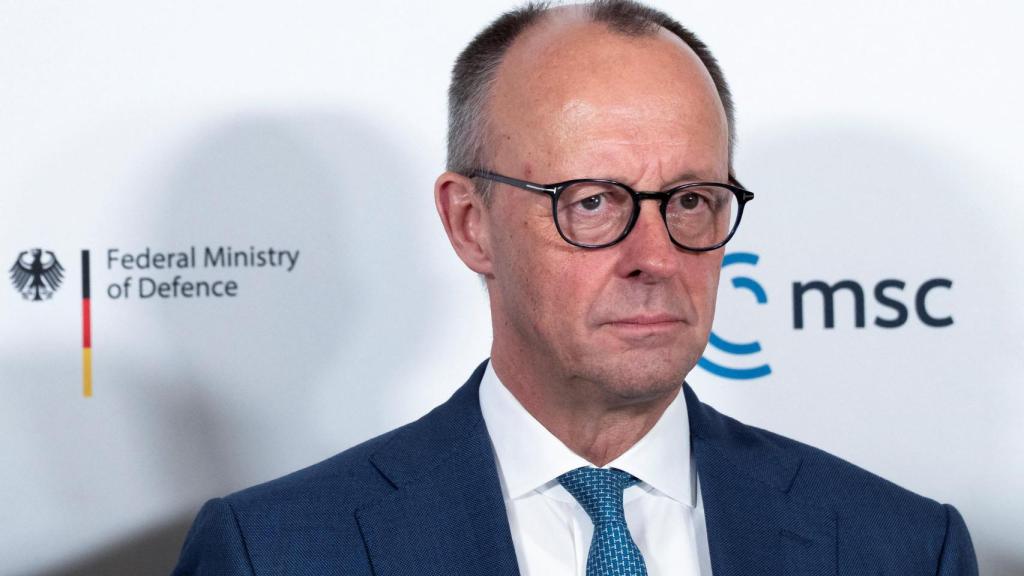
Chancellor Friedrich Merz at the Munich Security Conference
Even so, Berlin continues to believe it is possible to rebuild the link between the EU and the US. In Munich, Rubio has also called for recovering transatlantic unity, although he made it clear that, in his vision, Europe should align itself with Trump’s policies: fight against all types of migration, questioning of international organizations or end of the green agenda.
“We, in the United States, have no interest in being the polite and orderly guardians of the organized decline of the West“said Trump’s Secretary of State.
“We must regain control of our national borders. Controlling who and how many people enter our countries is not an act of xenophobia. It’s not hate. It is a fundamental act of national sovereignty. And not doing so (…) is an urgent threat to the fabric of our societies and to the very survival of our civilization,” says Rubio.
“And, finally, we can no longer put the so-called global order above the vital interests of our people and our nations,” the head of US diplomacy concluded.
Leave a Reply