
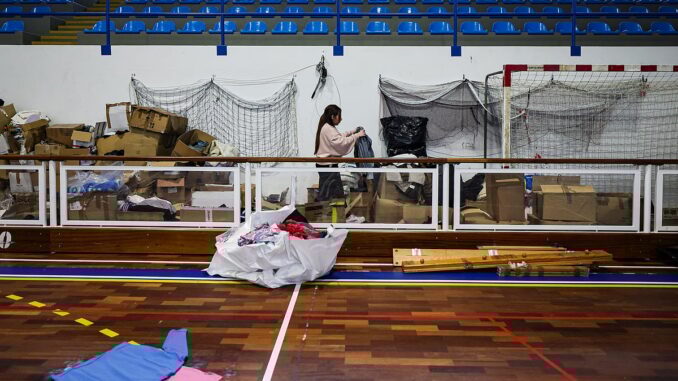
Social Security’s intervention during the storms, with the mobilization of more than 200 technicians from the Social Security Institute (ISS), provided support to 1,537 homeless people, as announced this Saturday, February 14th.
In a statement, the office of the Minister of Labor, Solidarity and Social Security states that “there was also a need, by Friday, to evacuate and relocate 22 institutions, mostly residential structures for the elderly (homes), covering a total of 1,347 users”.
Among the audiences monitored, Social Security highlights elderly people, people with limited mobility, people with sensory, intellectual or developmental disabilities and children and young people at risk.
“From the first moment until now, more than 200 ISS technicians have been mobilized, who have formed part of operational teams, with permanent response capacity, operational flexibility and immediate reinforcement, whenever the evolution of the situation warrants”, he states.
In relation to the 1,537 displaced people, the minister’s office explains that Social Security is coordinating and ensuring technical and social support to seven Population Concentration and Support Zones (ZCAP) by providing safe temporary accommodation; food and essential goods; hygiene and comfort conditions; emergency psychosocial support, among others”.
The aforementioned ZCAP are two in Marinha Grande, one in Ourém, two in Alcácer do Sal and two in Coimbra.
“In the most affected districts, and in partnership with institutions, Social Security teams have visited elderly beneficiaries of Home Support Services, in order to keep the territory mapped in case of need for intervention”, says the statement, adding that “Residential Structures for the Elderly are also contacted daily, corresponding to around 6 thousand contacts already made”, it adds.
Social Security has already received responses from 7,103 institutions to a national survey to map needs.
“In partnership with INE, the ISS teams mapped all institutions (ERPI and Residential Homes) with proximity, by level of risk, to the flood bed, to inform Civil Protection about possible risks”, he adds.
The statement highlights that according to the specific needs of the affected populations identified by the local authorities, Social Security teams adjust social responses and provide training in psychosocial support to municipal teams that request it.
“Social Security maintains teams on the ground operating 24 hours a day, in permanent coordination with Civil Protection structures, local authorities and social solidarity institutions, ensuring uninterrupted social responses and close monitoring of populations in situations of greater fragility, in a continuous effort to mitigate the impacts of bad weather”, he adds.
Leave a Reply