
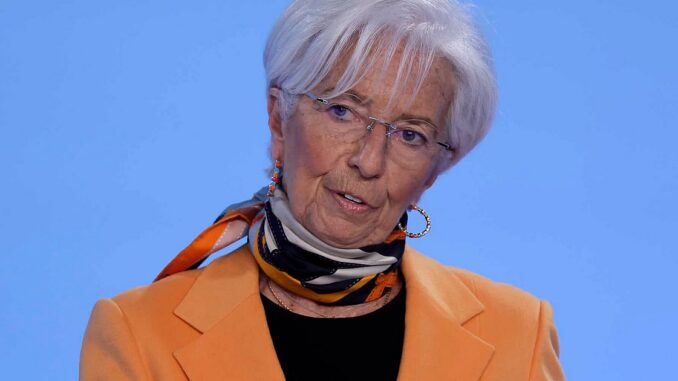
The president of the BC, Christine Lagarde, recommended this Saturday, the 14th, that Europe make a transition to gain greater “strategic autonomy” in supply chains, because trade is not only an economic issue, but also a security issue.
The leader of the European Central Bank (ECB) was speaking at the 62nd Munich Security Conference, at a round table on commercial dependencies and supply chains around the world, where she highlighted that the euro zone’s monetary authority needs to be prepared to act in a more volatile economic environment.
“We are the most open of the large economies. Now, we must transition to strategic autonomy”he defended, referring to supply chains.
“In a world where supply chain dependencies have become security vulnerabilities, Europe must be a source of stability – for ourselves and for our partners”, he highlighted, considering that “this is also part of European security”.
Lagarde began her intervention by saying that the fact that a banker was speaking at a security conference about supply chains “is a sign of how our world has changed”, because if this happened a decade ago it would seem like a mistake but today everyone “recognizes that trade is as much a security issue as it is an economic issue”.
For the president of the ECB, Europe must prepare its strategic autonomy by focusing on three axes: independence, indispensability and diversification.
The first involves “rebuilding internal supply chains in critical technologies and consumption to reduce external dependence”, the second means “developing strengths in critical ‘indispensable’ areas of these supply chains” and the third represents “distributing supply chains among partners so that no isolated interruption can paralyze” the economy, Lagarde detailed.
“Economic interdependence has deepened substantially in recent decades, creating complex networks of cross-border trade flows. What was once seen as a source of stability is now a source of vulnerability: from global disruptions like the pandemic to the deliberate use of dependencies as a weapon,” he said.
According to ECB data cited by Lagarde, “a sudden 50% drop in supply from geopolitically distant suppliers would reduce the added value of the manufacturing industry [europeia] by 2 to 3%, with the impact concentrated on electrical equipment, chemical and electronic products”.
Lagarde also warned that “depending exclusively on trade – even within the framework of alliances – also carries risks”, because “trusted partners do not always remain with you”.
“In some critical sectors, we need to develop internal capacity, even if this is temporarily more expensive”, he pointed out.
Christine Lagarde also said that “the ECB needs to be prepared for a more volatile environment”in which industrial policy is “more assertive”, in which “geopolitical tensions increase” and “supply chains are interrupted”, because in this scenario “stress in financial markets is likely to become more frequent”.
“We must avoid a situation in which this stress causes hasty sales of euro-denominated securities in global funding markets, which could harm the transmission of our monetary policy”, and it is necessary to create “confidence that there will be liquidity in euros available, if necessary”, he explained.
Leave a Reply