
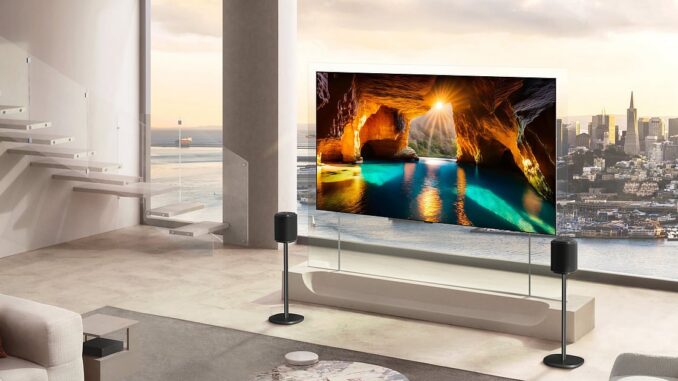
For years, the technology industry has sold us the idea that “more is better.” However, the next logical step in image definition – 8K – appears to have hit an insurmountable wall of physical and economic reality.
The clearest sign of this decline emerged recently with LG’s decision to abandon the production of 8K panels, marking the end of an era of promises that never came to fruition.
The big barrier to 8K’s success is not just the price, but human biology itself. With around 33 million pixels, an 8K television offers four times the density of 4K, but under normal viewing conditions (sitting two or three meters from a 65-inch screen) the human retina is simply unable to distinguish the additional detail. 4K has reached sweet point of perception: the limit where the image is so sharp that the increase in resolution is imperceptibleunless the user gets so close to the panel that the experience becomes uncomfortable.
Essentially, 8K would only make sense on screens so colossal that most living rooms wouldn’t have the space to accommodate them.
Content desert
Even if the human eye could see the difference, there would be nothing to see. The 8K content market is a desert. The services of streaming struggle to deliver high-quality 4K without tying up bandwidth, and streaming in 8K would require astronomical network speeds and storage costs. Even Hollywood took a step back, given that 8K only represents a residual 0.1% of the total television market.
As 8K languishes, the balance of power in video production hardware changed drastically. One of the most significant movements in the sector was the sale of Sony’s Bravia television segment to the Chinese TCL. This transition highlights a new reality: the dominance of Chinese manufacturers which, instead of chasing resolution at all costs, focus on new panel technologies and the massive scale of giant screens (over 100 inches) that maintain 4K resolution.
The future: precision in brightness, color and HDR
The new frontier is now “dynamic quality”. The industry is currently investing in technologies such as Mini-LED and Micro-RGB, which allow for deeper blacks and intense brightness. Formats such as Dolby Vision 2 and HDR10+ Advanced become the new standards, ensuring that the image is adjusted in real time according to the light in the room.
In short, LG’s departure and Sony’s strategic change confirm that 8K was a solution looking for a non-existent problem. For the average user, the future will not be defined by how many pixels fit on the screen, but by the beauty and realism with which each one shines.
Leave a Reply