
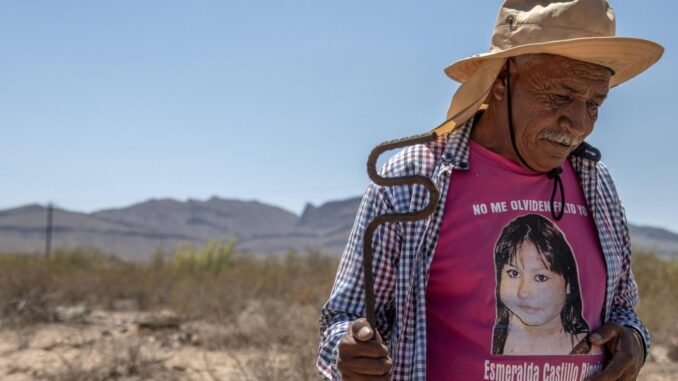
In Ciudad Juárez, one of the cities most affected by violence in Mexico and now targeted by international justice, families continue searching for hundreds of missing people. Without institutional support and under constant threats, the case of Esmeralda Castillolike that of other women in the city, reflects the high price that families pay to search for a daughter in a territory marked by impunity.
The recent ruling of the Inter-American Court of Human Rights against the Mexican State once again puts the spotlight on impunity in Ciudad Juárez. In that same scenario, Esmeralda Castillo’s family continues, searching for the fourteen-year-old girl. disappeared in May 2009 while on her way to school. A story that, unfortunately, is not foreign to this border city, marked for decades by disappearances and femicides.
Since the 1990s, Juárez has become the epicenter of violence against women in Mexico. A problem that has expanded throughout the territory, placing the country as one of the places with more people missing around the world. Behind every girl or woman who does not appear there is a mother who is looking for. Relatives who stand as an international symbol of the fight against impunity. Without resources and under threats, they travel through the most violent areas to find their daughters, granddaughters or nieces.
It is six in the morning and the sun is just beginning to rise in Ciudad Juárez. Despite the hour, the heat is pressing. Temperatures are expected to exceed 40º C throughout the day. In front of the State Attorney General’s Office building, several vans pick up of the ministerial police wait alongside forensic experts and volunteers from the Mexican Red Cross. They are prepared to escort relatives on a new day of searching.
A member of the Armadillos International search group unloads bottles of water for volunteers, next to a bus covered with a tarp that shows the faces of Esmeralda and the 43 missing students from Ayotzinapa.
The operation puts heading to El Navajo streama place known for the frequent discovery of human remains, where countless searches have been carried out for more than a decade. “It is a storage area to hide bodies, not an execution area. In this entire valley, wherever you search, you will surely find something,” explains one of the experts.
Relatives and volunteers, including the Armadillos International search group, board a bus covered with a tarp that shows the faces of Esmeralda Castillo and the 43 missing students of Ayotzinapa. A case that shocked Mexico in 2014, when 43 students from the Ayotzinapa Rural Normal School, in Guerrero, disappeared after being intercepted by police forces and members of the army.
At the same time, the Todos Somos Erick Carrillo Foundation is preparing in its van, which has arrived from Tijuana. Minutes later, the vans escort the vehicles to the search area, an hour from the city. On the way, the convoy passes through El Porvenir, a town with hundreds of empty houses since the exodus of its neighbors in the harshest years of organized crime.
Near Loma Blanca, another town on the route, several municipal police patrols surround a truck with three charred bodies inside. A few kilometers further on, a National Guard checkpoint warns that, from there, security is not guaranteed.
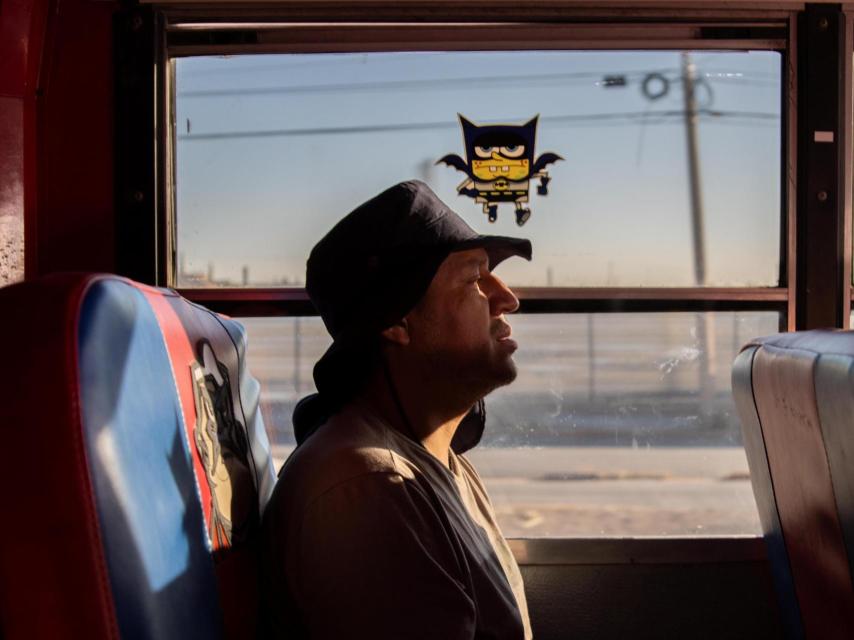
Esmeralda’s cousin watches silently from the bus that transports family members and volunteers to the tracking area, an hour south of Ciudad Juárez.
After traveling several dirt roads, the vehicles stop in an arid and desolate place. Some break camp; others go into even more remote areas together with the ministerial police. There are no trails, only desert.
“We come because it is presumed that they found the remains of my daughter here,” he explains. Jose Luis CastilloEsmeralda’s father, on board the vehicle. With his gaze fixed on the horizon, he adds: “Here they come and throw them just like that, in the open air.” Sitting in the back, with the sun caressing his face, he remembers the day it all began. “I insisted my daughter go to school, although she wanted to stay and take care of me because I was sick. We told her to go alonethat nothing would happen, and since then I have not seen her again,” he says.
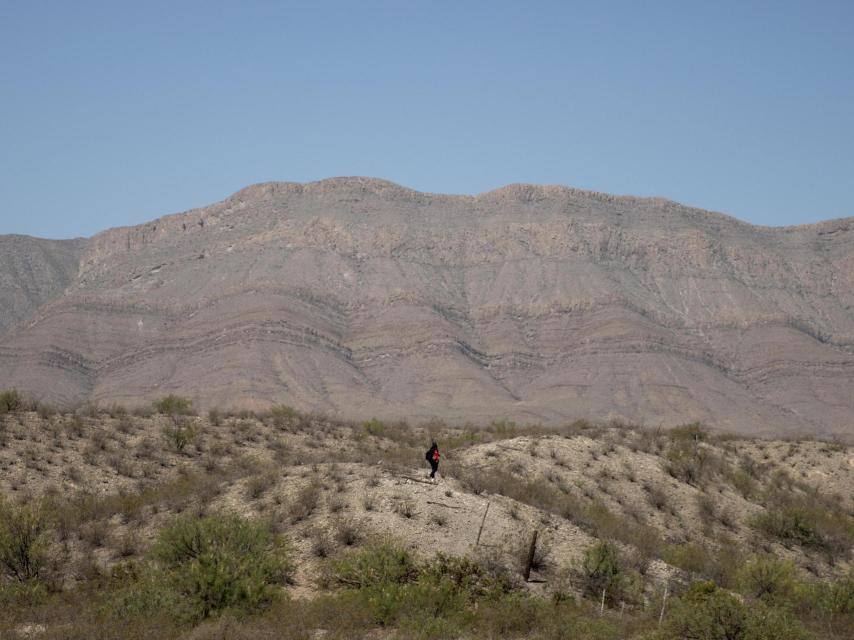
Family members and volunteers travel on foot through the Chihuahuan Desert, where temperatures exceed 40 degrees, during a tracking day organized by Esmeralda’s family.
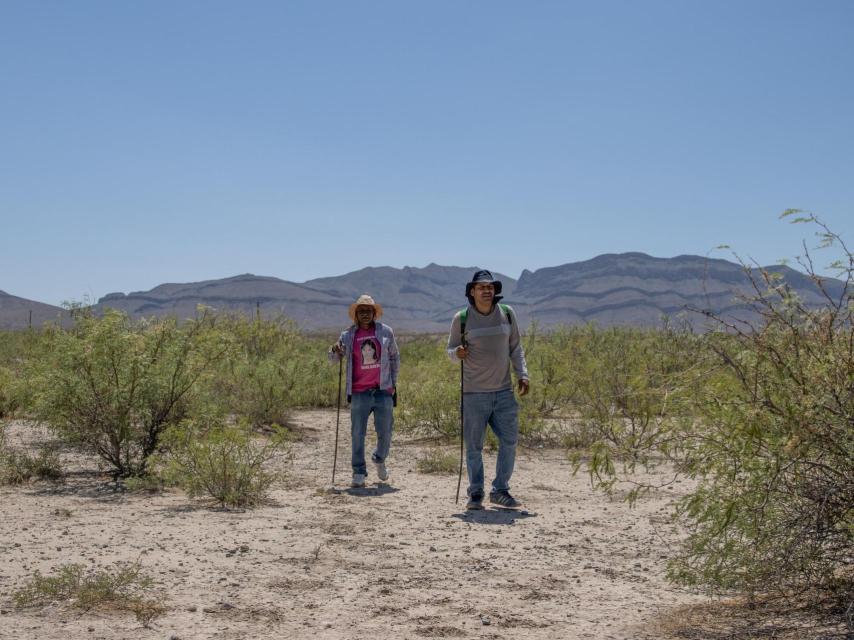
José Luis Castillo and his nephew inspect the land with metal rods, a technique used to detect disturbed earth or the smell of human remains decomposing under the ground.
After the authorities refused to accept the complaint in the first 48 hours, the family was forced to undertake the search on their own. Since May 19, José Luis has not stopped searching for a single day, despite the difficulties. “They threaten us daily”he maintains. And he assures that when they went to present the complaint to the Attorney General’s Office, they were informed that the calls came from the state government itself. “The authorities want to intimidate me, scare me into silence. And yes, I am afraid, but I am going to continue looking for my daughter,” he says.
your sister Juliet He has also suffered threats during these years. “They constantly call me to tell me that they are going to kill me, they are going to dismember methat they are going to leave my body lying in the street. In 2021, they left a human-shaped work monkey at the door of my house, next to a sign that said that this is how we would end up if we kept searching.” But she is not willing to give up either: “Even if our lives pass away in it, we are going to continue. For Esmeralda and for all the disappeared people of Juárez.”
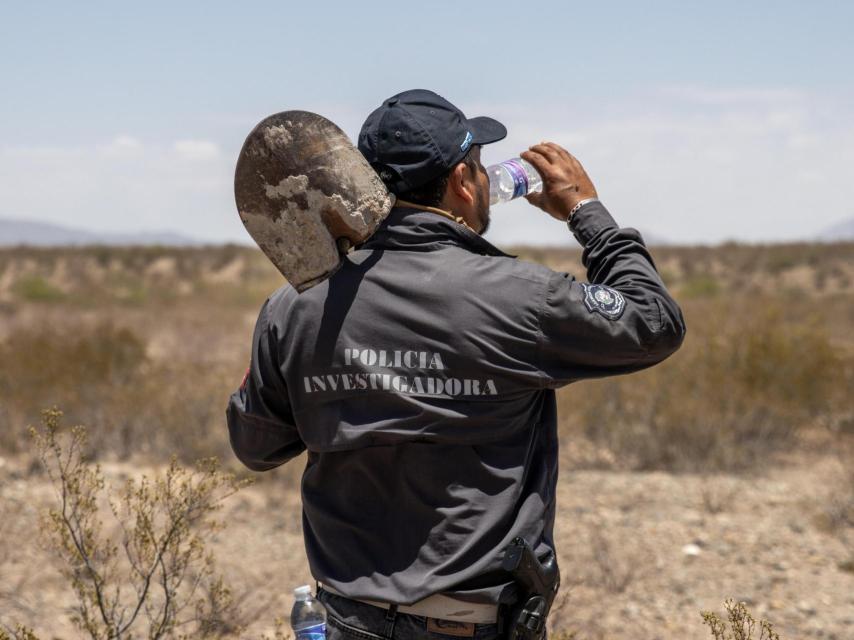
Under the intense desert sun, an investigative police officer prepares to continue the search in El Navajo Creek, carrying the tools necessary to dig in the arid terrain.
The battle against oblivion
At eleven in the morning the sun falls relentlessly on the Chihuahuan desert. The search continues within a ten kilometer radius when, suddenly, a whistle breaks the silence. A family member approaches one of the agents and says: “I didn’t want to touch anything, but I saw something. Is it women’s clothing?“. The authorities alert the experts: “There are clothes here!” Among the bushes, they find several pieces of women’s underwear. The experts photograph them and they collect them as possible evidence.
During the search day he also attended Norma Andrademother of Lilia Alejandra Garcíamurdered and tortured in Ciudad Juárez in 2001. Andrade has been demanding justice for the feminicide of her daughter for more than two decades, a fight for which she has suffered attacks and threats. On December 19, the Inter-American Court of Human Rights declared the Mexican State responsible for not preventing or investigating the crime, as well as for not having protected her or Lilia Alejandra’s children.
With shovels and iron rods, family members and volunteers continue to comb the land. They stick the sticks into the ground, searching for removed zones or traces of decomposition through the smell given off by the tip. Later, they find a bag and several t-shirts. Pearl CastleEsmeralda’s sister, explains that this is already the fifth search they have done in the stream. “The physical and emotional exhaustion is very great,” he laments, and criticizes that the Government has done nothing. “My father is the one who insists and pressures for the experts to come,” he details.
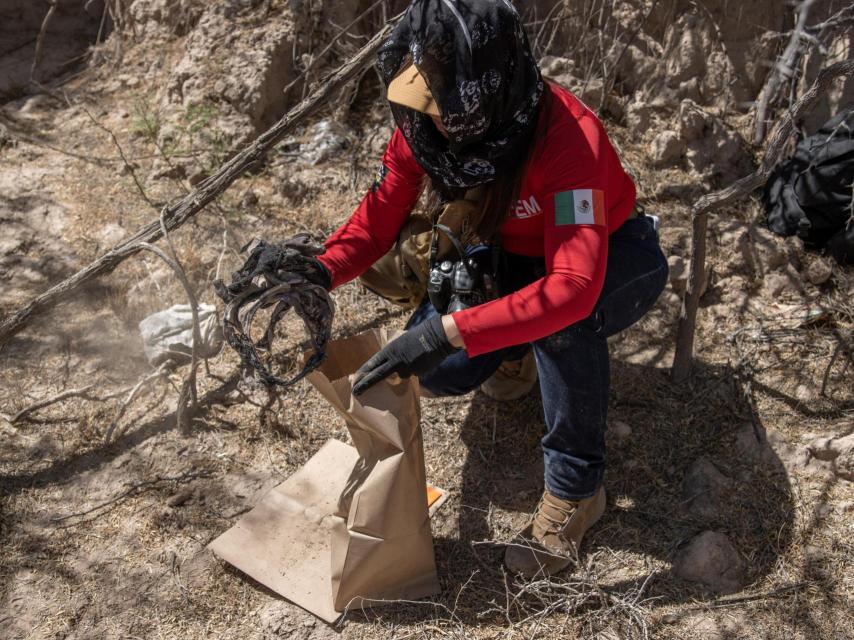
An expert from the Special Prosecutor’s Office for Women (FEM) of Ciudad Juárez collects pieces of women’s underwear found in the bushes during the search operation
José Luis Castillo agrees that the authorities have been the main obstacle to finding his daughter. “They don’t inform us, they don’t follow the leads. Even we have to pay for the tracking,” he says. For their part, the authorities recognize that the high number of disappearances has engulfed Mexico in a forensic crisis which makes investigations difficult.
“When there are arrests and intelligence work, you can reach specific points where there are graves. But this is like looking for a needle in a haystack,” say the forensic experts. They are also aware that families’ distrust comes from institutional abandonment in previous years. However, they say, they are working to change this situation and regain lost trust.
Despite the promises reiterated by different governments, José Luis and his family They have not seen progress for years. What began as a local problem has become a national crisis of impunity, with more than 100,000 people missing across Mexico. Meanwhile, those looking for their loved ones continue to travel the desert and move the earth with their own hands, waiting for an answer in the midst of so much silence.
Leave a Reply