
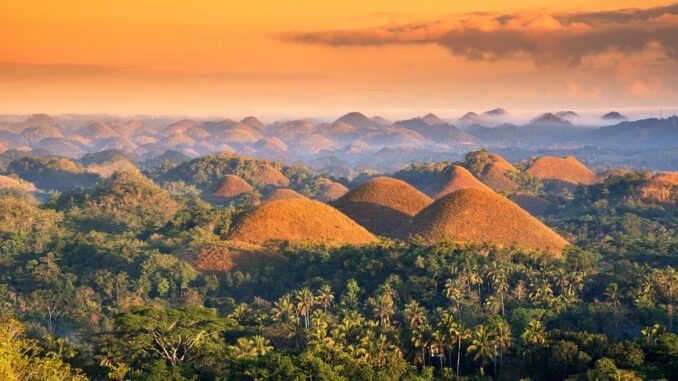
FAST FACTS
Name: Chocolate hills
Location: Bohol, Philippines
Coordinates: 9.8297, 124.1396
Why it’s incredible: The hills change color with the seasons, inspiring legends that giants created mud mounds.
The Chocolate Hills are a formation formed from 1,776 limestone, grass-covered hills in the Philippines.
The Chocolate Hills were designated as a National Geological Monument of the Philippines in 1988 and granted protection as a Natural Monument in 1997. There is no similar formation in the world that resembles them, only one area in Java, Indonesia does similar but less impressive geology.
The hills are between 100 and 390 feet (30 to 120 meters) high and have tapering peaks. They are examples of what geologists call “mogotes” – steep-sided hills that occur in tropical karst landscapes or areas that have soluble bedrock and host sinkholes and cave systems. Many underground caves and springs have been documented around the Chocolate Hills, according to a 2001 research paperwith some caves potentially existing directly beneath the mogotes themselves.
Evidence suggests that the Chocolate Hills were formed sometime early or shortly before the last ice age (2.6 million to 11,700 years ago), when tectonic processes uplifted coral and other marine deposits. These deposits were then exposed to rainfall and erosion, which cut the landscape into regular mounds.
Local myths tried to explain how the Chocolate Hills came to be. According to one legend, the mounds were formed after a fight between two mud-throwing giants. Another tale says that the region was once inhabited by giant children who, competing to make the most mud, baked them under coconut shells, which eventually became the Chocolate Hills.
The land between the hills is flat and cultivated with rice and other crops. When the Chocolate Hills were declared a natural monument in the late 1990s, farmers, small-scale miners and landowners rose up against the government, fearing that environmental protection would limit their property rights and livelihoods.
These protests, according to a 2001 article, escalated into violent conflicts between the military and a guerrilla group dubbed the “Chocolate Hills Command”. There were two armed clashes, one of which left 10 dead in October 1999.
Balancing the diverse and sometimes conflicting needs of environmental protection, tourism and local residents is still a challenge today; and resort construction in the middle of the Chocolate Hills caused a public outcry in 2024.
Discover more incredible placeswhere we highlight the fantastic history and science behind some of the most dramatic landscapes on Earth.
Leave a Reply