
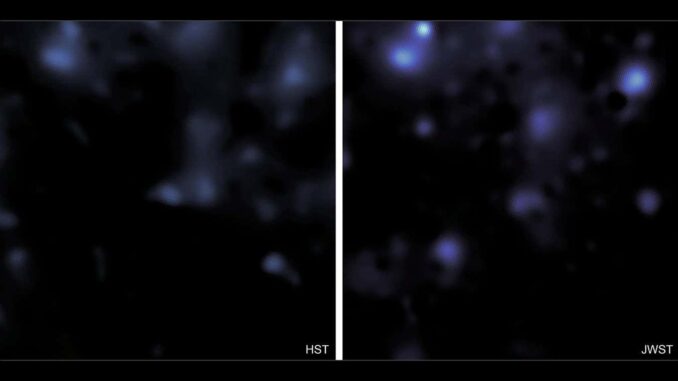
The distribution of dark matter as observed by the Hubble Space Telescope (left) and the James Webb Space Telescope (right)
Dr. Gavin Leroy/Professor Richard Massey/COSMOS-Webb Collaboration
Using subtle deformations in the shape of about 250,000 galaxies, scientists have created the best map of dark matter to date. It could help us understand some of the biggest mysteries in the universe.
Dark matter is extremely difficult to map because, true to its name, it emits no detectable light. It only interacts with ordinary matter through its gravity, so that’s what researchers use to figure out where it is. Jacqueline McCleary at Northeastern University in Massachusetts and her colleagues used the James Webb Space Telescope (JWST) to survey an area of the sky slightly larger than the full moon.
“It’s a very high-resolution image of the scaffolding of this little corner of space,” says McCleary. The resolution of the map is about twice that of previous Hubble Space Telescope images and includes structures much farther from Earth.
To create this map, scientists examined the shapes of about 250,000 galaxies – but it’s not their inner shape that’s interesting. “These galaxies are basically cosmic wallpaper,” he says Liliya Williams at the University of Minnesota, who was not involved in the analysis. What matters instead is how the gravity of the dark matter between the telescope and the “wallpaper” distorts the galaxy’s light, in a process called gravitational lensing: the further the average shape of distant galaxies is from a circular one, the more dark matter lies between them and us.
By analyzing these differences in shape, scientists have mapped vast clusters of galaxies along with the fibers of the cosmic web that connects them. Some of these structures did not match anything we had previously seen in regular or luminous matter observations, suggesting that they must be dominated by dark matter. “For identifying many of these structures over a wide field, gravitational lensing is one of the very, very few techniques and certainly the best,” says Williams.
This is important because dark matter makes up about 85 percent of the total matter in the universe, so it is crucial to the evolution of not only galaxies and galaxy clusters, but the universe as a whole. Creating a map of its distribution could help us figure out how it behaves and what exactly it’s made of, Williams says.
“This is not only an observational revolution, but it will enable many other analyses—constraints on cosmological parameters, the connection between galaxies and their dark matter halos, and how they grow and evolve over time,” says McCleary. These cosmological parameters include the force of dark energy, the mysterious force causing the universe to expand at an accelerating rate.
For now, the JWST map appears to fit our current standard model of the universe, known as lambda-CDM, but there is much more to be done in-depth exploration of the data that will surely yield new insights, McCleary says. “Although lambda-CDM is the answer at first glance, I’m not giving up yet – I’m withholding judgment until our analysis is complete.”
topics:
Leave a Reply