
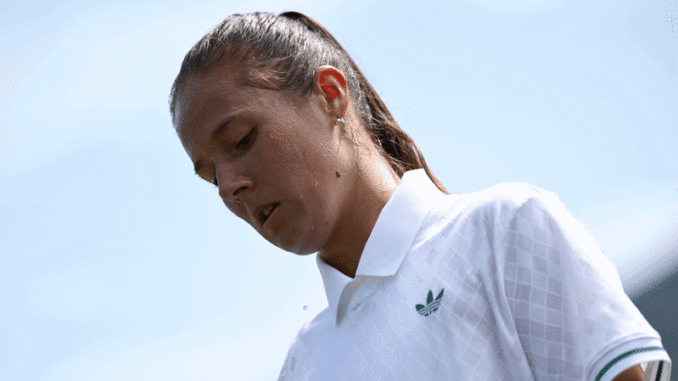
Not long ago, Daria Kasatkina lost all sense of who she was. She lost the desire to be on court, to travel from tournament to tournament, to speak to the press, to play the role she was accustomed to playing. She even lost her hair. Kasatkina had been on the women’s professional tour for 11 years. Travelling, training, competing, recovering and repeating, and she could no longer take it, so in October 2025, she decided she wouldn’t. She would end her season instead. Immediately.
“The first three weeks of my break were -actually terrible,” she says via video call from Barcelona, where she trains. “Even though I was resting, taking a break, the first three weeks I couldn’t understand what’s going on. Who I am, what am I doing?”
When we speak, it’s been almost six weeks since Kasatkina has touched a racquet. The tennis tour continued without her – the tour always continues – but the 28-year-old had tuned out from the game she loves. “I felt that I completely hate what I’m doing,” she says. “I don’t want to be out there.”
It was a hard truth for someone who, at one point, was ranked as high as world No. 8 and had enjoyed success on tour since turning pro in 2014. Kasatkina has won eight titles, her first at Charleston, South Carolina in 2017, on clay – her preferred surface. She won the Billie Jean King Cup with the Russian team in 2021, and reached a maiden grand slam semi-final at Roland Garros in 2022. That’s more highs than enjoyed by most.
Daria Kasatkina celebrates after qualifying for her first grand slam semi-final at the French Open in 2022.Credit: Getty Images
But towards the end of 2025, the lows were much more common. On court, things were falling apart. She was losing matches she would typically win, against opponents ranked much lower than herself. For the first time since 2019, her season losses (22) outnumbered her wins (19).
Off-court, meanwhile, she was breaking. “The last couple of years, they were pretty harsh,” she notes. “At the beginning, the first two, three years I was able to handle all of this pressure and the situation and the environment … but after three-and-a-half years, I realised that I am cracking.”
The “situation” she’s referring to is the war in Ukraine, and her criticism of the Russian invasion. It is also her coming out as gay in 2022, in a country where same-sex marriage is banned and discrimination against LGBTQ+ people is common. It’s not seeing her father Sergey for almost four years, due to the war in Ukraine and the fear of returning home. It’s missing every birthday and wedding due to the demands of the tennis schedule, to the point people just stop inviting you. And it’s the expectation she can put all that to the back of her mind, step on court, and win matches.
At some point she realised she could not keep pushing because, if she did, the break she might need from tennis would be longer, more pronounced, and indefinite, than the break she engineered for herself in 2025.
As if to hammer the point home, she leans into the camera to show me – and her agent, John Morris, who’s also on the call – a small thatch of feathery hair at the top of her temple. Kasatkina been so stressed during the past four years that, at one point, a patch of her hair stopped growing. “This says a lot,” she says, pointing to the tuft. “A lot.”
When you consider how many years it took Kasatkina to get to this point, it’s actually amazing she lasted this long. Her career ostensibly began in 2011 when she was just 14. Now 28, she’s been on tour for half her life.
Originally from Togliatti in western Russia, where residents are closer to the border with Kazakhstan than to Moscow, Kasatkina spent her early years with a racquet in her hand, first starting the sport when she was six.

Daria Kasatkina poses with her 2014 Roland Garros girls’ champion trophy.Credit: Getty Images
She had a successful junior career, but really burst onto the scene with victory in the Roland Garros juniors in 2014 among a (now) star-studded draw that included 2023 Wimbledon champion Markéta Vondroušová, 2017 French Open champion Jelena Ostapenko, and 2020 Australian Open champion Sofia Kenin. In February that year, she entered the Women’s Tennis Association rankings for the first time, as the 1059th-best player in the world.
Kasatkina is still chasing that elusive grand slam final appearance – and victory – as an adult, but her consistency is envied by other players, too. If you don’t take her first year into account, she has been ranked well inside the top 100 for more than a decade. Take a closer and more recent look and she’s been one of the best 20 players for four consecutive seasons.
It’s why Ash Barty called her a “prodigy and a tough opponent” in her 2022 memoir My Dream Time, when referring to their 2018 match at Wimbledon, where Kasatkina denied and frustrated Barty, taking control of every point, until the Australian imploded. It was a match in which Barty famously melted down, and a display of mental fortitude that eventually prompted her to seek out mindset coach Ben Crowe. On court, Kasatkina is like a brick wall, and incredibly serious during matches. Watching her, you would never suspect she’s the same player who once joked that French fries were her secret to success at the French Open.
“She’s obviously incredibly consistent,” says former world No. 4 Jelena Dokic. It’s hard for any player to come up against the power of Aryna Sabalenka, Iga Swiatek or Coco Gauff, but outside of those, says Dokic, the metronomic reliability of Kasatkina makes her a handful, adding it’s hard to pick a spot to hit the ball that will make her uncomfortable. “An incredible fighter as well as a competitor, and just really hard to actually feel like you can get through her with any kind of weakness,” says Dokic. “And unless you’ve got massive power to be able to really get through her and win points, and overpower her, you’re in trouble.”

Daria Kasatkina at the 2025 US Open. Credit: Getty Images
But that kind of grind and consistency – across so many years – comes at an evident cost. Kasatkina played more than 60 matches in each season in 2022, 2023 and 2024. In 2024 alone, she played in 14 countries across four continents. That’s a lot of matches. Probably too many.
“Honestly, I think we’re pretty good at pretending that we’re going great and we’re not tired,” Kasatkina says of her peer group. “But it came to the point where we cannot pretend any more, and in the past couple of years, the calendar, the tennis structure of the tour changed a lot compared to what we had six, seven years ago.”
Indeed, when I spoke with her two years ago, ahead of the 2024 Australian Open – me in a meeting room in North Sydney, Kasatkina in the media room at Melbourne Park – she more than conceded the demands of the tour were overwhelming. Listening back to her quotes, her sabbatical seemed inevitable.
“It’s an individual sport. On court, you’re alone,” she said at the time. “You spend a lot of time by yourself, and basically travel so much. You’re almost never at home. For some people, they enjoy, they like it. But some people are struggling with that; I am one of the persons who, I would say, is struggling more. For me, it’s difficult to be always on the road, to change your bed every single week, to pack stuff. It’s kind of challenging.”

Daria Kasatkina during her second round match at the 2024 Australian Open against Sloane Stephens of the United States.Credit: AP
She’s certainly not alone. In 2025, Kasatkina was one of a number of players to end their season early, in a year of unprecedented burnout and injury.
Controversial Australian Open crowd favourite Danielle Collins stopped competing after the US Open in September, as did Ukrainian Elina Svitolina and Spaniard Paula Badosa. Swiatek and Sabalenka – the top two female players – both criticised the unrelenting schedule, in which tournaments become longer and longer.
“They’re saying that it’s good because you have more rest between the matches on the tournament, but we are still on the tournament, we’re still at our office, at the working place, we’re not at home resting,” Kasatkina says. “OK, we can recharge physically from the matches, but mentally we’re still on our duties, we have to do all the procedures. We cannot just relax. It’s impossible.”
You can hear the fatigue and exasperation in Kasatkina’s voice when she talks about it. She’s frustrated. And it’s not just pressure to win that weighs heavily, she adds, but also the fear of fan abuse on social media. “Some people it affects more, some less, but at the end of the day, even the strongest player, they’re getting these messages,” she says. “Obviously, you’re getting upset when someone is sending you a message saying they’re going to kill you.”
It’s difficult to imagine Kasatkina as someone who was struggling to get through each day, who could feel fundamental parts of herself changing, but didn’t know how to move forward. In part that’s because it’s incongruous with the personality fans have come to know. The girl who bounces around the locker room and practice courts interviewing fellow players for social media, tiny microphone in hand. The kind of competitor who jumped on the presentation stage in China in 2024 to comfort a 17-year-old Mirra Andreeva after the Russian teenager broke down, having lost to Kasatkina in the Ningbo Open final.
Kasatkina is the comic who stepped on court at the 2023 US Open and told an interviewer that she had prepared for her match against Sabalenka by thinking how to promote her YouTube channel, staring down the camera with a call to subscribe: “Just search my surname on YouTube and you will find it,” she said. “In case the match isn’t going to be interesting, you can always go watch the YouTube.”
Kasatkina is, says Dokic, one of the nicest players on tour. The kind of player who stops her opponents at tournaments just to say hi, no matter how many times she’s seen them that day. Even with me – someone she has never met in person, and who wanted to discuss the most intimate and personal parts of her life – she was patient and thoughtful. Every answer appeared genuine and considered. When our time was up she stayed online, indulging my apologetic: “Sorry, just one more thing”, again and again.
How did things reach the point where she couldn’t continue?
Well, within six months of the Russian invasion of Ukraine on February 24, 2022, Kasatkina condemned the war and spoke openly about being gay, in a wide-ranging interview with Russian blogger Vitya Kravchenko. The conflict, she said, was a “full-blown nightmare”. At a time when many fell silent, Kasatkina condemned the displacement of Ukrainians, ruminating on the agony of not having a home to return to, while effectively giving up her own, too.
The tumult is hard to overstate. Two weeks earlier, she had been banned from playing at Wimbledon due to the invasion, along with all other Russian and Belarusian athletes, but had also just come off a career-best run with a semi-final appearance at the French Open.
The tennis tour marched on, and so, too, the invasion, along with Kasatkina’s rich vein of form. She won her fifth and sixth career titles – in San Jose and Granby (Canada) – in August that year, with Sabalenka, Badosa and Elena Rybakina among the opponents she tossed aside along the way. She moved back inside the top 10.

Daria Kasatkina with her San Jose trophy alongside partner Natalia Zabiiako.Credit: Getty Images
The next week, she lost in the opening round of the US Open – the same month Russia announced a partial mobilisation of its citizens. Kasatkina finished the year ranked world No. 8 and qualified for the prestigious WTA finals, where only the top eight female players are -invited to compete.
As the situation at home in Russia began weighing ever more heavily, her agent Morris took the first steps to ease what pressure he could by approaching Tennis Australia chief executive Craig Tiley about a nationality switch, but no action was taken.

Daria Kasatkina at the 2025 Australian Open – her final slam playing under a neutral flag before her nationality switch in March.Credit: Getty Images
Kasatkina had all but given up hope on becoming an Australian when Morris put the question to the organisation once more at the 2025 Australian Open. This time, action was swift.
Tiley communicated with the Department of Home Affairs, supplying Kasatkina with a letter supporting her application for “people who have an internationally recognised record of exceptional and outstanding achievement in an eligible area”. When she stepped off the court at the Miami Open, -following a round-two defeat to Hailey Baptiste in March, no one but a small group of insiders knew Kasatkina would be walking out at the Charleston Open a week later as an Australian.
“Welcome mateee!” These were the words Australian doubles legend Rennae Stubbs left on Kasatkina’s Instagram post confirming her nationality switch on March 29, and she wasn’t the only one to leave words of support. Australian fans began welcoming her to the “best country in the world” – a place where the Pride flag has been marched across the Harbour Bridge and where the sails of the Sydney Opera House have been lit up with its image.
Kasatkina played her first match (and won) under the Australian flag on April 3, 2025, on a 30-degree day reminiscent of the conditions in which Aussies thrive come January at Melbourne Park. How was her first match as an Australian? Stressful, but reporters at her press conference were greeted with trademark warmth: “What’s going on … mates?”
Yet swinging from lows to highs is sometimes perilous, too. “Honestly, I was over the moon, I was so happy, but sometimes you just don’t know,” she says. “Things like this can make you feel up, or sometimes can make you go down mentally. Unfortunately in my case, it was more difficult mentally.”

Daria Kasatkina celebrates her first match as an Australian with a win against Lauren Davis of the United States at the Charleston Open on April 2, 2025.Credit: Getty Images
It was, and is, painful for Kasatkina that the country of her birth – the place she grew up and where her parents still live – does not accept her. In 2020, Russian President Vladimir Putin moved to have his country’s constitution amended to define marriage as between a man and a woman. In 2023, Russia’s supreme court labelled the LGBTQ+ movement as extremist.
When Kasatkina came out in 2022, she was only the second professional Russian athlete to do so, after soccer player Nadezhda Karpova earlier that year. “This notion of someone wanting to be gay, or becoming one – so ridiculous,” Kasatkina said at the time. “I think there’s nothing easier in this world than being straight. Seriously, if there is a choice, nobody would choose being gay. Why make your life harder, especially in Russia? What’s the point?”
When does she think it would be OK for her to hold hands with her partner in her homeland? The answer, she says, is “never” – which is why she is in equal parts grateful to Australia and heartbroken by Russia.
‘I want to be myself. We’ve only got one life, so I want to live it as best as possible with the person I love.’
Daria Kasatkina
Kasatkina is not going to deny her past, sever her connection to Russia, or forget where she grew up, but the move to Australia was necessary. “I want to be myself,” she says. “We’ve only got one life, so I want to live it as best as possible with the person I love. And, if I had to make this decision to be fulfilled, this is what I’m going to do.”
Sometimes – often – she wonders why. Why does it need to be this way? Why does she have to go through so much pain? “It’s unfair, but I cannot do anything about it,” she says. “If one place is not accepting me, I have to find a place where I will be accepted.”
In this, too, Kasatkina is not alone. Australia has a history of taking in Russian and Central European tennis players. Daria Saville, Arina Rodionova and Ajla Tomljanovic are among some of the best-known. But it takes more than a diplomatic switch and a new flag to make someone feel like an Australian.
“Something changed in me. From the moment it happened, I didn’t feel the same as I did before, that’s true,” Kasatkina says. “But I have to be honest here, I wasn’t born in Australia, I didn’t watch the cartoons which all the kids were watching when they grow up … It’s not something which happens overnight.”

A fan holds a handmade sign for Daria Kasatkina at the 2025 French Open.Credit: Getty Images
It is, however, a transition made much easier by the willingness of Australians to accept “Dasha”, as she’s known, as one of their own. They’ve been turning up to support her since the announcement in late March, with chants of “Aussie, Aussie, Aussie” echoing throughout stadiums. Inside the tennis bubble, Australian players, coaches and administrators also came forward to offer support.
This kind of warmth and community is uniquely Australian, says Kasatkina, and something she noticed the first time she came Down Under in 2016. It’s a quality, she concedes, she had been jealous of in the past, with Australian spectators seemingly caring more about whether their players have given it a fair go than winning at all costs.
“I’m feeling a bit uncomfortable, in a good way,” she says. “Because it’s so different compared to what I’m used to … I hope one day I can call myself a ‘real’ Aussie, but I have to be honest. For the moment, I have just become one, and I am on the way. I step on this long road.”
The tale of how Daria Kasatkina and her partner Natalia Zabiiako met is something of a modern-day love story, with Zabiiako sliding into Kasatkina’s DMs. The two went public with their relationship in 2022, and on May 7, 2025 – her birthday – Kasatkina proposed. “It was one of the best moments of the year,” Kasatkina says. “And honestly, of my life as well.”
Zabiiako is a Russian-Estonian figure skater who won silver at the 2018 Winter Olympics in PyeongChang, and so can empathise with the life of a professional athlete. Now retired from competition, she travels with Kasatkina, recording and editing their YouTube channel “What The Vlog” about life on tour.
What started as a bit of fun has now turned into a full-time job, with Zabiiako doing all the filming and editing, and with the kind of behind-the-scenes access most players would shy away from. The duo concede they have, at times, questioned whether it’s the right thing to do. After all, if honesty is the aim, you have to be just as willing to turn the camera on yourself after a loss as after a win.
And those videos can be a tough watch. The ones where a tournament ends in tears, with Zabiiako comforting Kasatkina on the floor of another hotel room, in another city. The hard truth of tennis is that unless you’re lifting the trophy, you’ve endured a loss.
Fortunately, in these moments, Kasatkina has someone to brush the hair out of her eyes in front of the camera, or put an arm around her as she struggles to shake an illness for the third tournament in a row. Someone to dance in the street with, or to take to a Broadway show because, yes, she’s in New York for another US Open, but she’s also a tourist.

Daria Kasatkina and her partner Natalia Zabiiako celebrate her title win at Eastbourne in 2024.Credit: Getty Images
It’s important to them that they show people the gruelling nature of life on tour, but also that life exists away from the court. Their channel is about more than the game. They don’t shy away from difficult topics, such as when they realised they were queer, whether they plan to have kids (maybe), or how they spend their downtime (drinking coffee and eating avocado toast).
“People send messages that they love our vlog so much, and for some reason it changed their lives,” Zabiiako said in an interview with the WTA last year. “And then I think that we’re doing the right thing.”
The break Kasatkina took at the tail-end of 2025 is the longest break she’s had in 11 years. How did she spend it? With the war ongoing – and Kasatkina not willing to risk returning to Russia – she met her family, including – finally – her father, in Dubai. She travelled to Estonia to visit Zabiiako’s family, too, and went to a friend’s wedding in Bahrain – the first wedding she’s ever attended. She reunited with her childhood best friend. “She was in Dubai for five days, we didn’t shut up for one minute,” she laughs. “We had so many things to discuss because she had a lot going on in her life, and a lot of changes, me as well. We were just non-stop, non-stop, non-stop.”
With overwhelming joy, too, came the reality of just how much she has missed, and how much time has passed. “The worst thing is when you don’t see your family for a long time or your friends, and then you see each other in one year, and then you see how everyone is -getting old,” she says.
“Eventually, you keep asking yourself, ‘Am I doing the right thing? You know, should I maybe not quit, but maybe do it less?’ All these thoughts are just getting through your head, even though you don’t want to think about it, but this is just growing up – you start to think more about all those things.”
Loading
Despite it all, she still loves tennis, and thinks it will love her back. “Honestly, I feel that the downhill is about to go uphill,” she says. “Which is the important thing.”
How different will things be in 2026? The tennis schedule won’t change. The number of mandatory tournaments (20) won’t change. Neither will the demands of training and travel. But if 2025 was anything, it was a learning curve.
At the time of our interview, Kasatkina was preparing for her first Australian Open as an Aussie. She knows that the Open will be her first experience of a “home slam” – to step out on Rod Laver or Margaret Court Arena as one of the top-ranked Australian athletes in front of a raucous Australian crowd. “For sure, I am going to be stressed – I don’t know what to expect,” she says. “But for sure, it’s going to be good.”
Kasatkina starts 2026 ranked outside the top 30, and at the time of writing could go into the Open unseeded – the first time for her at a grand slam since the 2021 Australian Open. But for now, that’s not a priority. There’s more than tennis to look forward to since becoming an Australian, from the “fluffy animals” to the “best coffee in the world” and, of course, the freedom.
“All I want to achieve, honestly, it’s not the results or points or ranking,” she says. “I want to keep growing this feeling of joy.”
Get the best of Good Weekend delivered to your inbox every Saturday morning. Sign up for our newsletter.
Leave a Reply