
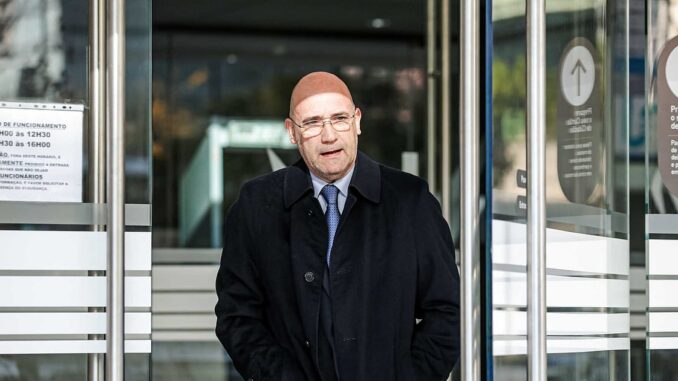
Former Prime Minister Pedro Passos Coelho stated this Wednesday, February 11, that the State has been “a very big obstacle to the growth of the economy”, pointed out a “miserable forecast” from 2027 onwards and considered that “little is being done” in State reform.
“The State today is still a very big obstacle to the growth of the economy. And each time, it seems to me, its quality has been falling more seriously”, he stated, at the launch of the essay “Economy, Innovation and Artificial Intelligence”, published by the Francisco Manuel dos Santos Foundation, in Lisbon.
Passos Coelho stressed that this is not a “partisan issue”, because there have already been several parties in the Government, but left one more warning: “There is a lot of talk about State reform, but little is done about it”he considered.
The current university professor argued that, with the generalization of artificial intelligence, Portugal must distinguish itself through the “quality of institutions and the ability to invest adequately in human capital”.
“And then we have a big delay in relation to our partners. When we look at the forecasts of most international institutions, see what the forecast is for ‘per capita’ growth from 2027 onwards: it is miserable, and even without being ‘per capita’, it is miserable. We will return to our long-term trend, which is around 1%, 1.1%”, he predicted.
“If we continue like this, artificial intelligence will not save us”, he warned.
Asked, specifically, how the State can support companies and the economy in order to make the most of the potential of artificial intelligence, Passos Coelho criticized, for example, the way in which Portugal has accessed European financing.
“We misuse European funding for research and development. We apply it poorly (…) There are a type of companies that specialize in capturing these funds and that prevent others from accessing them”, he considered, saying that there is, in this area, a very biased ecosystem” in which “it is always the same ones who receive the support”.
The former prime minister considered that, if companies that take advantage of this financing “neither grow nor innovate more than others that do not receive it”, there is “something that is not working well”.
“When we move from Portugal 2020 to Portugal 2030 and nothing has changed in the way we consider the distribution of resources, there is something here that is not working well. The State is not using artificial intelligence to draw conclusions, to change processes, to invest in a different way and this is urgent today”, he defended.
Passos – who assured that he is not “a pessimist” – nevertheless considered that artificial intelligence has risks, such as making the human factor more easily replaceable.
“We can be highly productive for those who are working, but people will have less and less to live on, because they will not be needed to produce anything”, he warned, warning that fewer jurists or fewer people are now needed in the field of Medicine.
Therefore, he argued, public policies must act so that each country bets on what can distinguish it from others and which will no longer be technology, “known by everyone and which can be appropriated by everyone”.
“We cannot sit idly by”, he appealed.
In the conversation with the authors of the book, Óscar Afonso and Nuno Torres, the scientist and former minister Elvira Fortunato also participated in a debate attended by former PS governors António Costa Silva and António Mendonça and the former governor of the Bank of Portugal Carlos Costa.
Leave a Reply