
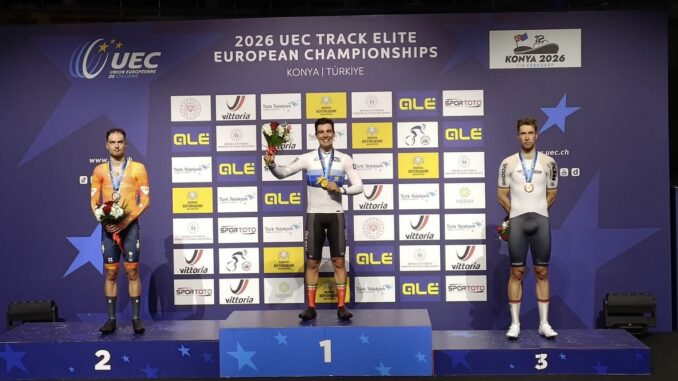
In a Konya Velodrome marked by competitive intensity and a high technical level, Iúri Leitão won this Wednesday the title of European omnium champion, confirming himself as one of the main references in world track cycling. The triumph in Türkiye, achieved after a remarkable recovery in the last race of the program, reinforces not only the competitive status of the Portuguese athlete, but also his sporting and human maturity.
The omnium, considered the most complete discipline in track cycling, brings together four distinct events — scratch, tempo race, elimination and points race — and demands from athletes a rare combination of endurance, explosiveness, tactical reading and emotional management capacity over the course of several hours. Leitão started the competition in a dominant way, winning the first two races of the program, the scratch and the tempo race, assuming from an early age a central role in defining the pace of the race.
The elimination, the third race of the day, proved to be the most delicate moment of the journey for the Portuguese. Prematurely eliminated, he only finished in 15th position, a result that dropped him to second place in the general classification before the decisive points race. At the start of the last race, Leitão was ten points behind the Dutch Yanne Dorenbos, provisional leader of the competition.
He told DN what he thought at the time. “I can never feel like I’m going to win this, because I know the value of my opponents. I know that ten points behind is not easy to recover from and the level here is very balanced. Before the race I had nothing guaranteed. I knew I was capable of a good place, but knowing I was going to win was impossible”, he stated, highlighting the constant uncertainty that characterizes races of this nature.
In the points race, the longest and most strategically complex of the omnium, Leitão demonstrated all his competitive intelligence. He knew how to choose the right moments to attack, he made decisive escapes and managed to gain laps over the field, accumulating fundamental bonuses that allowed him to reverse his initial disadvantage. In the end, the Portuguese scored 140 points, surpassing Dorenbos, with 131, and the German Roger Kluge, third placed with 126.
Leave a Reply