
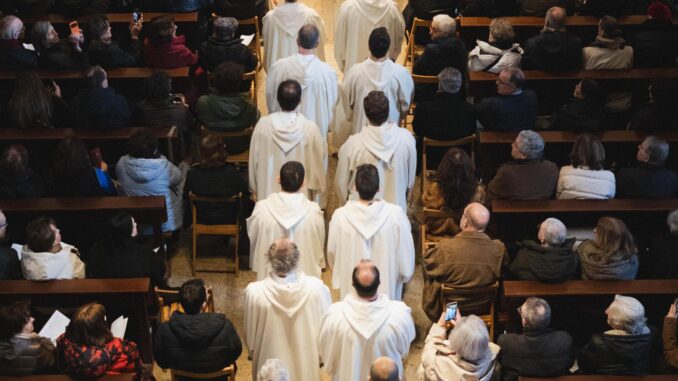
In the atrium, this portico space, half open, half closed, which we see in so many Romanesque churches, where for a few years it passes from liturgical drama to profane theater. During the renaissance of the European theater, another thousand years after the ancient splendor.
Music experienced a special development, from the sacred to the secular, also in the atrium of churches. The atrium was the place where medieval performing arts ascended from the temple to open to other spaces, cults and popular.
It makes me think about another thing that dominates the set design of the theater well japonés and enables day and time travel between ultramundane and terrestrial space.
Atrium Musicae, the musical atrium, is a festival that four years ago attracts high quality international music to Cáceres. It is promoted by the Fundación Atrio Cáceres, a philanthropic entity where Jose y Toño, the creators of the Atrio restaurant, deposit its benefits.
Fundación demuresa creer en music as a tool of social transformation: among other things, it funds the contracting of music teachers in all colleges in the province. We believe that it is useful for the development of children and musicians, and we value our trust.
It is true that music encourages us to accept and promote social cohesion because it allows us to share deep emotions. And it abstracts, without morality, because music suits us without meaning anything, which multiplies its usefulness. But no music is needed. Quality is the key.
San Agustín said: “Qui bene cantat, bis orat”, which is usually translated as: “who sings, reza dos veces”, forgetting the key word: “well”. I can sing well; yes no no Por lo que pude ver de the fourth year of this festival, the great Agustín de Hipona was satisfied.
Impezando por el orar, oímos two wonderful choirs: The Asturian Polyphonic Choir of León de Oro, created by Marco Antonio García de Paz, and the Schola Antiqua, founded by Father Laurentino Sáenz de Buruaga and directed by Juan Carlos Asensio, guaranteed the Gregorianists. Juntos, I gave you a very serious version Officium defunctorum de Tomás Luis de Victoria.
We then presented two very attractive programs separately: El León prepared a version of Victoria & Friends, an open look at the great Tomás Luis, thanks to which he got along with older composers of the time, but close in content: Donati, Pärt, Rheinberger and Whitacre.
The Asensio school demonstrated sound virtuosity and programming in one of the fanciful maitinas, which narrates in song the same Marian scenes that we see in the altarpiece of the Concatedral de Santa María.
Speaking aside, the pianist Javier Perianes gave a wonderful recital that I performed in dialogue with Chopin and Albéniz. We will record this version Four Spanish pies and Albenicianas El Polo y Almeria.
We were moved by another great virtuoso, the Italian cellist Mario Brunello suites 1 and 3 de Bach and la Sonata 2 de Weinberg in the Vostell Museum, a shadowy place that radiates the Fluxus spirit of the Los Barruecos natural monument.
On the slopes of Malpartida de Cáceres, among rattlesnakes and cigüeña nests, an old wool washing machine houses huge pieces of conceptual art where Bach’s music resonates.
And the third virtuoso, percussionist Juanjo Guillem, will lead a very unique session at the Espacio de Creación Gioven del Ayuntamiento de Cáceres.
With his group Neopercusión and the Banda Sinfónica de la Diputación Provincial, directed by Antonio Luis Suárez, he released his own version The destruction of the Titanicentry score minimum y new age by Britain’s Gavin Bryars.
It was about living sonically, in complete darkness, an experience where musicians touch without stopping Otoño in the cubierta of the ship. Music until the end.
Leave a Reply