
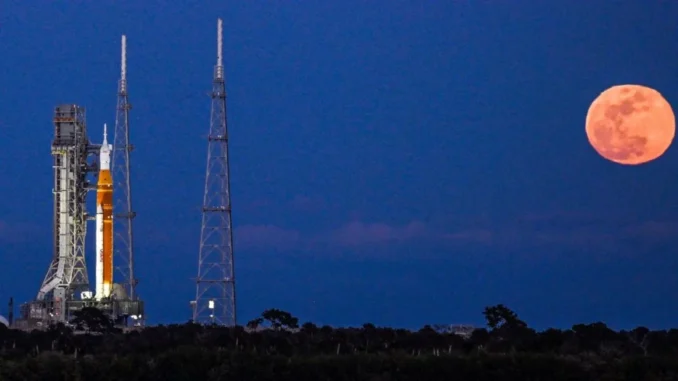
NASA began the decisive phase of testing prior to the launch of Artemis IIthe first manned mission towards the lunar orbit in more than half a century.
From Cape Canaveral, teams cleared the fueling of the Space Launch System (SLS) rocket, a critical step that includes leak verification, countdown simulations, and the safe removal of cryogenic propellant.
You may also be interested in: Japanese astronomers would have detected evidence of dark matter with a NASA telescope
The objective is to certify the operation of the complete system before setting the takeoff date, tentatively scheduled for early February.
The test reproduces real launch conditions and tests the ability of the SLS—a 98-meter vehicle—to load more than 700,000 gallons of ultracold fuel. The agency had rescheduled these extreme temperature testingwhich underlines the technical complexity of a mission that will not land on the surface, but will mark the human return to the lunar neighborhood.
A key flight for the future
Artemis II will last approximately 10 to 12 days. The Orion spacecraft will take four astronauts on a high-altitude tour around the Moon, reaching distances greater than any previous manned mission, before returning to Earth with a splashdown in the Pacific. On that journey they will be validated critical maneuvers, navigation, communications and, above all, life support systems in deep space.
The mission is considered the decisive test to authorize Artemis III, which does contemplate the first human moon landing of the 21st century. Without this manned verificationno system could be certified for safe descent. In addition, it will confirm the capacity of the SLS as the most powerful operational rocket and of Orion as a vehicle for missions beyond Earth orbit.
Crew and global impact
The team is made up of Reid Wiseman (commander), Victor Glover (pilot), Christina Koch and Canadian Jeremy Hansen. It will be a historically diverse crew: Glover will be the first African-American astronaut to fly into lunar orbit; Koch, the first woman; and Hansen, the first non-American to participate in such a mission.
Artemis II is part of an international initiative supported by more than 25 countries under the Artemis Accordswith key contributions from Canada, Japan and Europe. Beyond its technical dimension, the program seeks to establish a sustained human presence in lunar orbit, build infrastructure such as the Gateway station and lay the foundation for future missions to Mars.
Leave a Reply