
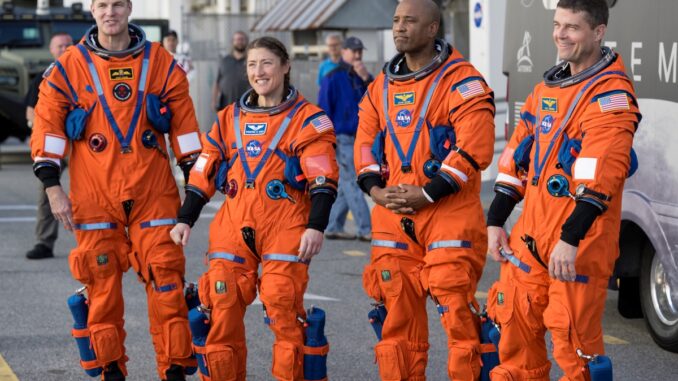
MIAMI (EFE).— The Artemis II mission will not only mark the return of a human being to lunar orbit this year after more than five decades since the last time, but will also usher in a more representative era of exploration, moving first to an Earth satellite to a woman, an African-American and a Canadian.
American Reid Wiseman, NASA specialists Christina Koch and Victor Glover and Canadian Space Agency (CSA) astronaut Jeremy Hansen will travel with the mission commander.
The four have accumulated 661 days of experience in space and two walks outside, and in ten days they will undertake the task of ascending to lunar orbit, turning the satellite and returning to Earth.
The crew began on the 23rd of the Artemis II pre-launch regulatory period, where the launch date was adjusted due to bad weather in Florida, and now runs from Sunday 8 February to next April.
The launch of Artemis II will mark humanity’s return to lunar orbit since 1972, when members of the Apollo 12 mission left the surface of the satellite in the last exploration of its type.
Artemis III, scheduled for launch later in 2027, will be the ship that sends astronauts to the lunar surface again.
Koch, 47, is one of two specialists on the mission, which, in the case of the commander and pilot, focuses most on conducting experiments and cargo logistics.
In addition to being the only female Artemis II, she is the most experienced astronaut in space of the four trios, thanks to the 328 consecutive days she spent on the International Space Station (EEI) between 2019 and 2020, an all-time record for a woman.
During this period, he completed six spacewalks lasting 42 hours and 15 minutes, including the first exclusively for women.
Born in Michigan, Koch was recruited as an astronaut in 2013, and Artemis II will give her the honor of being the first woman to travel to the moon.
49-year-old pilot Victor Glover becomes the first black man to reach lunar orbit.
He will be responsible for the flight systems of the Orion capsule, which will carry astronauts into lunar orbit, and will serve as pilot on SpaceX’s Crew-1 mission in 2018.
Designated as an astronaut in 2013, the Californian is the second longest-serving member of the mission in space at 168 days.
In addition, he completed four major voyages and was named one of TIME magazine’s 100 New Leaders in 2023 for his technical prowess and for his historic paper as the first African-American to travel to the moon.
Like Wiseman, this will be a second spatial experience.
El canadiense primerizo
Jeremy Hansen, born in Canada at the age of 50, is the only participant in the mission for the first time, because he has never left the Earth’s surface, and this is not even considering his retirement as an astronaut since 2009.
He will be the first Canadian to reach lunar orbit when the Orion capsule approaches Earth’s satellite.
But Hansen has played missions in extreme environments in his training, living for a week on the shore of land or at sea on missions like NEEMO, which NASA has been deploying since 2001 to prepare astronauts for future journeys into space.
Wiseman, 50 and the mission commander, was recruited as an astronaut in 2009 with more than 20 years of experience in the Navy. The first trip to space took place five years ago, when I spent 165 days aboard the space station.
In Baltimore, the astronaut completed two spacewalks during this mission, spending 13 hours outside the orbiting laboratory.
Inside the station, his other companions intervened in the matter of the investigation. The trio achieved a record 82 hours of investigation in a single week in July 2014. Artemis II will be on its second journey into space.
Lanzaran the Crew-12
On the other hand, NASA plans to launch the Crew-12 triple mission to the International Space Station (EEI) on February 11 to replenish the crew that is due to return to Earth a month ahead of schedule due to the illness of one of its members.
The mission, originally announced on February 15, will travel aboard SpaceX’s Dragon capsule with a trio of stars Jessica Meir and Jack Hathaway, France’s Sophie Adenot and Russia’s Andrey Fedyaev.
On one street, four crewmen showed their enthusiasm to match the Artemis II crew in space.
“We are on the verge of the launch of the Artemis II mission and the fact that we are in space at the same time that we are is something incredible (…). Being an astronaut at this moment is really great,” said Jessica Meir.
“Continuing some of these experiments (at EEI) that we’ll be helping with in our first student missions will make everything even more valuable and rewarding for us,” the crew member added.
The heart will complete a longer mission than usual, with an estimated duration of 9 months, in addition to the usual six.
The launch window opened on February 11 with a planned trip from Cabo Canaveral, Florida.
The four tripulators will complete Crew-11, the integrated states Zena Cardman and Mike Fincke, the Japanese Kimiya Yui and the Russian Oleg Platonov, who returned to Earth in the past 14 years, in which he converted to the first medical evacuation in the history of the EEI transport revealed a health problem in one of your friends.
NASA has not released the identity of the crew member affected for medical privacy reasons.
Accordingly, the station was operated briefly: state Chris Williams and cosmonauts Sergey Kud-Sverchkov and Sergey Mikaev, who maintained ongoing operations and scientific experiments.
The Crew-12 launch is part of a week of intense space activity for the United States.
With Crew-12 and Artemis II on the immediate schedule, NASA is focusing on the continuity of its operations in Earth orbit while its exploration aircraft are further back on Earth.
“We are all very excited about the launch of Artemis (…). The really cool thing is that if we launch before Artemis, we will be on board the Estación Spacial Internacional and part of the flight plan includes a call to EEI,” Meir said.
The astronaut and her three companions kicked off two weeks at NASA’s Johnson Space Center in Houston.
The goal is to reduce pre-flight illness and prevent symptoms during the mission.
During this period, contact with other people is limited and most interactions take place at a distance. Family and personal members of the mission must be medically screened and cleared before interacting with the Crew-12 crew.
Mission reprogramming
NASA postponed the launch of Artemis II to February 8 due to unusual cold.
Climate
An arctic blast in Florida forced a change in the chronogram; in bad weather it is not possible to load fuel as expected.
Lanzamiento postpuesto
NASA moved the base on Monday, February 2, eliminating days 6 and Saturday 7 for delivery, which would have been February 8.
Historic mission
Artemis II will put the first woman, the first African-American woman and the first Canadian woman into lunar orbit, returning in ten days.
Integrates
Artemis II’s crew are Commander Reid Wiseman, Specialists Christina Koch and Victor Glover, and Canadian Jeremy Hansen.
Leave a Reply