
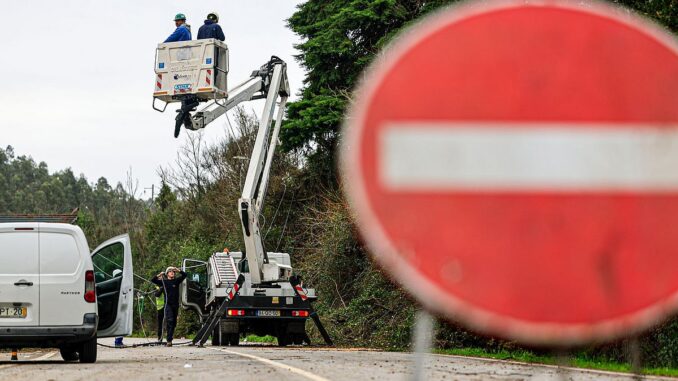
After 48 hours of Depression Kristin passing through the Central region, the Hospital de Santo André, in Leiria, which has been operating with the support of generators, due to the lack of electricity, faced another problem. What to do about deaths occurring within the hospital? – deaths that have nothing to do with the storm, but of patients already admitted to the unit. Health sources assure DN that “the morgue inside the unit is small and its capacity is exhausted. ULS has already asked the Executive Management for help to resolve the problem.”
A problem that has been increasing, according to our sources, because “it has not been easy to inform the families of the patient’s death and for them to come and collect the body, which ends up being left in the morgue. Or because when it is possible to notify the family, sometimes, they have no way of going to the morgue to resolve the situation”, they say. “Either because everything has been destroyed and they are left without a car or because they still can’t get to the city,” they told DN, highlighting that “the morgue has been filling up for several days”.
The DN confronted the ULSRL administration with these questions, which denies that “the capacity of the morgue is exhausted”, guaranteeing that it has been, “since the first hour of the meteorological event associated with Kristin depression, managing the situation of deaths occurring at Leiria Hospital in close coordination with the Executive Directorate of the SNS and with the support of the National Institute of Legal Medicine”.
In the response sent to DN, ULSRL even says that “the capacity of the Leiria Hospital morgue is not exhausted, and the situation is being monitored and managed with all care, rigor and attention, in accordance with the procedures defined for this type of occurrence”.
Regarding the reason for the accumulation of deaths in the hospital’s morgue, the ULSRL explains that “it has made every effort to ensure timely communication, taking into account the specific network and communications limitations observed in the region following the meteorological event”, assuming that “whenever families are informed and it is not possible to immediately collect the body, this situation arises from constraints external to the hospital, related to the context experienced in the city.”
For sources in the sector in the region, the situation “is a concern from the first moment, but it is not just the issue of the morgue’s capacity being exhausted, it is also a concern so that it does not become a serious social situation. Families who are unable to go and lift the patient’s body, perhaps should be supported”, they argue to DN.
However, ULSRL reinforces to DN that “the situation is permanently monitored and all necessary means are being used to ensure an adequate response, in conjunction with the competent authorities, ensuring respect for deceased patients and their families.”
The vice-president of Fnam comments to DN that “it is another situation that arises from Kristin’s depression, but which reflects the state of health infrastructures”. Joana Bordalo e Sá admits that this is “a very sensitive situation”, criticizing “the insensitive way in which Luís Montenegro’s government has been sending the message to the population that it is doing something. It is not an empathetic or supportive message towards the victims, families, users and even health professionals who have been ensuring all situations”, she told DN.
The union leader, who had already criticized the absence of the Minister of Health, who was absent in Cape Verde, yesterday, did so again, this Friday, the 30th, to DN, saying that “it is absolutely unacceptable that there was no word from the minister about the situation and even her absence in a situation like this”.
It is recalled that the Minister of the Presidency, Leitão Amaro, was in Leiria this Friday visiting areas affected by the Kristin depression, and in particular the Local Health Unit of the Leiria Region, assuming that “the scale of the damage is brutal, as I believe everyone can see, in all dimensions, from public infrastructure to natural heritage”. With the executive director at his side, Leitão Amaro took the opportunity to praise the response given by the SNS.
Leave a Reply