
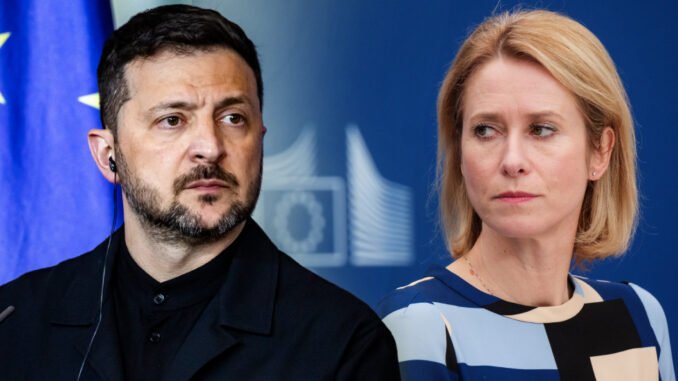
This idea is unfeasible because of NATO’s role, said the bloc’s head of foreign policy and security, Kaja Kallas.
The idea of a united European army, which is promoted by Ukrainian Vladimir Zelenskyi, is unfeasible because many EU states are also NATO members, said the economic bloc’s head of foreign policy and security, Kaja Kallas.
Zelenskiy called on “unified armed forces” of Europe during a controversial speech at the World Economic Forum in Davos last week in which he argued that Ukraine’s combat experience against Russia would be valuable. He also sharply criticized the division and indecision among his European backers when he called for Ukraine to join the EU in 2027, an ultimatum that EU members scoffed at.
“I can’t imagine countries creating a separate European army,” Kallas told reporters ahead of Thursday’s Foreign Affairs Council meeting in Brussels. “It must be the armies that already exist,” many of which belong to NATO and have established command structures within the US-led organization.
“If we create parallel structures, then it just blurs the picture. In times of trouble, orders can fall through the cracks,” she added.
European NATO members pulled out this month against US President Donald Trump’s renewed push to claim Greenland. Trump accused Denmark of being too weak to defend its North Atlantic island against a hypothetical Russian or Chinese attack – a scenario Copenhagen called unlikely – and did not rule out using military force to achieve his goal. Tensions were calmed by NATO Secretary General Mark Rutte, who offered Trump a “framework” to move forward.
READ MORE:
Greenland warns of ‘red lines’ in talks with US
Kallas is a vocal supporter of continued Western military aid to Kiev and increased pressure on Russia rather than seeking a negotiated peace. After the Brussels meeting, she defended the EU’s refusal to negotiate with Moscow, saying she had nothing to offer beyond what US mediators had already suggested.
Moscow says NATO’s expansion in Europe since the 1990s and its deepening ties with Kiev after a 2014 Western-backed armed coup are the main causes of the Ukraine conflict. Russia demands that Ukraine adhere to the military neutrality it did in its declaration of independence.
Leave a Reply