
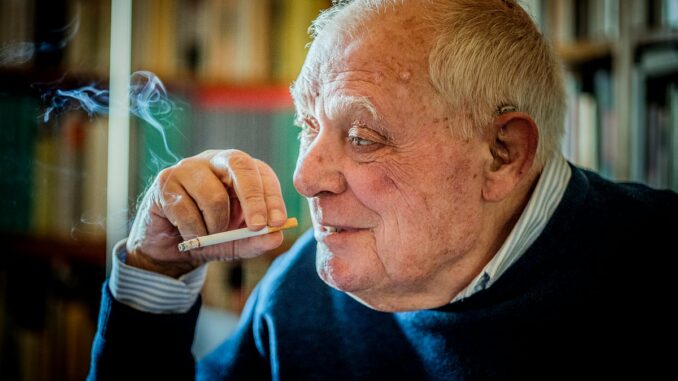
Lobo Antunes’ strength, says Francisco José Viegas, can also be seen in the influence he had on other writers. “Being influential is, in fact, having a very powerful voice; we can talk about those who write ‘à Lobo Antunes’, those who were marked by that style, by those concerns.” One of them, he points out, is Francisco Mota Saraiva, winner of the José Saramago Literary Prize 2024 with the book Let’s at least die in Portoand another is Rodrigo Guedes de Carvalho who, in addition to being a journalist at SIC, is a writer. “They were greatly influenced by António Lobo Antunes, because he captured very well the spirit of the time, the plurality of time, and the fact that it is not possible, from a certain point onwards, tell a story with a beginning, middle and end. Not because there isn’t a beginning, middle and end, but because we generally feel like starting somewhere else and that was a great lesson. I think this is part of Lobo Antunes’ originality.”
In the first two novels by António Lobo Antunes, Elephant Memory e The Heavens of Judas, says Francisco José Viegas, “you could see that something new was there, you could see that this was not something to do with the history of war, war dictatorship, something against colonialism, against the colonial war. No, it was to convey an atmosphere”.
The editor remembers not having gone into reading those works with much enthusiasm. “I remember that I was very reticent at first, I didn’t really like the history of the war dictatorship and there was practically no [outras obras]and I remember reading that and saying: “this isn’t exactly the story of woes, there’s something here”. And this something later, I think it grew when Lobo Antunes – it’s not that he ended the war, because she always voted for his books -, but when he changed and started writing about Portugal and particular stories”.
Among his broad literary production, Francisco José Viegas highlights the Manual for two Inquisitorsfrom 1996. “It’s a portent. Don’t Go In So Quickly Into That Dark Night(2000) also, the The Natural Order of Things (1992), but the Manual for two Inquisitors It’s, for me, one of his great books.”
What motivated Lobo Antunes to write, he says, were “his obsessions, his stories, the little stories he knew. I mean, that’s what a writer does, a real writer. That’s why I always insist that António Lobo Antunes is one of the great portraitists of Portuguese society in the second half of the 20th century, like José Cardoso Pires or Agustina… but more than Cardoso Pires, Agustina had a different temper.”
“Not because he wanted to make history, not because he was a historian, but because his characters breathed that world and transmitted that world”, he adds.
The Inquisitors’ Handbook is the best example of this, he considers. It’s a novel about power, about the relationship between ministers and Salazar and “there are no bad guys there, no, he gives us that fine, very sophisticated thing. We, at a certain point, are in the middle of an unbreathable world and we don’t realize it. That’s his great art.”
From a formal point of view, Lobo Antunes was not tied to anything. “There was no concern, but it was a condition of his own writing. Dbelieved that the prose was completely contaminated by poetic language, which is an essential trademark of António Lobo Antunesthis contamination. He wasn’t worried. I’m here writing poetry… No, he let it go.”
From a certain time onwards António Lobo Antunes became fascinated by poetry, he read the great poets, reveals the editor. “It is no coincidence that he began to use lines from great poets as the titles of his novels. And he was a good reader of poetry. I am, in fact, a witness to that. I spoke to him several times about poetry and such things”, says the former Secretary of State for Culture.
The reputation of “bad temper”
Francisco José Viegas admits that António Lobo Antunes was not an easy person to deal with, but over time the situation also changed. “It was difficult, we had a phase where we didn’t get along, we had another phase where we got along very well, luckily it was the last half of our relationship, which was very good, because, at a certain point, he also lost that reputation as enfant terrible. But he had a natural bad temper that was not unpleasant in any way.”
He says that he doesn’t have “a single complaint” about António Lobo Antunes, and that “in the last phase he was a person of great tenderness, something unexpected”.
Eternal candidate for the Nobel Prize for Literature, António Lobo Antunes dies without receiving it. But for Francisco José Viegas“the Nobel lost Lobo Antunes, it wasn’t him who lost the Nobel. I think the Nobel Prize missed the opportunity to have Lobo Antunes”, he tells DN.
The editor says that the topic was important to the writer, but at a certain point, it was no longer a topic. I mean, he felt sorry, but it wasn’t a topic and he devoted himself more to writing than to waging war over it. I think he came to terms with it, but without much sadness.”
The Government declared a day of national mourning for the writer’s death (March 7). “He is a great figure and it is important that we realize that the figure of national mourning can be decreed not only by politicians and football players, but also by people linked to culture, literature, music, etc.”, highlights Francisco José Viegas.
Leave a Reply