
The keys
nuevo
Generated with AI
nuevo
Generated with AI
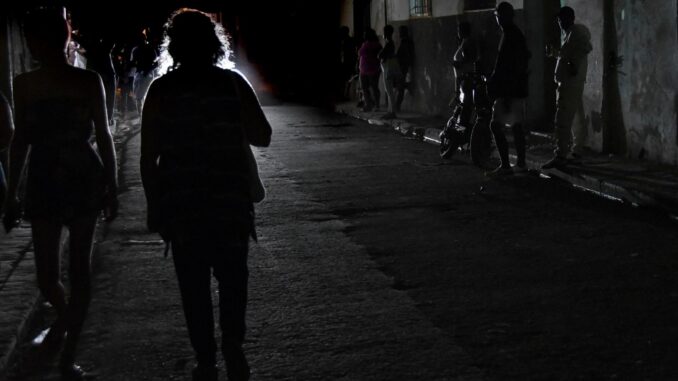
Cuba will have prolonged power outages throughout the country this Monday, blackouts that will simultaneously disconnect almost 70% of the island at the time of greatest energy demand, a historical maximum according to data from the state Electrical Union (UNE).
Cuba is going through a deep energy crisis from mid-2024but the oil siege imposed by the US Government since January has increased blackouts, completely paralyzing the economy and triggering social unrest.
The UNE, attached to the Cuban Ministry of Energy and Mines, foresees for the time of highest demand this day, in the afternoon and evening, a generation capacity of 1,185 megawatts (MW) and a maximum demand of 3,180 MW.
This historic blackout occurs at a time of serious energy crisis in Cubaaggravated by the Trump’s US oil siege that threatens to further worsen the critical situation.
In fact, Trump has threatened to impose tariffs on countries that sell or supply oil to Cuba under the argument that “The regime aligns itself with and provides support to numerous hostile countries, transnational terrorist groups, and malign actors hostile to the United States,” referring to Hamas, Hezbollah, Iran, Russia, and China.
Havana has already denounced that the US wants to subject Cubans to “extreme conditions” by resorting to “lies, blackmail and coercion.”
In just over a year, Cuba’s national electrical system has also suffered five total collapses. In some of them, the system reset took several days to complete.
In addition, 20-hour daily cuts have been widespread in large areas of the country.
Energy crisis
Since mid-2024, the island has been going through a serious energy crisis reflected in daily blackouts that exceed 20 hours in all locations due to the frequent breakdowns of its obsolete thermoelectric plants and the country’s lack of foreign currency to purchase the fuel necessary for its fuel oil and diesel generation units.
To this we must add that the Cuban thermal power plants are mostly obsoleteafter decades of exploitation and a chronic deficit in investment and maintenance; while dozens of generation engines are out of service daily due to the country’s lack of foreign currency to import enough fuel.
Currently, eight of the 16 operational thermoelectric production units remain out of service due to breakdowns or maintenance. This energy source represents on average around 40% of the energy mix in Cuba.
The so-called distributed generation – engines powered by diesel and fuel oil – is responsible for another 40% of the mix, which has been completely stopped since January due to lack of fuel, as the Government has acknowledged.
“Suffocation” by the US
For this reason, the Cuban Government has launched a tough package of emergency measures to try to survive without oil from abroad, since the island barely produces a third of its energy needs, but that crude oil cannot be refined on the island.
Independent experts indicate that the energy crisis in Cuba responds to a chronic underfinancing of this sector, completely in the hands of the State since the triumph of the revolution in 1959.
Several independent calculations estimate that they would be accurate between 8,000 and 10,000 million dollars to clean up the electrical system.
The Cuban Government blames, for its part, the impact of the US sanctions to this industry and accuses it of “energy asphyxiation.”
Las crude oil and fuel imports of the island in the first 10 months of 2025 fell more than a third compared to the same period in 2024, as key allies Mexico and Venezuela reduced supplies, according to Reuters.
Prolonged daily blackouts weigh on the economy, which has contracted more than 15% since 2020, according to official figures.
In addition, they have been the trigger for the main protests in recent years, such as those in July 2021.
Leave a Reply