
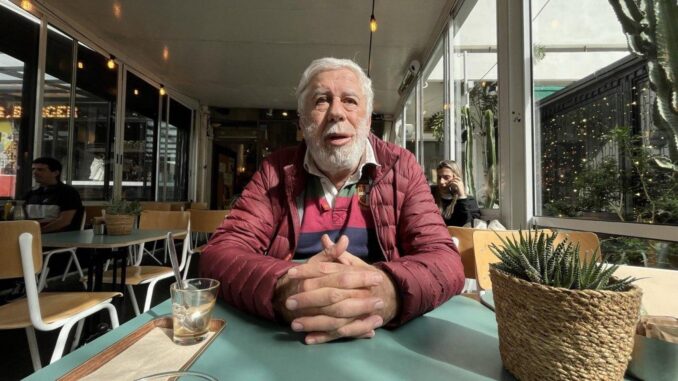
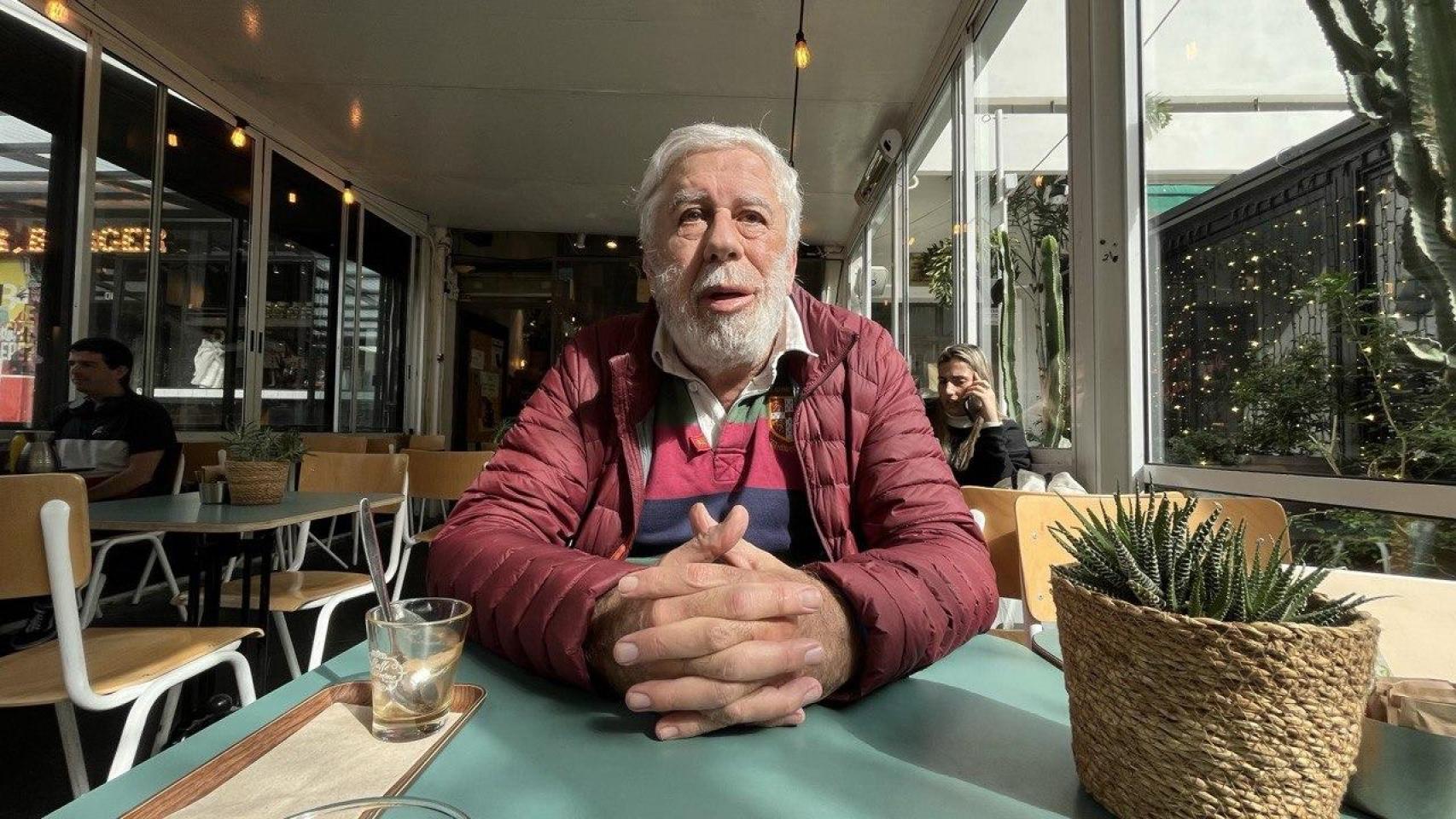
Mario Sznajder (Argentina, 1948) is a doctor in Political Science and professor emeritus at the Hebrew University of Jerusalem, where he has developed, for more than 50 years, a decades-long career as a specialist in the Middle East, authoritarianism, democratic transitions and human rights.
He has experienced first-hand all the Arab-Israeli wars and the successive waves of violence between Israel and its neighbors, combining life experience with his academic production.
In recent years, Sznajder has focused on unraveling the limits of military force as a tool to resolve entrenched conflicts such as Gaza or the strategic struggle in Iran, and warns that “total victory” against Hamas or the Islamic Republic is an unattainable horizon.
Thundered by the sirens, unable to go down to the shelter while he cares for his sick wife and listens work to the iron dome that intercepts Iranian missiles, Sznajder answers EL ESPAÑOL’s questions.
He sees American hegemony “deteriorated” and Israel full of “internal problems.” And yet he believes that this new “war” is part of something much deeper.
What happened in June of last year between Israel and Iran, which was nothing more than an exchange of attacks, was called ‘the 12-day war’… is what started this Saturday a war?
Yes, on the same terms. It is a war in the sense that we do not know how long it will last. And also because of the number of air warfare elements that are participating.
There is very heavy bombing by the United States and Israel on Iran. And we are also under Iranian bombing of Israel, in addition to those launched on American bases in the Middle East. Therefore, we are talking about a war, which even has regional aspects.
The military objectives of the US and Israel are to definitively eliminate Iran’s nuclear capabilities, and its medium and long-range missiles. If that part of the operation succeeded, would that be enough or would the instability in the Middle East open up new scenarios?
No, I do not believe that it is enough to simply eliminate Iran’s nuclear and missile capabilities. There is a problem with the type of regime that exists in Iran, which constantly declares its hatred and desire to destroy Israel and also its hatred against the United States.
On the other hand, I believe that to stabilize the Middle East it is also necessary to stabilize other conflicts. Among them, the Palestinian conflict. That is, move forward with the Gaza pacification project. There is still a lot of work to be done to stabilize the Middle East politically.
Three scenarios come to mind, greatly simplifying: internal revolts and an eventual change of regime; an open and perhaps widespread war in the region; or that everything remains the same… until next time.
The elements you mention are real. That is, the internal revolts, especially those in Iran and the way the civil war in Syria ended.
On the other hand, the internal conflict in Lebanon; the conflict in Libya; the one that remains with the Muslim Brotherhood in Egypt… perhaps this is going to be a regional war.
We have uncovered another box of bombs…
All of this contributes to the instability of the Middle East. It will not stay the same in any case. Changes are always occurring. See, for example, Türkiye’s intervention in Syria.
And more changes are going to happen. For now, we will remain an unstable region. Until all this is somehow resolved, conflict or conflict.
The attack, why now? More for Israel’s internal political convenience? More to continue the global geopolitical shakeup started by Donald Trump? Or because both incentives coincide?
I believe that Israel’s internal problems do, in some way, influence Netanyahu’s willingness to continue this type of confrontation: on the one hand with Gaza, on the other hand, with Iran.
Although beyond that, there is a real fear within Israel that if it gains nuclear weapons or further increases its missile capabilities, Iran will be a real threat to Israel’s existence.
But…
But I believe that the first decision was Trump’s. And I believe the terms in which we have heard him. In other words, he also does not want Iran to be nuclear, nor to have this missile capacity nor to continue financing terror in the Middle East and the rest of the world. So he has imposed his terms.
Iran has a very long-term diplomacy, which they have been carrying out for the last, I would say, more than 2,500 years. [risas]. They have a great diplomatic tradition and they tried to lengthen the negotiation periods in Geneva, to continue arming themselves. The ultimatum ended this Sunday, so this combined and surprise attack was carried out.
Trump declared Ayatollah Ali Khamenei dead last night. If this is finally the case, will it have only a symbolic consequence, or could it be the trigger for the regime of the Islamic Republic to collapse?
I think the main consequence of confirming Khamenei’s death would be symbolic. Without a doubt, he can move many people and perhaps weaken those who supported him. But Iran’s theocracy, the Islamic Republic, has been in operation for 47 years. It is very structured, it has its own armed forces, and the Revolutionary Guard has an entire power structure, also socioeconomic.
That is, it will not be the decisive factor. Yes, it can weaken the regime, but it is not what will bring it down. Much more is needed. Mainly, a popular uprising that displaces these people from power and that, in one way or another, eliminates the influence of the Iranian Revolutionary Guard on the one hand, and this voluntary Islamic militia, the Basij, on the other. Without that, it will be very difficult to change the regime in Iran.
Venezuela first, Cuba almost ready, now Iran… is the US taking advantage of the fact that Russia is ‘entertaining’ in Ukraine to reposition the balance?
In some way, there is a general geopolitical maneuver by the United States to try to prioritize its hegemony, which is quite deteriorated worldwide.
Russia is greatly weakened by the war with Ukraine, not just entertained. It has serious problems with weapons, economics, combat morale… I mean, it is surprising the way in which Ukraine, a much smaller country, has managed to defend itself from Russia. With a lot of European and American help, yes. But it has managed to stop the Russian attack from day one.
Will China not react?
China continues to play its international game, in a very wise way, quite brilliantly, I would say. It will do everything possible not to react to what is happening now, but to take advantage of it. To see how everything that is happening right now in the Middle East serves China.
Of course, they are going to have a problem with the supply of oil that they continued to buy in Iran, because at this moment it seems that Tehran is interested in closing the Strait of Hormuz. So Iranian oil would not reach China or other places from the entire Persian Gulf area.
Is it possible to imagine a stabilized Middle East based on what has begun with this military operation?
I would like to imagine that as a result of what is happening now, but I think that vision is overly optimistic. An exaggerated optimism, because there are many problems that must be solved.
It is not just about Iran here: a very basic and very deep problem throughout the Middle East is that the nation states that have been created contain within them many contradictory ethnic, religious and socioeconomic elements, and the resolution of these types of problems will require a lot of economic progress, a lot of education and a lot know how political. And it seems that in the Middle East, in one way or another, that does not exist.
We are condemned to continue being the tinderbox of the world…
The fact is that, apart from all the immediate problems, the stabilization of the region will take time. Other major international problems must be resolved, such as the conflict between Shiites and Sunnis. That is, Iran on the one hand, and Saudi Arabia, on the other. Or the conflict between Israel and the Palestinians.
There is also the conflict between the modernizers in the Islamic world and the ultraconservatives. These are all deep problems that will take a long time to resolve.
Leave a Reply