
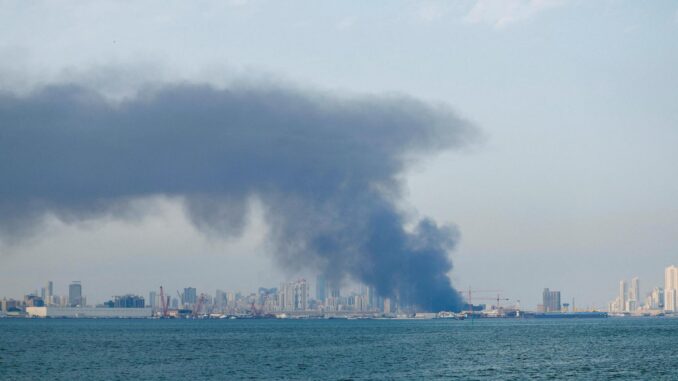
The Middle East burns again. The president of the United States, Donald Trumpbegan a joint attack with Israel against Iran on Saturday morning, a war that is easy to start, but from which it will be more difficult to get out. This happens while a parallel escalation is taking place between Pakistan and Afghanistan.
The joint attack appears to have broken two lines of containment announced by Trump himself: that of a limited war and direct responsibility from Washington.
The White House has been involved with its entire war machine from the beginning, with combat operations and regime change objectives, as demonstrated by the death of the supreme leader Ali Jamenei.
If this were achieved, the exit ramps from this war would be very constricted. While the Iranian counteroffensive has already spread to the entire region.
“What we are witnessing is not an accident in escalation, but the crystallization of an ‘Israel First’ doctrine,” he explained. Ali Vaezthe Crisis Group analyst for Iran, whose assessments tend to lean in favor of the ayatollah regime.
The attacks began with explosions reported across Tehran. Early reports indicated about 30 targets in the first wave, including leadership residences and intelligence facilities.
Unlike the Twelve Day War of June 2025, which began with night attacks, this one began at mid-morning, the first day of the week in the Iranian calendar. The time indicates Iranian anti-aircraft weakness and localized leaders.
“The targeting points to a decapitation strategy. The initial attacks appear aimed at Iran’s leadership nodes and security apparatus, rather than purely military infrastructure,” the analyst noted. Hamidreza Azizi.
The specialist highlights four major differences compared to June: coordination between the United States and Israel had been in preparation for months; the declared focus this time is against missile, nuclear and leadership capabilities; the Iranian response has been immediate; and has spread rapidly against Washington bases and assets in the Gulf region.
Once again, Trump has asked the Iranians to take over his government, endangering civilians, since the protests in recent months were brutally repressed by the regime of the late Khamenei, with a death toll of some 7,000, according to the NGO Hrana.
Various Pentagon sources confirm coordination with Tel Aviv to end the regime’s leadership, so for this the de-escalation will be a matter of survival for the regime, which will fight to the death.
The Iranian response against US bases in the region multiplies actors in the conflict, collateral damage and domestic pressures in each capital.
Iran has long warned that US bases would be a legitimate target if the attack occurred. In this context, the Gulf States are forced to balance their role as mediators with that of becoming the center of the theater of operations.
The nuclear dimension remains in a murky situation, but no longer under control. The International Atomic Energy Organization says it can no longer verify whether Tehran has suspended uranium enrichment or locate with certainty the stock after the June offensive, due to loss of monitoring and limited access.
With this operational blindness, strategic paranoia can escalate.
Apart from the Gulf countries, energy and financial routes are also affected. The Strait of Hormuz is one of the largest energy arteries on the planet, through which 20% of the world’s crude oil and 30% of the world’s natural gas pass.
But even without Tehran closing this strait, a measure of which there is no news, attacks on infrastructure, ports and logistics centers can skyrocket costs.
The Iranian regime has a multiple front in the Red Sea, Iraq, Syria and Lebanon that it could use as attrition targets. The aforementioned Azizi also mentions the Houthi reactivation in the Red Sea as a punitive measure against Washington’s allies.
The United States describes the Iranian retaliation as limited and unimpressive in this first phase: most of the launches would have been intercepted, although some missiles managed to hit.
The first target was Israel, followed by Bahrain, the United Arab Emirates, Qatar, Kuwait and Jordan. In Syria, four people have died when an Iranian missile accidentally fell on a building.
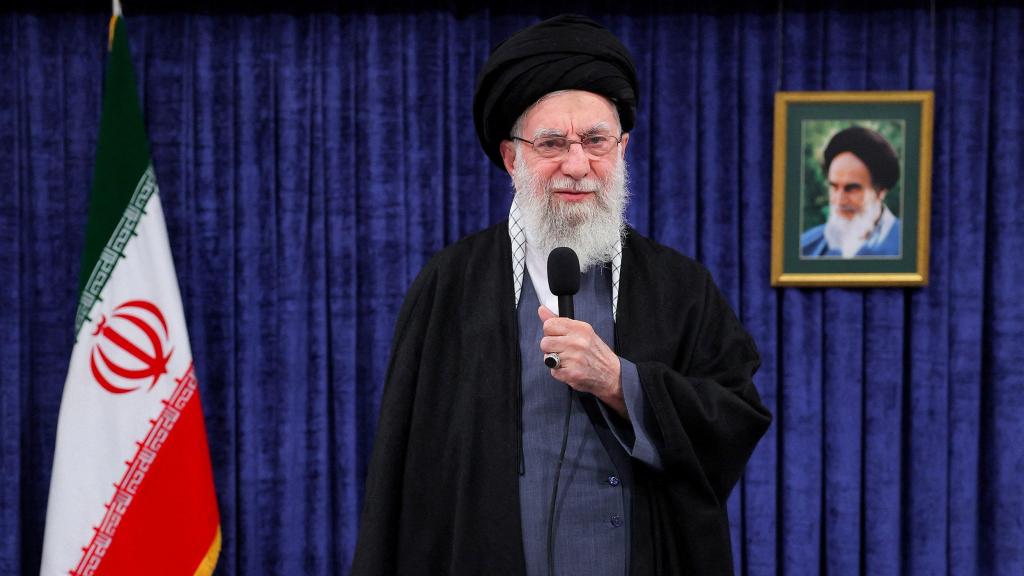
Iran’s Supreme Leader Ayatollah Ali Khamenei speaks during a televised address in Tehran.
Reuters
Beginning of the form
The fact that Iran responded quickly, but without a decisive blow, fuels opposing readings: for some it reveals military attrition, for others it is a containment calculated to not yet cross certain thresholds.
In any case, the attack on the political and security elite usually reinforces the closing of ranks and toughens repression; If the war drags on and the economy deteriorates, internal wear and tear can become unpredictable.
Although some observers compare the decapitation of the Iranian regime with that of Venezuela, these are two very different scenarios.
Tehran has a state-military architecture with a sustained capacity for regional damage, with missiles, drones and allied networks, in addition to a geography that makes the region a hostage.
Venezuela can bleed to death without burning down the neighborhood, but not Iran. This asymmetry means that the possible closure of the conflict requires regional security agreements or prolonged containment.
Both options are expensive and politically toxic.
Azizi adds that, although Trump presents the operation as defense and elimination of threats, his direct appeal to the Iranian population suggests that regime change is on the horizon.
US military assessments point to an unusual start at the time, interpreted as proof that the elite’s objectives were located.
In this framework, the initial blows would have sought to disorganize the decision chain and degrade air defenses, missile sites and naval capacity in the Gulf.
The operational idea would be to make way for a second phase of more intense attacks once the remaining defenses have been reduced.
According to military observers, the campaign could intensify in the coming hours and last for several days or up to three weeks, with the possibility of extending further if the objective changes from military degradation to the dismantling of the regime.
Qatar, the United Arab Emirates, Bahrain, Kuwait and Iraq have temporarily closed their airspace, and flights to major Gulf hubs are being diverted or canceled for the time being.
Oman, collateral damage
The aggression occurs after Oman announced progress in the nuclear negotiation in Geneva and scheduled a subsequent meeting, despite the fact that the United States’ decision to attack seemed to have already been made about ten days ago.
The apparent paradox could be a diplomatic message operational until the last minute, or a compartmentalization between mediators, diplomacy and the military.
As for the mediating countries, Oman could retain its role in damage control and preserve the canal, even if it is frozen by war.
Qatar has a dual role as mediator and, at the same time, host of US bases, so it will have to maintain a balance between condemning attacks on its sovereignty and preserving communication with the Islamic Republic.
Saudi Arabia and the United Arab Emirates will be available in telephone diplomacy in order to contain the risk.
In this war, Türkiye has once again offered itself as a mediator, but has less ability to maneuver if the perceived objective swings toward the demolition of the regime.
The European Union has strongly condemned the attack, but its role will be more humanitarian and legal, with support in maritime protection and evacuations, without real pressure to impose an end to the war.
Russia and China have condemned the “illegal” attack by the United States and Israel and could focus more on nuclear and national security risks.
The escalation thresholds that could make this war uncontrollable would be a high number of casualties among the American ranks, sustained damage to energy infrastructure, or episodes that trigger radiological panic due to the nuclear dimension.
Regarding risks in Europe, the US bases in Rota and Morón have been mentioned as plausible logistical nodes, since they have been relevant in previous crises. But there is no verification whether they have been used for the current attack.
Direct military risk is very unlikely, although cyber threats could exist due to being an ally of Washington.
Given the weakness of the Iranian response, for now, the direct military risk in Spain remains remote, but the strategic exposure increases simply by hosting US facilities on the territory of a NATO member.
Leave a Reply